
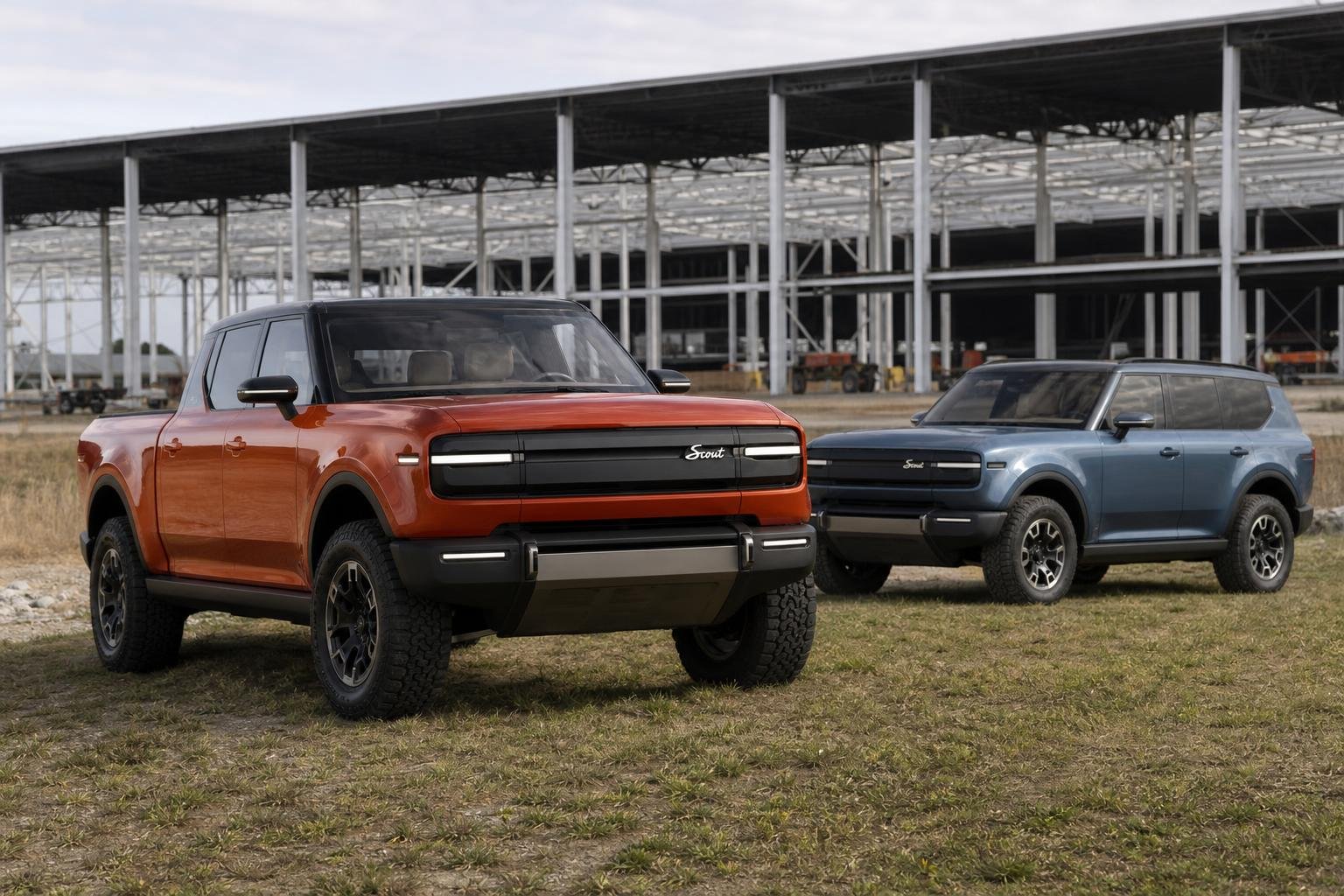

Scout Motors says it has collected approximately 212,000 reservations for its upcoming Terra pickup and Traveler SUV as construction advances at the company’s new manufacturing complex in Blythewood, South Carolina. The reservation total gives the Volkswagen-backed startup a substantial pool of potential customers, but converting those reservations into completed sales will be one of its biggest challenges before production begins.
The company’s roughly $2 billion factory is now about 85% complete, according to CEO Scott Keogh, with vehicle validation work already under way. Scout expects full production of the two models to begin in 2027, followed by customer deliveries in 2028.
A factory moving from construction to production preparation
Scout’s South Carolina operation is no longer only a proposed industrial project. Stamping, welding and paint operations are reportedly active, while most of the main manufacturing equipment has been installed. The company is building validation vehicles as it tests production processes and prepares for the transition to pre-production vehicles.
That stage is important for a new automaker. Validation builds allow engineers and manufacturing teams to identify problems involving fit and finish, assembly procedures, component quality and factory logistics before customer vehicles enter regular production. Scout expects this work to continue into 2027 as it prepares the plant for commercial output.
The facility is also planned to include a supplier park valued at approximately $300 million. Locating suppliers close to the assembly operation can reduce transportation requirements and simplify coordination, although a new plant still must establish reliable supply chains, quality controls and workforce processes before it can reach its intended production rate.
Reservations show interest, but not guaranteed demand
Scout opened reservations in October 2024 when it revealed the Terra and Traveler. Keogh told CNBC that the total could exceed 400,000 before customer production starts and that the company hopes to have between 12 and 18 months of orders lined up ahead of the launch.
Those figures should be treated as an indicator of early interest rather than a confirmed sales forecast. Reservations typically require less commitment than a signed purchase agreement, and some customers may cancel, delay their purchase or decide that the final vehicle does not meet their expectations. The experience of electric pickups such as the Ford F-150 Lightning and Tesla Cybertruck has shown that strong initial attention does not automatically translate into sustained volume sales.
Scout’s immediate commercial goal is therefore not simply to accumulate reservations. The company must turn those reservations into deposits, finalized orders and deliveries while maintaining pricing and production targets. Keogh said Scout wants to reach 100,000 vehicles quickly, describing that scale as a point at which the business can begin to “punch through.”
Extended-range models will lead the launch
Scout originally positioned the Terra and Traveler as all-electric vehicles, but the company has since added extended-range electric vehicle, or EREV, versions. These vehicles use electric motors for propulsion while carrying a gasoline engine that operates as a generator when the battery needs additional energy.
According to Keogh, approximately 87% of current reservations are for EREV models. The company plans to launch those versions before the fully electric variants, a strategy that reflects slower-than-expected electric-vehicle adoption and the practical concerns of buyers who want electric driving without depending entirely on public charging infrastructure.
The approach could be particularly relevant for buyers of large SUVs and pickups. These vehicles can consume more energy than smaller cars, and towing or traveling in remote areas can make access to charging more difficult. An onboard generator can provide additional flexibility, although it also introduces the mechanical complexity, fuel consumption and maintenance requirements associated with an internal-combustion engine.
Scout also plans to begin with mid-level trims rather than its most expensive versions. That decision could broaden the initial customer base and make it easier to build production volume, but it places pressure on the company to control costs. New vehicle programs often face high early expenses, and Scout will need to balance attainable pricing with the substantial investment required for its factory, battery systems and supplier network.
An American revival backed by Volkswagen
Scout is an independent U.S. company backed by Volkswagen Group. The original Scout was produced from 1960 through 1980 and helped establish the template for compact, rugged utility vehicles designed for both everyday transportation and off-road use.
The new company is attempting to use that heritage without simply recreating the old vehicle. Scout has described the Terra and Traveler as modern trucks and SUVs designed around electric propulsion, with an emphasis on ground clearance, approach angles, payload capability, off-road performance and digital features.
That positioning places Scout in a crowded and increasingly complicated market. It will face established automakers with extensive dealer, service and manufacturing networks, as well as newer electric-vehicle companies that have struggled to turn reservations and product excitement into consistent profitability. Volkswagen’s backing provides financial and technical support, but Scout must still develop its own manufacturing expertise and customer-support operation.
South Carolina’s larger manufacturing bet
The Blythewood project was announced in 2023 as a $2 billion investment with the potential to create at least 4,000 permanent jobs. The site covers approximately 1,600 acres, with the vehicle plant occupying about 1,100 acres. At full capacity, the operation was projected to produce more than 200,000 vehicles annually.
Those figures represent the plant’s planned long-term potential rather than an immediate production expectation. Reaching that scale will depend on demand, manufacturing reliability and Scout’s ability to expand from validation vehicles to efficient series production. The company’s reservation base gives it a starting point, but the first customer deliveries in 2028 will provide a much clearer test of whether the new Scout can establish itself.
For now, the project has moved beyond the announcement stage and into the more demanding work of proving that a new vehicle company can build, sell and support its products at scale. The factory’s progress and the high share of EREV reservations suggest Scout is adapting its launch plan to market conditions. Its next challenge will be demonstrating that the revived brand can turn that flexibility—and the appeal of its heritage—into dependable customer demand.
Sources: CNBC; Quartz; South Carolina Office of the Governor.
0 Comments