
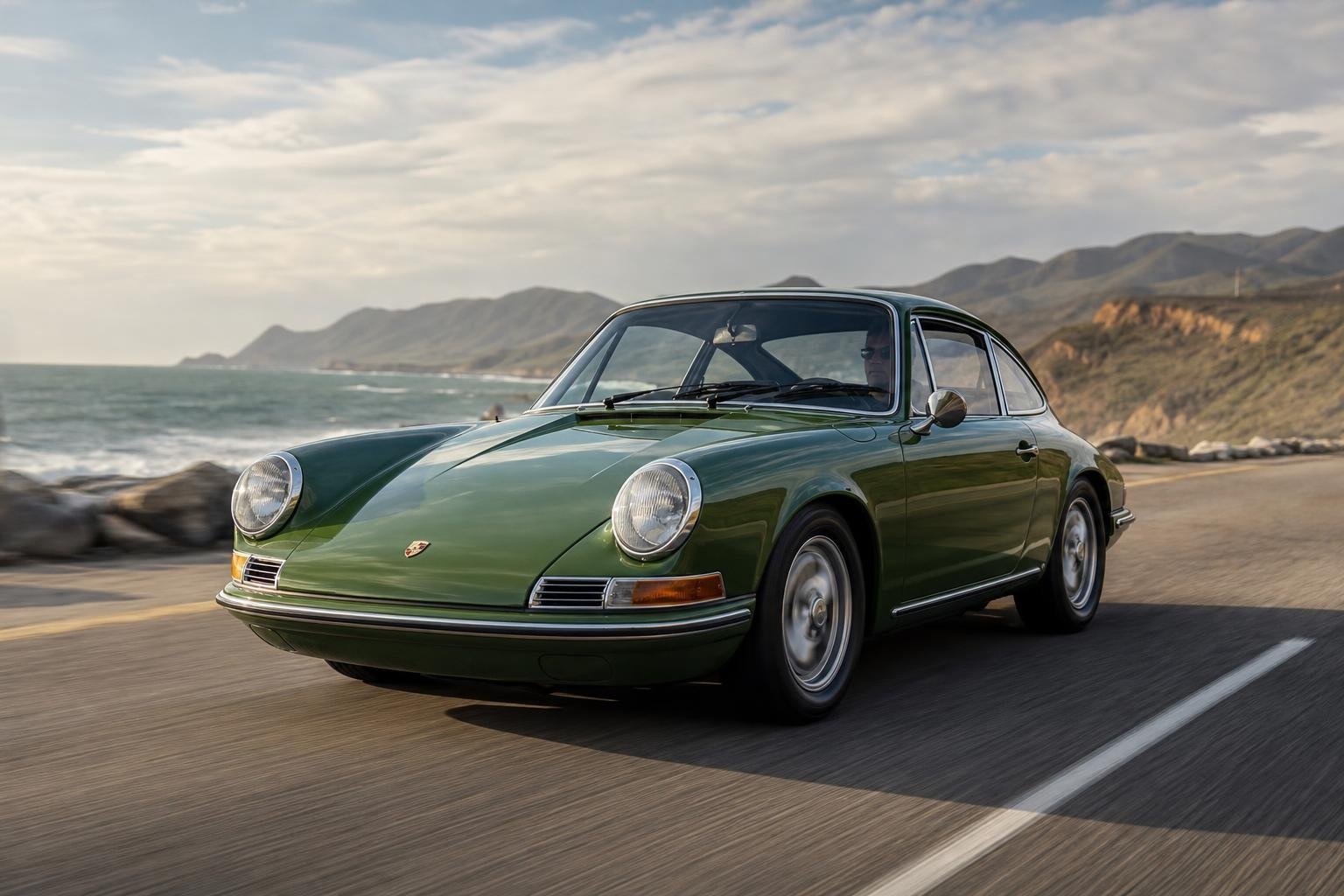

Inverted has transformed a 1967 Porsche 912 into a quiet, 300-horsepower electric sports car without disguising its classic identity. The bespoke conversion retains the compact Porsche’s original appearance while adding a 62-kWh battery, an estimated 250 miles of range and acceleration that dramatically outpaces the original four-cylinder car.
The project began with a customer-owned 912 that had already received a more powerful Porsche 911 engine. That conversion improved performance, but the owner wanted a classic sports car that would be better suited to daily driving. Inverted’s solution was not simply to replace the engine with an electric motor, but to restore and re-engineer the entire car around the owner’s brief.
A Porsche 912 with a very different powertrain
The original 912 was positioned as a more affordable alternative to the 911 and used a four-cylinder engine producing roughly 90 horsepower. Inverted’s rear-mounted electric motor produces 300 hp, giving the converted car more than three times the output of the factory model.
Inverted claims acceleration from zero to 62 mph in approximately four seconds. That compares with around 13 seconds for the original gasoline-powered 912. Electric propulsion also delivers its torque immediately, so the performance should feel substantially more forceful in normal traffic as well as during hard acceleration.
However, the conversion has not been designed to remove every element of the vintage Porsche experience. According to PistonHeads, the customer requested that the car retain unassisted steering and brakes. That means the driver remains involved in managing the car’s controls rather than simply operating a high-performance EV with a classic body.
Why the battery is split between both ends
The most interesting engineering decision is the layout of the 62-kWh battery pack. Rather than placing the entire pack behind the rear axle where the original engine was located, Inverted divided it into two sections. One section sits at the rear and the other is mounted under the front hood.
That arrangement addresses a fundamental characteristic of early rear-engined Porsches. Adding a large amount of mass behind the rear axle could make the car’s handling less predictable, particularly during abrupt lift-off in a corner. The split pack allows Inverted to distribute the additional weight between both ends and, according to the company, achieve better balance than the original car.
The compromise is reduced luggage capacity at both ends. In a car being built primarily as a daily driver, that may be a reasonable trade-off, but the battery packaging demonstrates why classic EV conversions require more than simply finding space for cells and a motor. Battery location affects the balance and character of the finished vehicle.
Range and charging suit the car’s intended role
Inverted estimates that the electric 912 can travel around 250 miles on a charge. That figure has not been independently verified in the supplied reporting, but it would provide a substantial usable range for commuting and local trips in a lightweight classic sports car.
DC fast charging is supported at up to 100.6 hp. That is modest beside modern electric vehicles, many of which accept considerably higher charging rates, but the 912 is not competing with a new long-distance crossover. For an owner who can charge overnight, the combination of 250-mile claimed range and a relatively small, bespoke vehicle should be adequate for regular use.
More importantly, the charging hardware does not appear to dominate the car’s design. The exterior remains visually close to a conventional 1967 912, with the charging connection discreetly positioned beneath the original fuel-filler flap. To an observer, the car largely presents as a carefully restored classic rather than an obvious technology demonstrator.
Classic details meet modern usability
Inverted also rebuilt the interior instead of leaving the conversion’s electrical systems exposed. The cabin reportedly combines Muirhead leather and Alcantara with air conditioning and Apple CarPlay, bringing modern convenience to a car whose original equipment was designed nearly six decades ago.
The instrumentation has been adapted in a similarly restrained way. The central tachometer has been replaced by a power-percentage display, while the former fuel gauge now indicates battery charge. Those changes preserve the visual language of the Porsche dashboard while giving the driver information relevant to an electric powertrain.
That balance is central to the appeal of the project. The conversion does not attempt to make the 912 look like a contemporary EV, nor does it preserve the original car so rigidly that daily use becomes impractical. Instead, it uses modern propulsion and comfort equipment to make the classic more usable while retaining its shape, controls and analog atmosphere.
The larger question behind the conversion
Electric conversions of valuable classics remain divisive. Removing an original engine can reduce historical authenticity, and a battery pack adds weight that the chassis was never designed to carry. The 912’s split-pack layout shows how those concerns can be addressed, but it also illustrates why high-quality conversions are complex and expensive engineering projects rather than simple engine replacements.
For this particular car, the original powertrain had already been replaced by a 911 engine, so the owner was not removing an untouched factory configuration. Inverted’s work instead represents another stage in the car’s life: a full restoration and modernization intended to preserve the classic Porsche experience in a more dependable daily-driver format.
The finished 912 will not reproduce the sound or mechanical rhythm of its flat-four—or its later 911 engine—but it offers a different kind of involvement. With 300 hp, unassisted controls and a battery layout developed around handling, it aims to combine the immediacy of an EV with the physical character of a lightweight vintage sports car. That makes it a more thoughtful conversion than a simple high-output powertrain swap.
Sources: InsideEVs; PistonHeads.
0 Comments