
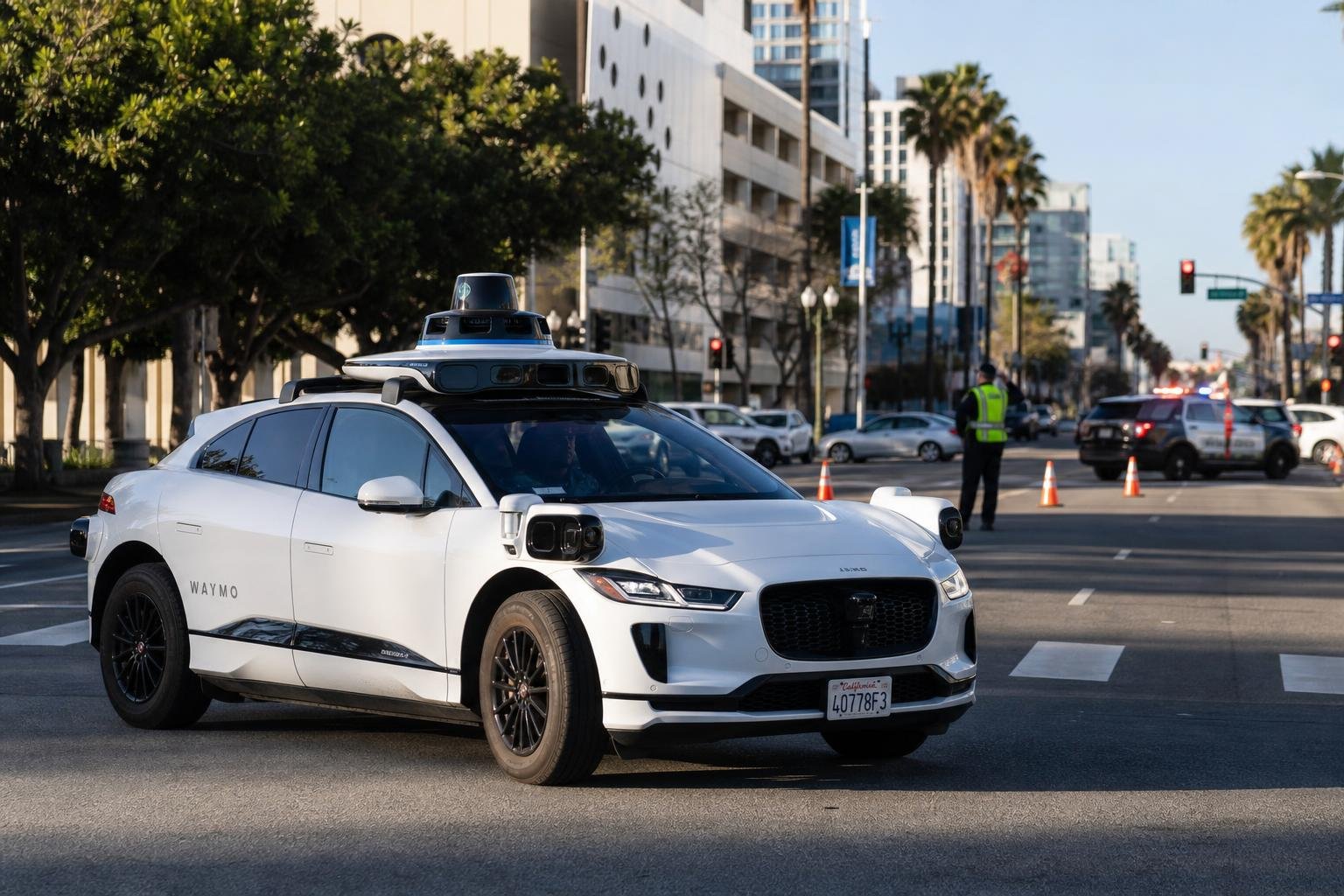

Waymo has filed two software recalls covering its autonomous driving system after robotaxis struggled with closed freeway lanes and intersections controlled by police or other authorized personnel. The vehicles will remain in service, but the action highlights one of the hardest problems for driverless technology: responding when people temporarily override the normal rules of the road.
The recalls followed a series of incidents involving construction zones, emergency traffic control and unusual freeway conditions. California regulators recently barred Waymo vehicles from operating on state freeways, and Waymo subsequently suspended its freeway operations nationwide while it investigated the issues.
Why Waymo is recalling the vehicles
According to reporting carried by Reuters, Waymo said one recall is intended to strengthen how its system navigates closed freeway lanes. Under certain circumstances, a robotaxi could enter a lane that had been closed for construction and continue driving instead of recognizing that the normal route was no longer available. Waymo said no collisions or injuries had been reported in connection with the closed-lane events.
The second recall addresses manually controlled intersections. The software update is designed to improve how the Waymo Driver responds when law enforcement officers or emergency personnel direct traffic by hand. Waymo reportedly completed that update on November 6, while the remedy for the closed-lane issue was still being developed when the recall was announced.
These are software issues rather than mechanical failures. That means the vehicles do not need to be collected from customers or taken off the road for physical repairs. Waymo can distribute revised software across the affected fleet, although the company and regulators can still restrict where the vehicles operate while the fix is evaluated.
The freeway incident that exposed the problem
A rolling roadblock, sometimes called a traffic break, is a familiar sight to many California drivers. Highway Patrol vehicles move slowly across multiple lanes with emergency lights activated, creating a temporary buffer so officers or road crews can clear debris, manage a crash or prepare drivers for a hazard ahead.
Human motorists generally understand the message without needing a formal sign. They slow down, remain behind the patrol vehicle and accept that the temporary traffic pattern takes priority over the posted speed limit or the route shown on a navigation display. The source incident described a Waymo vehicle attempting to pass a California Highway Patrol rolling roadblock rather than treating it as an instruction to remain behind the officers.
That behavior is concerning even if the vehicle avoids a collision. A traffic break can be protecting workers, damaged vehicles or a crash scene that is not yet visible to approaching motorists. Passing through it could place the robotaxi inside an area that police consider closed, while also forcing officers to react to a vehicle that is not following their plan.
Driving involves more than signs and traffic lights
Autonomous vehicles are trained to interpret lane markings, traffic signals, road signs, nearby objects and the predicted movements of other road users. Those capabilities are essential, but temporary human instructions create a different kind of challenge. The vehicle must determine that an officer, flagger or road worker has authority, understand the gesture being made and continue following that instruction even when it conflicts with a normal traffic signal.
People solve many of these situations socially. A driver may recognize that a police officer waving traffic through a red light is acting in response to an accident or signal failure. At a four-way stop, drivers often use eye contact, hand gestures or a cautious movement to establish who should proceed. When a lane is blocked by a fallen tree, motorists negotiate around it using a mixture of observation and informal cooperation.
For a robotaxi, those interactions must be converted into software decisions with appropriate safeguards. The system also has to account for ambiguity. A person standing near an intersection might be directing traffic, trying to cross the road or simply gesturing to another driver. A robotaxi cannot safely assume that every wave is an authorized command, but refusing to respond to legitimate instructions can be just as problematic.
Why freeway access matters to Waymo
Freeway operation is important to the commercial usefulness of an autonomous taxi. High-speed roads often provide the quickest connection between residential areas, business districts and airports. Removing them from the operating area can lengthen trips, reduce the number of rides a vehicle can complete and make the service less attractive to passengers.
The restriction also affects Waymo’s broader expansion plans. Business Insider previously reported that airport trips are particularly valuable to rideshare drivers because they can generate higher fares and strong demand. Waymo already provides airport service in Phoenix, while airports in other major markets have been assessing whether driverless vehicles can operate safely around crowded curbs, luggage traffic and human-controlled traffic patterns.
That environment makes the ability to follow temporary instructions especially important. Airport approaches regularly involve police officers, traffic marshals, construction workers and changing pickup rules. A vehicle that performs well on an ordinary mapped route but cannot reliably interpret those instructions may still require operational limits that reduce its commercial value.
A software recall does not mean the service has failed
Waymo’s decision to issue voluntary recalls and suspend freeway service should not be interpreted as evidence that its vehicles are incapable of routine autonomous driving. The company operates a commercial service in several U.S. cities, and its systems are designed to handle dense urban traffic without a human driver behind the wheel.
However, performance in ordinary conditions is only one part of the safety case. A driverless vehicle must also respond conservatively when its map, sensors and assumptions disagree with what people at the scene are communicating. The most important question is not whether a robotaxi can complete millions of predictable trips, but whether it can recognize when a familiar road has become an exceptional situation.
Waymo’s immediate response—software updates combined with restrictions on freeway use—reflects that distinction. The company can reduce exposure while engineers study the behavior, but regulators will ultimately judge whether the revised system responds consistently in construction zones and manually controlled intersections.
The larger test for autonomous mobility
Driverless technology is often evaluated through statistics such as miles driven, collision rates and injury outcomes. Those measurements remain important, but public acceptance also depends on whether autonomous vehicles behave in ways that other road users understand. A robotaxi that avoids most crashes but ignores an officer’s clear direction can still create a serious trust problem.
For Waymo, the recalls are therefore more than routine software maintenance. They expose the gap between navigating a road according to its permanent rules and participating in a transportation system where people regularly create temporary ones. Resolving that gap will be essential as the company seeks to expand beyond carefully selected urban routes and into freeways, airports and larger markets.
The vehicles may stay on the road during the recall, but their return to unrestricted freeway service will depend on whether the updated Waymo Driver can reliably recognize when a human instruction takes priority over the road it expected to see.
Sources: InsideEVs; Reuters, via The Charlotte Observer; Business Insider.

0 Comments