
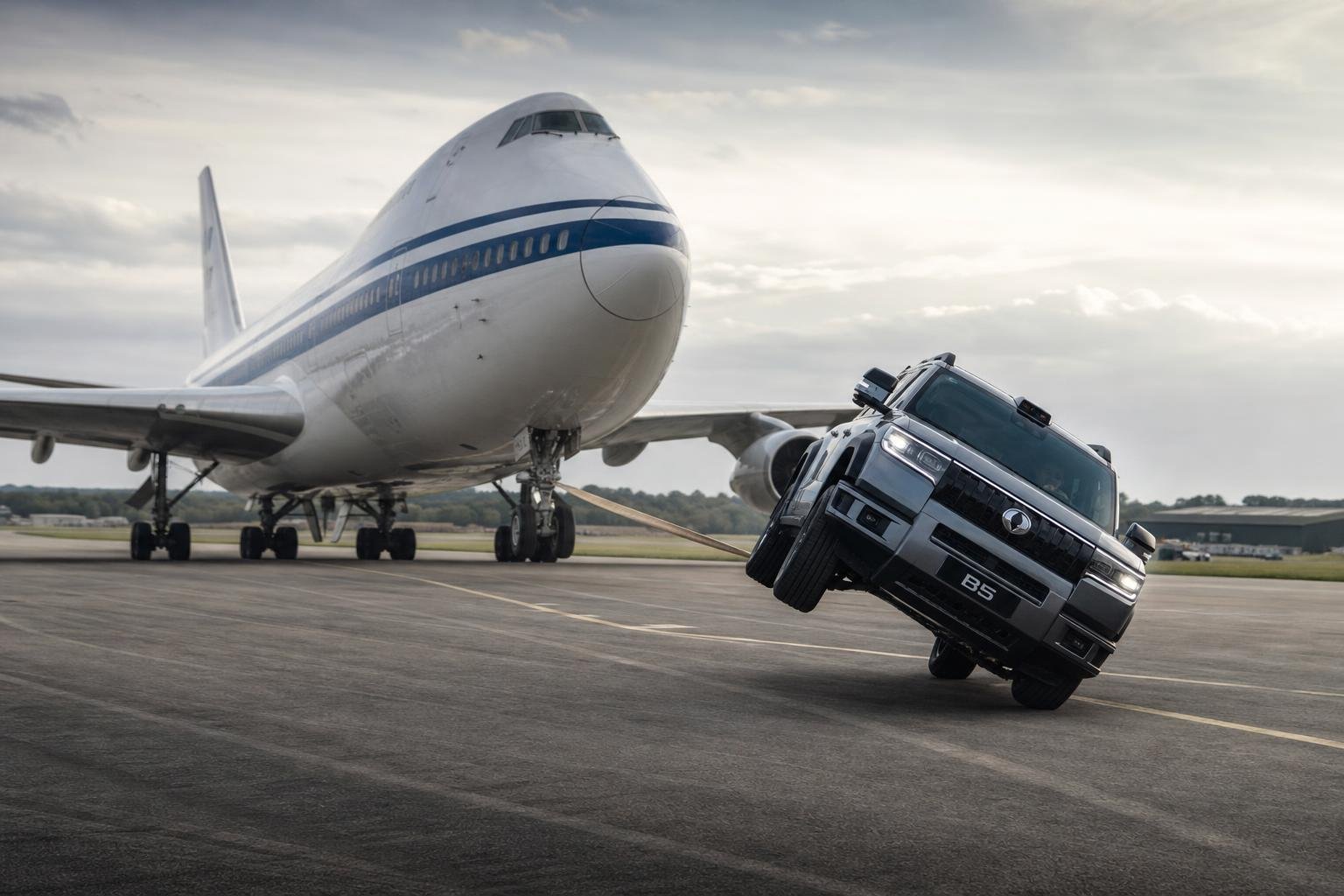

Denza has recreated one of the automotive world’s most memorable towing stunts—but with a far more extreme twist. The BYD-owned brand used its B5 plug-in hybrid SUV to pull a Boeing 747-400 at Dunsfold Aerodrome in Surrey, England, eventually completing the run with only the two wheels on the vehicle’s left side.
The aircraft weighed approximately 396,832.1 pounds and retained its engines and passenger cabin. Across three attempts, the B5 moved the jumbo jet a combined 5,249.34 feet using electric power alone, according to Denza. The demonstration was designed to promote the SUV ahead of its UK launch, rather than establish a practical towing benchmark for customers.
Three runs, progressively fewer wheels
Denza began with a conventional four-wheel tow before removing one wheel for the second attempt. For the final run, both right-side wheels were removed, leaving the SUV supported by and driving on its two left-side wheels.
The vehicle was not simply driven out of a showroom and connected to the aircraft. Engineers fabricated a bespoke towing attachment, removed seats to create room for ballast and installed small stabilisers to help control the SUV with its wheels missing. The three-wheel attempt used approximately 4,409.2 pounds of ballast, while the two-wheel run used roughly 9,920.8 pounds.
Those preparations were particularly important because the B5 needed both traction and stability. Loading the vehicle increased the downward force on its remaining tyres, helping them transfer the electric motors’ torque to the runway. The stabilisers, meanwhile, helped prevent the SUV from leaning dangerously toward its unsupported side.
Why an electric SUV can move a jumbo jet
A 180-tonne aircraft sounds far beyond the capability of a roughly three-tonne SUV, but the headline weight does not tell the whole story. The Boeing was rolling on its own landing gear, with wheels and bearings designed to support the aircraft while it moves around an airport. The Denza was not dragging the jet across the ground; it was overcoming rolling resistance and starting the aircraft moving on a prepared, level surface.
That distinction explains why airport tractors can move large aircraft without the enormous power figures suggested by the aircraft’s mass. At very low speeds, available grip and the force required to start the load moving are more important than top-end horsepower.
The B5’s electric drive system is well suited to that task. Its electric motors can deliver strong torque from standstill and control it precisely, reducing the wheelspin that could otherwise make the stunt impossible. Denza reports combined output of approximately 400 kilowatts, or about 536 horsepower, and 560.5 lb-ft of torque from its plug-in hybrid system.
The B5 is more than a publicity vehicle
Known as the Bao 5 in some markets, the B5 uses BYD’s DMO off-road plug-in hybrid architecture. The system combines a 1.5-litre turbocharged petrol engine with electric drive and a high-voltage battery. Published specifications vary by market and trim, but the UK-market vehicle is reported to use a battery of approximately 31.8 kWh and offer around 55.92 miles of claimed electric driving range under local testing conditions.
The SUV also uses a ladder-frame chassis, electronically controlled four-wheel drive and locking differentials. Higher-specification versions feature BYD’s DiSus-P hydraulic suspension, which can adjust ride height and help manage body movement over uneven terrain. Those features are relevant to off-road driving and low-speed traction, although they do not turn the B5 into a heavy-duty airport tug.
Denza says the powertrain itself remained mechanically unchanged for the demonstration. However, the custom tow hardware, ballast, stabilisers and removed seats mean the vehicle was not operating in normal road-going condition. That distinction matters when interpreting the result.
A spectacular stunt that does not change the tow rating
The B5’s reported normal braked towing capacity is approximately 5,511.6 pounds in the UK. That figure is vastly below the weight of the Boeing, but it is not a contradiction. A trailer places a different combination of vertical load, braking demand, cornering force and sustained stress on the tow vehicle. In this case, the aircraft remained supported by its own landing gear on a controlled airfield surface.
The event also took place under carefully managed conditions. Reports indicate that rain initially reduced available traction, forcing the team to wait for the runway to improve. BYD UK senior technician Mark Gallifant drove the SUV, and Denza said inspections after the runs found no apparent damage or unusual stress to the drivetrain, chassis or tyres.
Those checks are reassuring, but they are not equivalent to an independent durability test. Denza describes the event as a production-vehicle achievement, while the record-style claims remain manufacturer claims rather than results identified here as being certified by an independent record organisation.
Denza’s answer to established SUV brands
The stunt deliberately recalls Volkswagen’s 2006 demonstration, when a Touareg V10 TDI towed a Boeing 747 at the same former airfield. Porsche later raised the stakes by using a Cayenne S Diesel to pull an Airbus A380, which was substantially heavier than the Boeing used by Volkswagen and Denza.
Denza’s contribution is not simply repeating the aircraft tow. The company has used the spectacle to highlight how electric motors, software-controlled traction and an electrified off-road chassis can work together. It also gives the Chinese brand a memorable introduction as it targets established premium SUV rivals such as the Land Rover Defender in Europe.
For potential buyers, the useful takeaway is not that a B5 could replace an airport tug. It is that electrification can provide extremely controllable low-speed torque, while a ladder-frame platform and advanced suspension can support demanding off-road applications. The Boeing 747 was marketing theatre, but the engineering principles behind the stunt are genuine.
Denza has therefore achieved exactly what the demonstration was intended to do: make the B5 impossible to ignore. Whether the SUV can win customers will depend on everyday factors such as price, refinement, charging access, service support and real-world towing performance. Pulling a jumbo jet on two wheels may open the conversation, but it cannot answer those ownership questions by itself.
Sources: InsideEVs; WhichCar; Top Gear; CarNewsChina.
0 Comments