
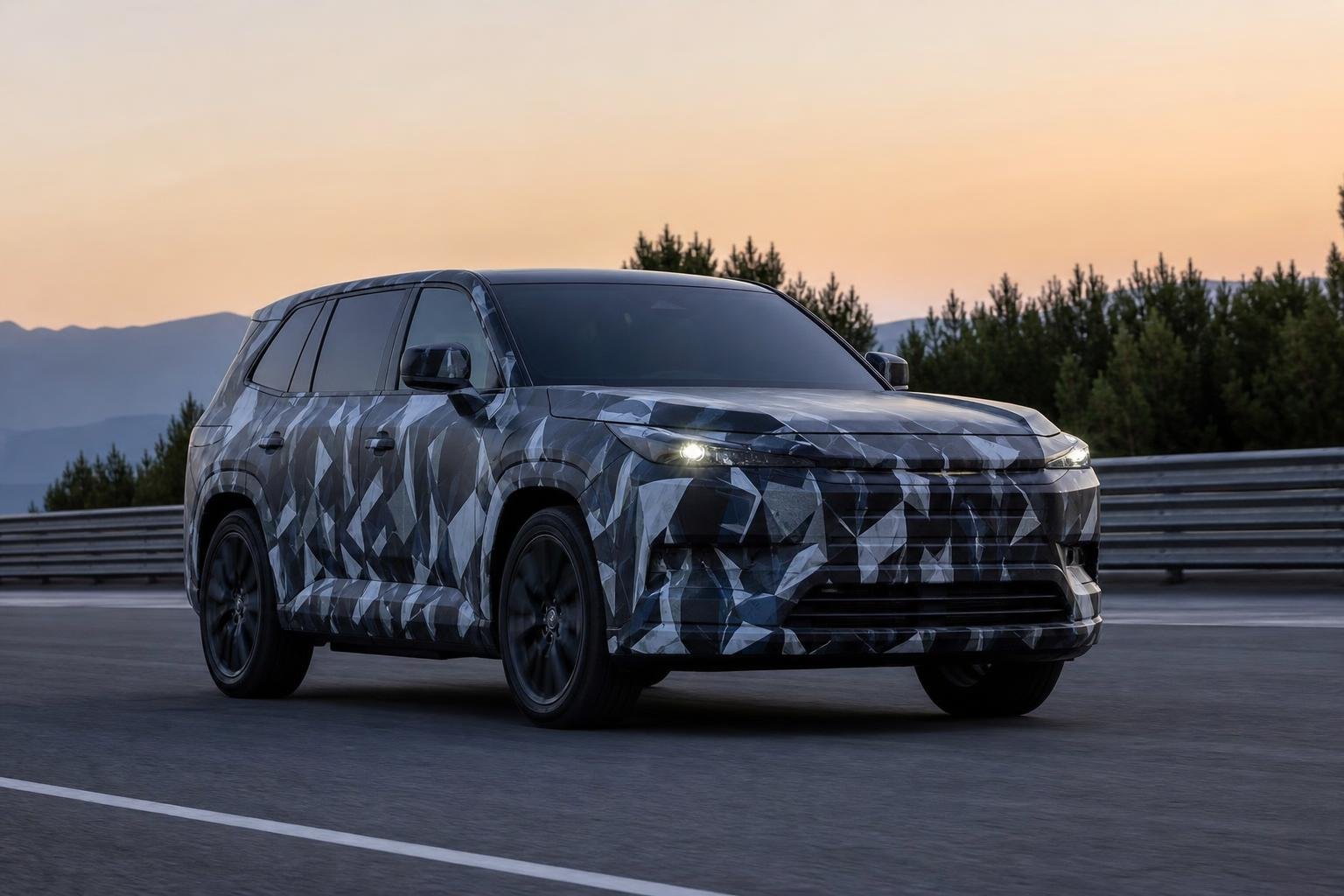

Toyota is preparing to add a new kind of electrified vehicle to its lineup, and the first preview appears to show a midsize SUV related to the Highlander. GAC Toyota, the automaker’s Chinese joint venture, posted a blurred teaser on Weibo ahead of a November 27, 2026, reveal at the Guangzhou Motor Show.
Toyota has not confirmed the vehicle’s name, specifications, or whether it is connected directly to the Highlander nameplate. However, the silhouette and the wording used in the teaser have led multiple outlets to identify it as a likely Highlander-based model.
How Toyota’s first EREV would work
An extended-range electric vehicle, or EREV, uses electric motors to drive the wheels. Its gasoline engine does not mechanically power the vehicle; instead, it operates as a generator that supplies electricity to the battery when needed.
That makes an EREV different from Toyota’s familiar hybrid system, in which the gasoline engine can drive the wheels, and from a plug-in hybrid, which typically combines electric drive with a mechanical connection between the engine and drivetrain. An EREV is also different from a battery-electric vehicle because it carries a gasoline engine for longer trips and situations where charging is inconvenient.
For consumers, the appeal is straightforward. Daily driving can retain the quiet, smooth response associated with an EV, while the gasoline generator reduces dependence on public charging during road trips. The compromise is that an EREV still burns fuel and carries the weight and complexity of both an electric powertrain and an internal-combustion engine.
Why Toyota is pursuing the technology in China
The timing suggests that Toyota’s EREV program is driven as much by the Chinese market as by powertrain strategy. China’s automakers have pushed battery-electric vehicles into an aggressive price war, putting pressure on established manufacturers that rely heavily on gasoline and conventional hybrid models.
Reports cited by Electrek say Toyota plans to begin producing the China-built EREV in spring 2027, with a reported target of approximately 200,000 vehicles during 2027 and about 400,000 in 2028. Those figures have not been confirmed in the teaser, but they indicate that Toyota may view the technology as a significant part of its Chinese product plan rather than a limited experiment.
A smaller battery can reduce material cost compared with a long-range battery-electric vehicle, while the electric-drive experience gives the vehicle a more modern operating character than a conventional hybrid. That could help Toyota address buyers who want an EV-like vehicle but remain concerned about charging access and long-distance travel.
The strategy also reflects a practical limitation. EREVs are not as energy-efficient as battery-electric vehicles because they ultimately use gasoline to generate electricity. They are best understood as a transition technology or a market-specific solution, not as a direct replacement for a pure EV in every use case.
The Highlander connection remains unconfirmed
The teaser image provides few hard details beyond the SUV’s general shape. Reports describe it as a potential flagship for Toyota’s range-extender effort in China, while the proportions and design cues resemble the recently announced electric Highlander for the United States.
That resemblance does not mean the two vehicles share the same powertrain or market strategy. Toyota’s U.S. model is a dedicated battery-electric SUV with three rows of seating for up to seven passengers. Toyota’s official U.S. materials identify that vehicle as the 2028 Highlander and list XLE and Limited grades, front- or all-wheel drive, and a 95.8-kWh battery with a manufacturer-estimated range of 315 miles in specified all-wheel-drive versions.
The Chinese EREV could use related styling or packaging while receiving different dimensions, software, battery capacity, and interior features. Toyota has not confirmed whether it will offer three rows, nor has it announced a U.S. launch for the range-extender model. The two vehicles should therefore be treated as separate products until Toyota provides more information.
A new choice for buyers—but not a simple one
For Chinese consumers, an EREV could occupy an increasingly important middle ground. A fully electric SUV offers lower operating emissions and no gasoline engine, but it requires dependable access to charging. A conventional hybrid avoids most charging concerns but does not deliver the same electric-only driving experience. An EREV attempts to combine the strongest parts of both approaches.
Its value will depend on details Toyota has not yet disclosed, including electric-only range, total range, battery size, generator output, charging speed, seating capacity, price, and fuel economy. Those figures will determine whether the vehicle offers a genuine ownership advantage or simply adds another layer of complexity to Toyota’s electrification lineup.
Toyota’s long experience with hybrids could help it develop a dependable system, but hybrid expertise alone does not guarantee success in China’s rapidly changing EV market. Local manufacturers have already made range-extender vehicles familiar to buyers, and Toyota will need competitive pricing, software, charging performance, and interior technology—not just a recognizable badge.
Toyota’s electrification strategy becomes more flexible
The expected EREV would become Toyota’s fifth major electrified powertrain category, alongside battery-electric vehicles, plug-in hybrids, conventional hybrids, and fuel-cell electric vehicles. That broader portfolio gives the company more ways to respond to different markets, but it also makes its product strategy harder for consumers to understand.
For now, the November reveal matters less because it answers every question than because it confirms Toyota is willing to enter a technology category it previously watched from the sidelines. The company’s challenge will be turning that flexibility into products that are clearly differentiated and genuinely useful for the people expected to buy them.
Sources: Motor1; Electrek; Toyota USA Newsroom.
0 Comments