
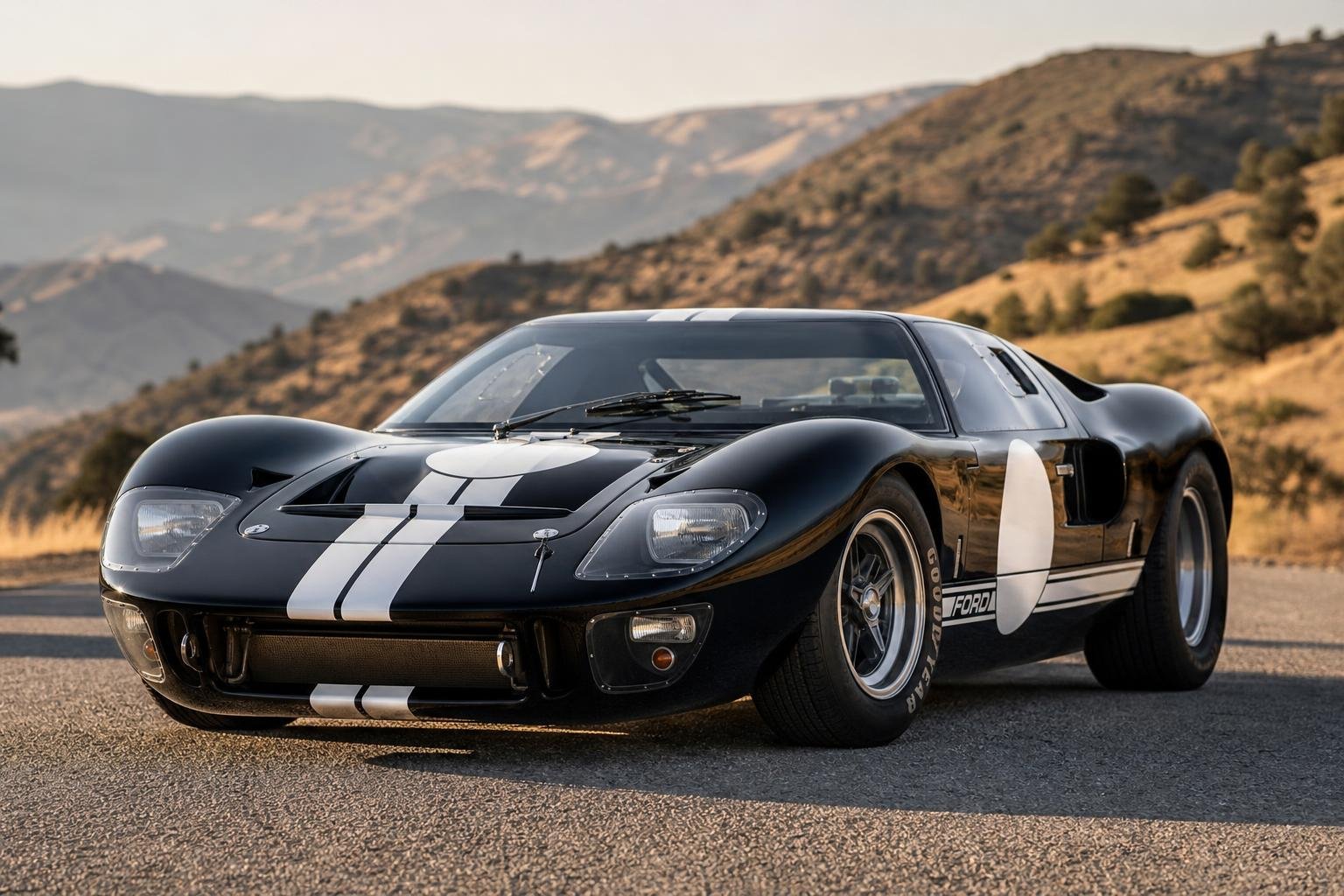

A 1965 Ford GT40 Mk I with documented driving history involving Carroll Shelby will return to the auction block at Mecum’s Kissimmee sale in January 2027. Chassis P/1018 previously crossed the same auction stage in 2026 but failed to sell, a result that adds an important layer to its already unusual collector-car story.
The GT40 is scheduled to headline part of Mecum’s January 5–17 event at Osceola Heritage Park in Florida. No estimate or reserve information has been supplied, but the car is listed in Mecum’s active catalog. Its next appearance will likely attract attention not only because of Shelby’s connection, but also because its history illustrates how selectively the collector market evaluates significant competition cars.
A GT40 with a Shelby connection—but not a race-winning résumé
According to the auction history supplied for the car, P/1018 was one of 48 Mk I coupes built. Marque historian Ronnie Spain identifies it as one of only two GT40s with a documented Shelby driving history, making the car unusually important even though it was not one of the GT40s that delivered Ford’s famous Le Mans victories.
Ford handed its GT40 racing program to Shelby American in Los Angeles at the end of 1964. Shelby’s organization then became deeply involved in the program’s Daytona and Le Mans efforts. P/1018 arrived at Shelby American for show and demonstration duties rather than competition, but its role still placed it close to the center of Ford’s mid-1960s endurance-racing campaign.
The car reportedly had nose damage when it arrived at Shelby American. That did not prevent the team from using it for promotional photography with Shelby. Records identify Shelby driving P/1018 on November 9, 1965, and again on January 6, 1966. Those dates are central to the car’s appeal: they connect a surviving GT40 directly to the driver and engineer whose name remains inseparable from Ford’s racing success.
Original details and a complicated visual history
P/1018 retains its original chassis tub and was the first GT40 built with a three-hole chassis panel, a detail used by specialists to distinguish it from other surviving cars. Its 289-cubic-inch Ford V8 and ZF five-speed manual transaxle were rebuilt in the mid-1990s.
The car’s appearance has changed several times. It has worn dark blue and Gulf Oil livery during its life, while its current maroon finish represents the color it carried when it left the factory in 1965. For a buyer, that distinction matters. A period-correct color can support the car’s historical presentation, but changing paint and rebuilt mechanical components also mean the vehicle should be evaluated as a documented historic automobile rather than assumed to be untouched simply because it retains its original tub.
That is one of the practical complications of buying a car such as P/1018. The most valuable examples are not always the ones with the most famous individual association. Collectors also consider originality, configuration, documented ownership, restoration quality and whether the car’s current condition accurately reflects its history. In this case, the Shelby connection is compelling, but it exists alongside a life that included promotional work, repainting and mechanical rebuilding.
From Shelby American to Hollywood
P/1018’s documented history extends beyond Shelby American. MGM Studios leased the GT40 in 1968, and road racer Bob Bondurant drove it during camera test laps for the film Grand Prix. The car also appeared in the television series The Man from U.N.C.L.E.
Those appearances give the GT40 a second kind of cultural relevance. It was not merely a racing machine preserved by chance; it became part of the visual language that helped define the era’s fascination with high-speed European and American sports cars. The connection is particularly notable in light of the later film Ford v Ferrari, which renewed public interest in Shelby, Ken Miles and Ford’s campaign against Ferrari at Le Mans.
As Business Insider reported, the film’s sound team tracked down GT40s and used authentic engine sounds in the movie, even though the cars seen on screen were picture cars rather than original competition GT40s. That detail underscores the model’s enduring status: genuine examples are scarce enough that filmmakers and collectors must treat them as valuable historical artifacts, not disposable props.
Why the previous auction result matters
P/1018’s 2026 no-sale is more informative than a dramatic headline price would have been. A GT40 can carry extraordinary provenance and still fail to meet a seller’s expectations. Reporting about Mecum’s 2026 Kissimmee event made clear that the roughly $12 million GT40 result belonged to a different car, the 1966 GT40 Mk II Factory Lightweight known as XGT-3—not P/1018.
That distinction matters because GT40 values are shaped by more than the model name. XGT-3 was presented as one of only three lightweight Mk II examples and was praised for its originality. P/1018 has a different profile: a documented Shelby driving history, show-car duties, film appearances, original chassis tub and a Mk I specification. Both are significant, but they appeal to different parts of the collector market.
For prospective bidders, the renewed listing makes careful verification especially important. The auction catalog and supporting records should establish the chassis identity, Shelby driving documentation, restoration history, mechanical work and film credits. A buyer should also understand which components remain original, which were rebuilt and how the current maroon finish relates to the car’s factory appearance.
A rare ownership opportunity with real trade-offs
P/1018 offers something few historic cars can: a direct, documented link to Carroll Shelby, a recognizable role in Shelby American’s GT40 program and a period entertainment history that extends beyond the racetrack. It is also a tangible reminder that automotive history is rarely as tidy as a museum placard suggests. Cars are repaired, repainted, demonstrated, leased and sometimes overlooked before their importance is fully recognized.
The 2027 auction will reveal whether buyers place a premium on that layered history or remain more focused on competition results and originality. Either way, P/1018’s return is not simply another chance to buy a famous Ford. It is a test of how the collector market weighs personal provenance against specification, condition and authenticity—and a reminder that even a GT40 with Carroll Shelby behind the wheel is not automatically guaranteed a sale.
Sources: Motor1; Business Insider; Yahoo Finance.
0 Comments