
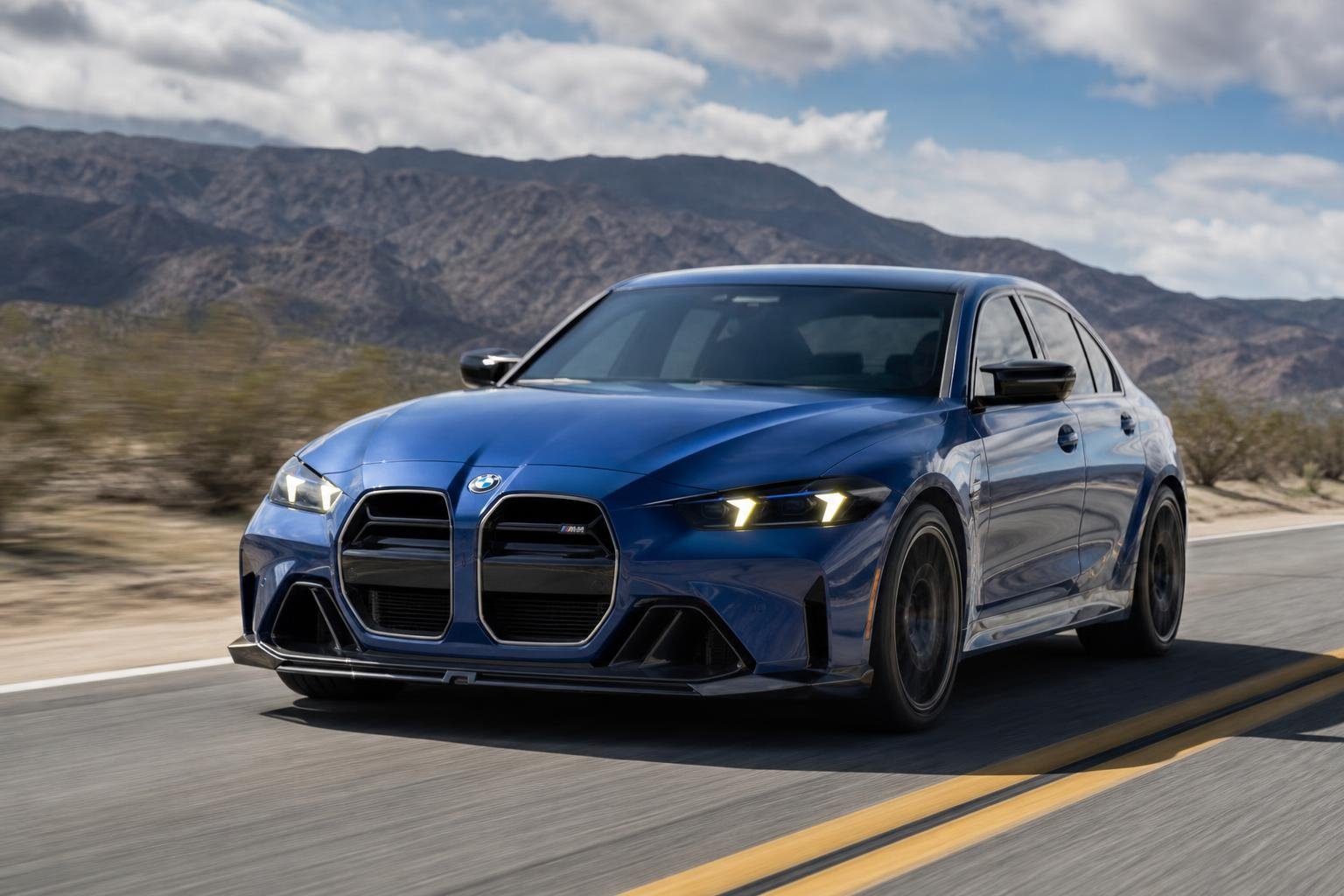

BMW’s first fully electric M3 is reportedly nearing its public debut, with CES 2027 in Las Vegas emerging as the likely venue. BMW has not confirmed the event, but the timing would fit the company’s broader plan: begin building the electric ZA0 at its Munich plant in 2027 as production of the current gasoline-powered G80 M3 winds down.
That transition will not happen all at once. The electric M3 is expected to arrive before a next-generation gasoline model, reportedly known internally as the G84, reaches the market around 2028. For at least part of that period, buyers could face an unusual choice between an established combustion performance sedan and a radically different electric successor.
A technology-show debut for a technology-heavy M3
Reporting cited by Motor1 points to CES rather than a traditional auto show for the ZA0’s world reveal. That choice would make sense for a vehicle whose most important features are hidden beneath the bodywork.
The electric M3 is being developed around four electrically excited synchronous motors, with one motor assigned to each wheel. This layout gives BMW much finer control over torque distribution than a conventional all-wheel-drive system. Rather than relying mainly on brakes or a mechanical differential to manage wheelspin, software can adjust the output at each corner as the car accelerates, turns and changes direction.
BMW has been testing the prototype at locations including Miramas, the Nürburgring and public roads in California. The company’s repeated emphasis has been that the car must feel like an M3 from behind the wheel, not merely produce impressive numbers. That distinction matters because electric performance cars can deliver enormous acceleration while still feeling heavy, artificial or disconnected during cornering.
838 horsepower is only the beginning of the engineering story
Preliminary figures point to a combined 838 hp and 885 lb-ft of torque, although production specifications have not been finalized. Other background reporting has cited a different torque figure, underscoring that these numbers should be treated as targets rather than confirmed specifications.
BMW is targeting a 0-to-62-mph time of less than three seconds. In everyday driving, that figure will be less important than how consistently the car can deploy its power. Four motors can make it possible to vary front-to-rear and side-to-side torque almost instantly, helping the M3 leave corners with greater stability while also giving engineers more control over the car’s balance.
The system is expected to work with BMW’s Heart of Joy control architecture, which coordinates propulsion, braking and vehicle dynamics. The benefit is not simply faster software response. Combining those systems can reduce the delay between what the driver requests and how the car responds, while allowing regenerative braking and friction braking to operate as part of one coordinated strategy.
BMW also plans to use simulated gear changes and multiple driving modes, including six virtual gears. Electric motors do not require traditional multi-speed transmissions to produce strong acceleration, so the virtual shifts are primarily about response and character. That may appeal to drivers who want more interaction, but it also creates a question BMW will have to answer: can simulated mechanical behavior enhance the experience without feeling like a layer of theater over a fundamentally different powertrain?
Range and charging will shape the ownership experience
BMW’s preliminary range target is roughly 404 miles under the WLTP testing cycle. A stricter EPA-style estimate cited in background reporting places real-world U.S. expectations closer to 300 miles. The difference is not necessarily a contradiction; the two testing procedures use different conditions and produce results that are not directly interchangeable.
For American buyers, the eventual EPA rating will be more useful than the larger WLTP number. It will help set realistic expectations for highway trips, cold-weather driving and the energy demands of repeated acceleration. A high-performance sedan with four motors may be efficient during steady cruising, but aggressive driving can consume energy quickly.
Charging could be the more consequential advantage. BMW is targeting up to 420 kilowatts of DC fast-charging capability and says the car could add as much as 217 miles of range in 10 minutes under ideal conditions. That performance depends on a compatible charger, battery temperature and the vehicle’s charging curve, so it should not be interpreted as a guaranteed result at every station.
Still, rapid charging would make the electric M3 easier to use as a daily vehicle. Buyers may accept a shorter practical range than the WLTP headline suggests if the car can recover a substantial amount of driving distance during a brief stop. The charging network, however, remains just as important as the vehicle’s maximum capability.
The gasoline M3 will remain part of the decision
The current G80 M3 is expected to continue through 2027, with production timing varying by market. That gives BMW room to position the ZA0 as an expansion of the M3 family rather than an immediate replacement for every gasoline model.
A gasoline M3 reportedly designated G84 is expected around mid-2028. If that schedule holds, BMW could offer both powertrain philosophies in close succession: an electric M3 built around software-controlled torque delivery and a combustion model retaining the sound, shifting and refueling characteristics many M buyers still value.
That overlap could make the electric car easier to evaluate on its own merits. Buyers will not necessarily be forced to choose between an old model and a new one. They may instead compare two different interpretations of the same performance-sedan formula, weighing acceleration and charging convenience against weight, driving character, fuel stops and established engine appeal.
Why the debut matters to potential buyers
The ZA0’s challenge is not proving that an electric car can be fast. Many already are. BMW must show that its four-motor system, coordinated controls and simulated driver interaction make the car satisfying on ordinary roads as well as capable on a track.
The reported specifications suggest an M3 with extraordinary performance, but the consumer decision will depend on details that remain unknown: final range, curb weight, pricing, cargo and interior packaging, charging behavior, and how much of the prototype’s promised character survives production development.
If BMW delivers on its targets, the electric M3 could become one of the clearest tests yet of whether a familiar performance name can move into the electric era without losing its identity. CES 2027 may provide the first full answer, but the more important evidence will come when buyers can drive the finished car alongside the gasoline M3 it is meant to complement—and eventually succeed.
0 Comments