
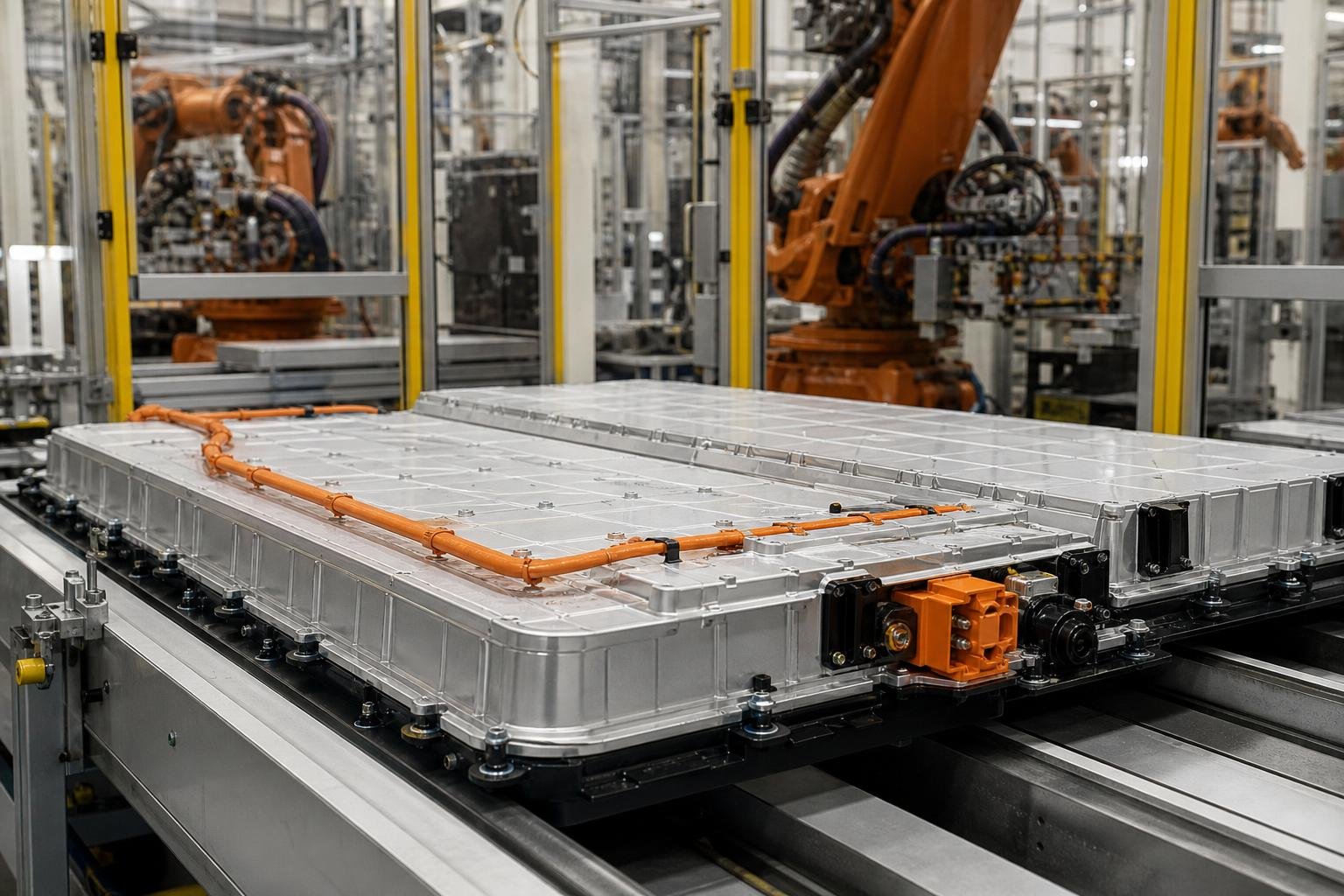

BMW has started series production of high-voltage battery packs at its new Woodruff, South Carolina, facility, creating a regional battery operation for the company’s next generation of electric vehicles. The first model scheduled to use packs assembled there is the electric iX5, which will be built nearby at BMW’s Spartanburg plant.
The development is strategically important because BMW is moving beyond importing finished battery systems for its U.S.-built EVs. Although Woodruff does not manufacture battery cells, it will inspect, assemble and validate the cells before delivering complete packs to the vehicle factory. BMW says the site will eventually support six Neue Klasse electric models assembled in the United States.
A battery plant built around the Spartanburg factory
Plant Woodruff is located approximately 15 miles from BMW’s vehicle assembly operation in Spartanburg. That short distance should simplify logistics between the two facilities, allowing finished battery packs to move to the vehicle plant without relying on long-distance transportation from overseas suppliers.
The electric iX5 will lead BMW’s U.S. electric-vehicle production expansion. After it, BMW says five additional EVs made in Spartanburg will use battery packs assembled at Woodruff.
The facility is BMW’s first high-voltage battery plant in the United States. It also joins the company’s wider Gen6 battery production network, following the start of series production at sites in Debrecen, Hungary; Irlbach-Straßkirchen, Germany; Shenyang, China; and San Luis Potosí, Mexico.
Woodruff will assemble cells rather than produce them
Woodruff is not a cell-manufacturing plant. BMW receives finished cylindrical cells from suppliers and subjects them to extensive inspection before they enter the battery assembly process. For U.S. production, BMW says the Gen6 cells will be sourced from LG Energy Solution in the United States, while Samsung SDI will supply cells for European factories.
Each incoming cell is checked for voltage and other operating parameters under BMW’s stated “zero-defect” approach. The cells are then grouped and connected to cooling hardware. This clustering process is intended to ensure that the finished pack has consistent electrical performance and effective thermal management.
Battery packs are monitored continuously as they move through the production line. BMW is using more than 250 robots, artificial intelligence-powered digital assistants and real-time quality checks to identify problems during assembly rather than waiting until a completed pack reaches final inspection.
Why BMW is moving to cell-to-pack construction
The Gen6 battery packs use a cell-to-pack design. Traditional EV batteries typically divide their cells into modules, which are then installed inside the larger pack housing. In a cell-to-pack system, the cells are installed more directly into the enclosure, reducing the space taken up by intermediate module structures.
That packaging approach can make more of the battery enclosure available for active energy storage. BMW says the cells are protected by a hardened foam structure, while the cooling system is integrated as part of the pack assembly. The potential benefit is greater energy density, meaning more stored energy can fit into a battery of a similar physical size.
For a large electric SUV such as the iX5, packaging efficiency matters. The vehicle needs enough battery capacity to deliver useful driving range without allowing the battery to consume excessive cabin or cargo space. Higher energy density can also give engineers more flexibility when balancing range, weight and vehicle performance.
Production has moved quickly from construction to series output
BMW began construction of the Woodruff facility in September 2023. Manufacturing equipment was installed approximately one year later, and the first pre-series battery packs were produced during the summer of 2025. The plant has now progressed to series production and employs more than 300 people.
Employees receive virtual-reality training before working on the production line. The program allows them to practice manufacturing procedures in a simulated environment, including operations that would otherwise require access to active equipment. BMW says the training is intended to prepare staff for real assembly work while supporting the plant’s quality-control objectives.
The combination of automated equipment and employee training reflects the complexity of modern EV battery production. A battery pack is not simply a collection of cells: electrical connections, cooling circuits, insulation, structural materials and control electronics must all work together. A defect in any of those systems can affect safety, performance or durability.
A lower-emissions production claim with important limits
BMW says the Woodruff site does not use fossil fuels during normal operation and that its industrial trucks are powered by hydrogen. The company also says its latest Gen6 cylindrical cells generate 28 percent fewer carbon dioxide emissions than the cells used in the outgoing iX.
Those claims address the manufacturing footprint of the battery system, but they do not mean the entire vehicle is emissions-free across its supply chain. Cell production, raw-material extraction, transportation and electricity generation all influence an EV’s lifecycle impact. Local pack assembly can reduce some logistics requirements, but it is only one part of that calculation.
What the plant means for the electric iX5
The electric iX5 will be the first U.S.-built BMW to receive battery packs from Woodruff, linking the company’s new battery strategy directly to one of its most important vehicle programs. Building the pack and the vehicle in the same regional manufacturing network should give BMW greater control over production coordination and quality processes.
It also gives the automaker a foundation for expanding U.S. electric-vehicle output. The success of that strategy will depend on more than battery assembly capacity: BMW must also maintain reliable cell supplies, integrate the packs efficiently into vehicle production and persuade customers to choose the new electric models.
For now, Woodruff represents a practical first step rather than a fully domestic battery supply chain. BMW is assembling packs in the United States and sourcing cells from a U.S. supplier, but the cells themselves are still supplied by specialist battery companies. Even so, the plant gives the upcoming iX5 and five later Neue Klasse models a dedicated regional battery operation—an important change as BMW prepares Spartanburg for a more electric future.
Sources: InsideEVs
0 Comments