
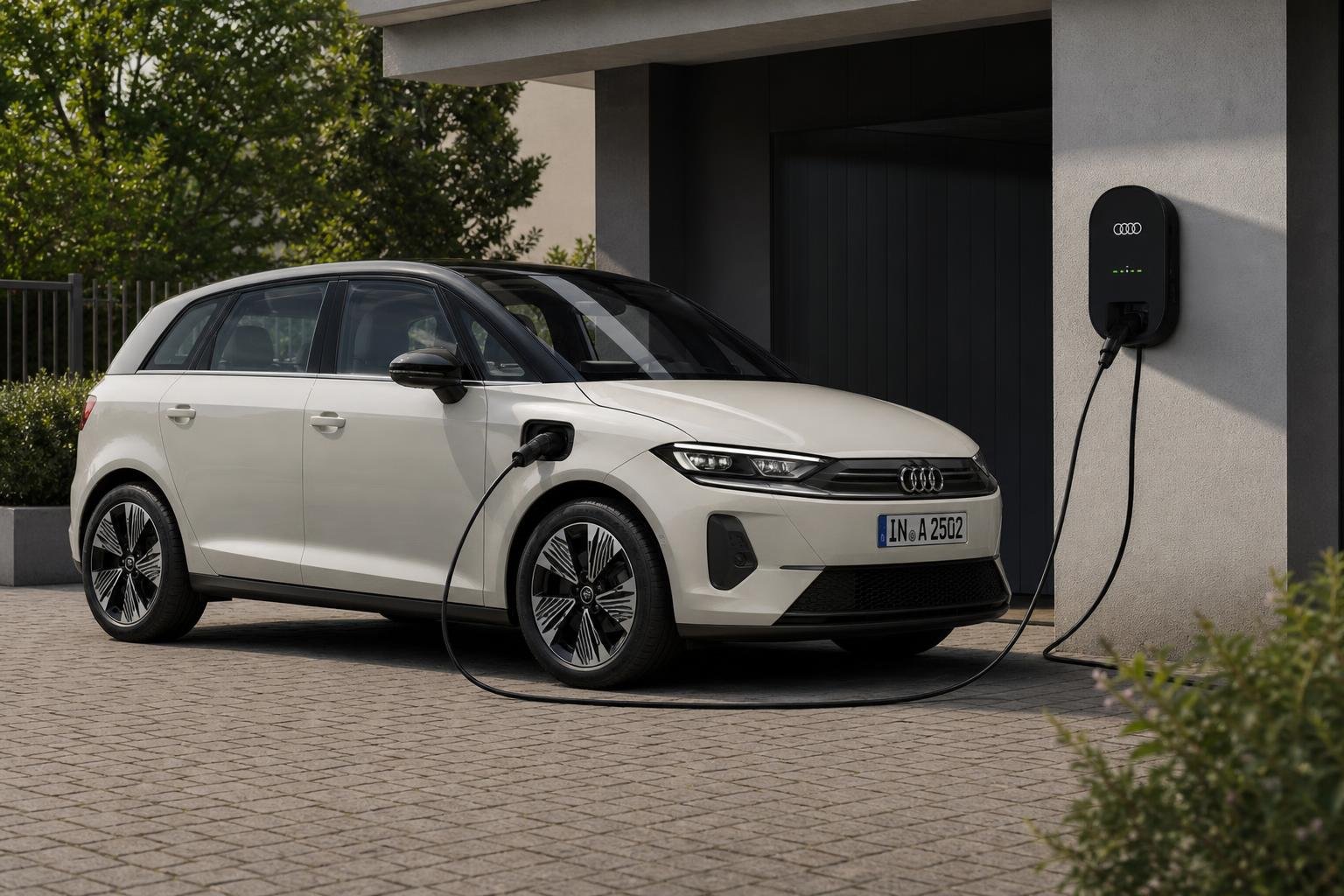

The Audi A2 e-tron is designed to do more than transport its occupants. With optional bidirectional charging, the compact electric model can supply power to external equipment or send stored energy into a compatible home electrical system. Audi says vehicle-to-load (V0.53 US gallons) and vehicle-to-home (V2H) functions will be available, while vehicle-to-grid (V2G) remains dependent on regulatory and infrastructure approvals.
That gives the A2 e-tron a second role as mobile energy storage. Owners could use it to run suitable tools, camping equipment or other devices away from a conventional outlet, while a properly equipped home installation could draw on the vehicle during periods of high electricity demand or a power interruption.
Three different forms of bidirectional charging
V0.53 US gallons is the simplest application. It allows the vehicle’s high-voltage battery to supply electricity directly to connected devices. In practical terms, that could make the A2 e-tron useful at a campsite, on a work site or during outdoor events. The car does not need to be integrated into a building’s electrical system for this function.
V2H is more capable but also more demanding. Audi requires a compatible bidirectional DC wallbox, rather than a conventional home charger, to transfer energy between the vehicle and the household. The wallbox and the home’s electrical equipment must be installed and configured to safely manage the energy flow.
Audi limits the home-energy exchange to a 20-to-80-percent battery state-of-charge window. Below 20 percent, the vehicle will charge from the grid rather than discharge into the home. Above 80 percent, it will supply energy to the household but will not continue charging from the grid. That operating range preserves a reserve for driving and avoids treating the battery as a permanently available home battery.
V2G would take the concept one step further by allowing electricity to flow from the car back into the public grid. Audi says that capability will require suitable regulations, charging hardware, home installation arrangements and electricity tariffs. The company has not provided a firm launch date for the feature.
The A2 e-tron’s battery options
The A2 e-tron will be offered with 52-kWh, 61-kWh and 84-kWh battery packs. The two smaller batteries use lithium iron phosphate (LFP) chemistry, while the largest pack uses nickel-manganese-cobalt cells. Audi also uses a cell-to-pack construction for the LFP batteries, integrating cells directly into the pack instead of placing them inside separate modules.
That arrangement can improve packaging efficiency and free up space within the vehicle. Audi’s stated objective is not simply to provide a large battery, but to combine useful range with low energy consumption. The manufacturer quotes preliminary WLTP energy consumption as low as 12.8 kWh per 62.14 miles for a 140-kW version fitted with its efficiency package.
The longest-range A2 e-tron is claimed to cover up to 401.41 miles on the WLTP cycle, although that figure applies to a specific configuration and should not be treated as a real-world guarantee. Audi’s compact EV uses a drag coefficient of 0.24, with features including an active cooling-air intake, a largely enclosed underbody, aerodynamic wheels, air curtains and wheel-arch gap reducers.
Those details matter to bidirectional charging because a more efficient vehicle needs less stored energy to cover a given distance. In theory, that leaves owners with more flexibility to use the battery for household or external loads without sacrificing as much driving range. The practical result will still depend on the power demand, weather, driving conditions and the amount of energy reserved by the owner.
Charging hardware and battery management
DC fast-charging capability ranges from 100 to 245.4 hp, depending on the battery and powertrain version. Audi quotes 10-to-80-percent charging times of 24 minutes for the 52-kWh battery, 26 minutes for the 61-kWh version and 29 minutes for the 84-kWh pack under defined test conditions.
The A2 e-tron also introduces Audi’s OCDC 2.0 component, which combines the onboard charger and DC/DC converter. The system is paired with software adapted to the flatter voltage curve of LFP cells. Because that chemistry is harder to assess from voltage alone, the battery-management system must estimate state of charge and battery aging using additional operating data.
Thermal management is particularly important when a battery is both charging and discharging. Audi says the system continuously monitors battery temperature, current flow and state of charge during both processes. That control strategy is intended to produce more predictable behavior and keep the battery within defined temperature limits.
The company also highlights the durability advantages of LFP chemistry, including its lower reliance on nickel and cobalt and its slower aging characteristics compared with some alternative chemistries. Those claims come from Audi’s technical information; independent long-term testing of the A2 e-tron is not yet available.
Why this feature matters to buyers
Bidirectional charging changes the value proposition of an electric car. Instead of functioning only as a vehicle that consumes electricity, the A2 e-tron can become part of a household’s energy-management system. Owners with time-of-use electricity plans could potentially charge during cheaper periods and use stored energy later, although the financial benefit will depend on local rates, installation costs and battery-use policies.
The hardware requirement is the main limitation. V2H is not activated simply by plugging the car into an ordinary AC wallbox. A compatible bidirectional DC charger and an appropriate home installation are necessary, and backup operation during an outage may require additional equipment to isolate the house from the public grid.
There is also a distinction between having a large battery and having a high-power home backup system. Audi has not supplied all of the output-power, installation-cost or operating-duration details needed to determine exactly which household appliances the A2 e-tron can support, or for how long. Those specifications will be important for buyers considering the car as an alternative to a stationary battery.
A compact EV with a broader role
The A2 e-tron’s bidirectional functions fit Audi’s wider effort to make efficiency the defining feature of its entry-level electric model. Its relatively low consumption, aerodynamic body and multiple battery choices are intended to reduce charging demand, while V0.53 US gallons and V2H give the battery uses beyond driving.
For now, V0.53 US gallons and V2H are the tangible benefits. V2G remains a future possibility rather than a feature owners can immediately use. Even so, the A2 e-tron shows how automakers are beginning to treat electric vehicles as flexible energy assets. The success of that idea will depend not only on the car, but also on charger availability, electrical standards, utility rules and the cost of installation.
Sources: Motor1.com; Audi: Bidirectional charging and the A2 e-tron; Audi: A2 e-tron efficiency benchmark; Audi: A2 e-tron battery technology.



0 Comments