
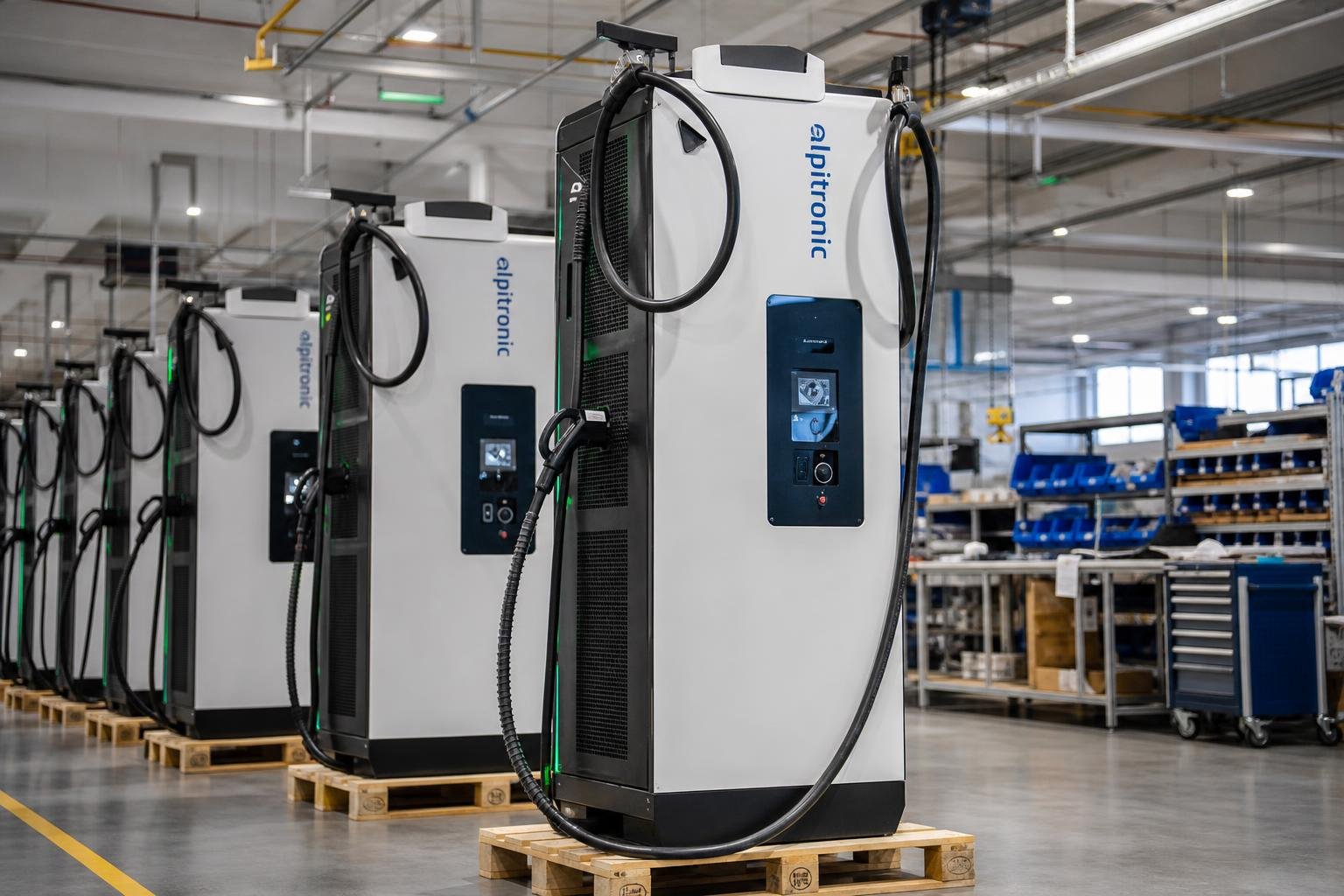

Alpitronic is expanding its manufacturing footprint in the United States with a new $33.94 million facility in Fort Mill, South Carolina. Scheduled to begin production in February 2027, the 173,315-square-foot site will assemble the company’s high-power HYC400 and HYC1000 DC fast-charging systems while also serving as a testing laboratory, repair center, warehouse and logistics hub.
The investment is important because Alpitronic’s hardware is increasingly appearing behind some of America’s most visible charging networks. Its chargers are being deployed by Ionna, Walmart, Mercedes-Benz and BP Pulse, among others. Drivers may recognize the network operator’s branding at a station, but the equipment itself is often supplied by a separate specialist manufacturer.
South Carolina facility will support Alpitronic’s U.S. expansion
Alpitronic Americas said the Fort Mill project will create 70 jobs and place more of its North American production under the company’s direct control. The company’s North American headquarters are in Charlotte, North Carolina, while its global headquarters remain in Bolzano, Italy.
York County’s Coordinating Council for Economic Development has committed a $200,000 Set-Aside grant to help cover building improvements. The majority of the investment will come from Alpitronic, which opened its first local manufacturing facility in Wisconsin in 2024.
“North America is central to our next phase of growth,” Patrik Herrnegger, CEO of Alpitronic Americas, said in a statement reported by InsideEVs. The company says local manufacturing should move it closer to customers and improve its ability to provide equipment, service and support in the region.
The additional site also reflects a broader shift in the charging industry. Rather than relying entirely on imported equipment, manufacturers are adding U.S. assembly and service capacity to shorten delivery times and meet the requirements of public charging programs.
What Alpitronic’s HYC400 and HYC1000 systems do
The HYC400 is an all-in-one DC fast charger capable of delivering up to 400 kilowatts to a single vehicle. Unlike systems that separate the power electronics into a cabinet positioned away from the vehicle, the HYC400 integrates the required equipment into the charging unit itself.
A 400-kW rating does not mean every electric vehicle will accept 536.4 hp. The vehicle’s battery architecture, state of charge, temperature and charging curve determine the actual power delivered. Even so, higher-output equipment gives newer EVs with suitable hardware the potential to spend less time at a charging site, particularly when the battery is at a low state of charge.
The HYC1000 takes a different approach. Its system uses a 1,000-kW power cabinet connected to as many as four charging stalls. Each stall can be fitted with two ports, and the system can distribute available power dynamically between vehicles. One vehicle can receive as much as 804.6 hp when sufficient capacity is available, while other connected vehicles can receive a lower share.
That power-sharing capability is important for station operators. A site does not need to provide the maximum output to every connected vehicle simultaneously, which can help make better use of expensive grid and power-conversion equipment. The approach is particularly relevant as charging sites grow from a handful of stalls into larger hubs serving passenger vehicles, commercial vehicles or both.
Silicon carbide is central to Alpitronic’s design
Alpitronic attributes part of its charger design philosophy to the use of silicon carbide, or SiC, power components. These components are used in power electronics to switch and convert electricity efficiently. The company claims its systems can achieve 97.5 percent efficiency.
Higher efficiency means less electricity is lost as heat during the conversion from the grid’s alternating current to the direct current required by an EV battery. That can reduce the energy that a site must purchase for a given amount of energy delivered to vehicles, although the effect on a driver’s bill depends on how the charging operator sets prices.
Reduced heat losses can also allow a charger to use smaller cooling systems and occupy less space. Alpitronic says its SiC-based systems are smaller, quieter and cooler than they would be with less efficient components. Those attributes matter at retail locations, highway rest areas and urban sites where equipment noise, footprint and visual impact can influence the choice of installation.
Efficiency alone, however, does not determine the quality of a public charging experience. Uptime, payment systems, software communication, cable handling, maintenance and the site’s electrical supply are equally important. A charger capable of extremely high output is of limited value if it is unavailable, derated by heat or unable to communicate reliably with a vehicle.
Domestic production is becoming more important
Alpitronic is not the only charging-equipment supplier expanding U.S. production. Ingeteam has invested in manufacturing capacity in Milwaukee, Wisconsin, for DC fast chargers and Level 2 equipment. Wallbox opened a North American factory in Arlington, Texas, while Delta Electronics has supplied domestically manufactured 350-kW chargers to EVgo.
These projects developed alongside federal efforts to establish a national charging network and attach domestic-manufacturing conditions to some public funding. Earlier federal charging standards required U.S. production of charger enclosures and set domestic-content requirements for equipment supported by certain programs. Those rules have encouraged both established electrical-equipment companies and newer charging specialists to reassess where they assemble hardware.
Local manufacturing does not automatically mean every component is made in the United States. Chargers remain complex systems containing power semiconductors, control electronics, cables, cooling equipment and communications hardware sourced through international supply chains. However, domestic assembly can improve access to service, simplify logistics and help manufacturers tailor products to American electrical, regulatory and connector requirements.
Why the factory matters to EV drivers
For drivers, the immediate benefit will not necessarily be a new Alpitronic-branded network. Alpitronic generally supplies the hardware, while companies such as Walmart, Ionna or other operators own the customer relationship and manage the charging site.
The factory could nevertheless affect the public charging experience by increasing the supply of high-power equipment and providing a regional base for testing, repairs and spare parts. Faster access to replacement hardware can be especially valuable at busy stations, where a failed dispenser can remove a significant percentage of a site’s capacity.
The broader significance is that charging infrastructure is becoming an industrial sector in its own right. Automakers may promote the vehicle, and network operators may control the app and payment system, but specialized manufacturers determine much of the equipment’s power capability, packaging and serviceability.
When Alpitronic’s Fort Mill facility begins production in 2027, it will add another U.S. source for some of the most powerful charging systems being installed today. The success of the investment will ultimately be judged less by its headline output than by how reliably those chargers operate in the places where EV drivers depend on them.
Sources: InsideEVs; Ingeteam; EVgo; Arlington Economic Development Corporation.



0 Comments