
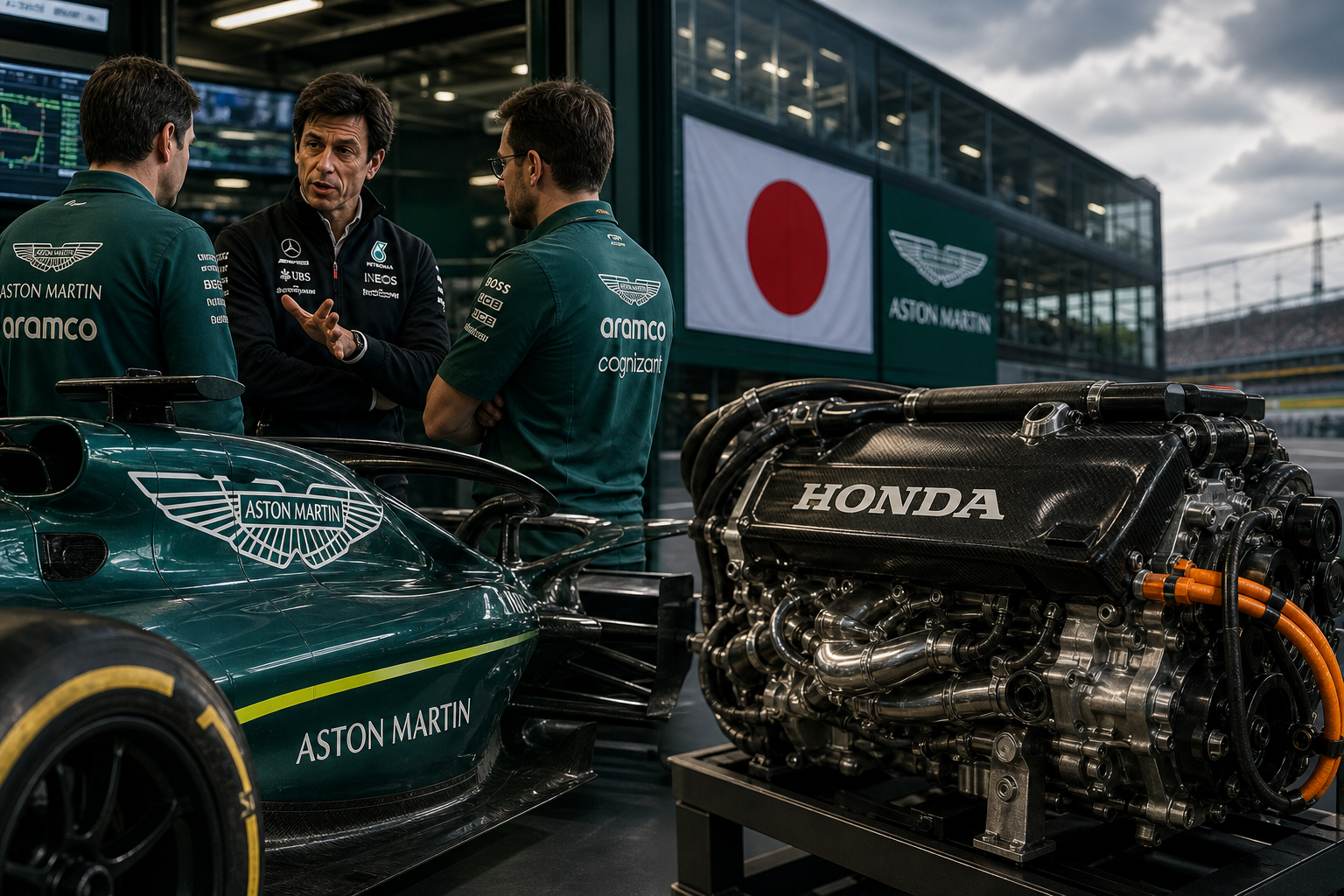

Mercedes team principal Toto Wolff says Honda will need significant support if it is to be competitive as Aston Martin’s works engine partner under Formula 1’s next rules cycle. The comments come as Aston Martin prepares for its factory partnership with the Japanese manufacturer and as Fernando Alonso has reportedly been in conversation with FIA president Mohammed Ben Sulayem.
Honda’s return as Aston Martin’s power-unit partner is one of the more intriguing shifts in F1’s engine landscape. After previously deciding to leave Formula 1, Honda reversed course late and committed to the sport again, but the change in direction left the company with less time to prepare than rivals that had been working toward the new regulations from the start. That timing matters. Formula 1’s engine formula is set to change again, and arriving late to the development cycle can leave even a major manufacturer playing catch-up.
Honda’s late return has created a difficult starting point
Honda’s initial decision to walk away from Formula 1 was a serious setback for any long-term programme, and the manufacturer’s subsequent U-turn meant rebuilding momentum and resources at speed. In modern F1, that’s not a small task. Power-unit development is intensely regulated, expensive and time-sensitive, and manufacturers spend years aligning technical staff, facilities and testing programmes around a new rule set.
That is why Wolff’s assessment is significant. He is not suggesting Honda lacks the expertise to become competitive; rather, he is acknowledging how difficult it is to enter a new phase of regulation without the same preparation time as established rivals. In Formula 1, a late start can mean not only fewer development hours but also less opportunity to validate concepts, refine reliability, and build the broader operational structure needed to support a works team.
Aston Martin’s power-unit project is central to its ambitions
Aston Martin’s future is closely tied to this partnership. The team has invested heavily in building itself into a genuine front-running operation, and a factory engine deal is a crucial part of that plan. Having a dedicated manufacturer alongside the chassis programme is usually a prerequisite for sustained success at the front of Formula 1, especially when the regulations place so much emphasis on how efficiently the power unit and chassis work together.
The challenge is that the new regulations do not just reward outright horsepower. They also ask manufacturers to manage energy deployment, battery performance, packaging and reliability in a far more integrated way than before. That increases the burden on any new partnership, especially one still in the process of establishing its technical workflow. For Aston Martin, success will depend on how quickly the team and Honda can become more than the sum of their parts.
Why Wolff’s remarks carry weight
Wolff’s comments matter because Mercedes has spent years operating at the sharp end of Formula 1’s power-unit competition. Few team bosses know better how much infrastructure and specialist knowledge is required to make an engine programme work at the highest level. His view also reflects a broader truth about the current F1 environment: the gap between being a participant and being a front-running manufacturer is often defined by preparation, not just ambition.
There is no suggestion that Honda’s presence in Formula 1 is in doubt. The manufacturer has a deep racing pedigree and remains a serious technical organisation. But Wolff’s message is clear enough: if Honda is to deliver a competitive Aston Martin power unit under the new rules, it will likely need more than a standard manufacturer effort. It will need the right support structure, the right timeline and, inevitably, a strong partnership with Aston Martin itself.
The Alonso and FIA backdrop
The wider context adds another layer of interest. Reports of Fernando Alonso speaking with Mohammed Ben Sulayem, the FIA president, have surfaced alongside the Honda discussion, underlining how closely driver, team, manufacturer and governing body matters are now intertwined in Formula 1. Alonso is central to Aston Martin’s current and near-term hopes, and any conversations involving his position, the FIA, and the team’s future direction naturally draw attention.
For Aston Martin, the priority is straightforward even if the execution is not: build a package capable of taking advantage of Formula 1’s next rules cycle. That means a competitive chassis, a strong works engine, and a programme capable of developing quickly once the regulations arrive. Honda’s task is to arrive ready enough that Aston Martin is not forced to spend the opening phase of the new era simply trying to close the gap.
Wolff’s view suggests the scale of that task is being understood inside the paddock. Honda has the name, the experience and the engineering base to matter in Formula 1 again. What remains to be seen is whether the manufacturer can turn a late return into a properly competitive works programme in time for Aston Martin’s next big step.

0 Comments