
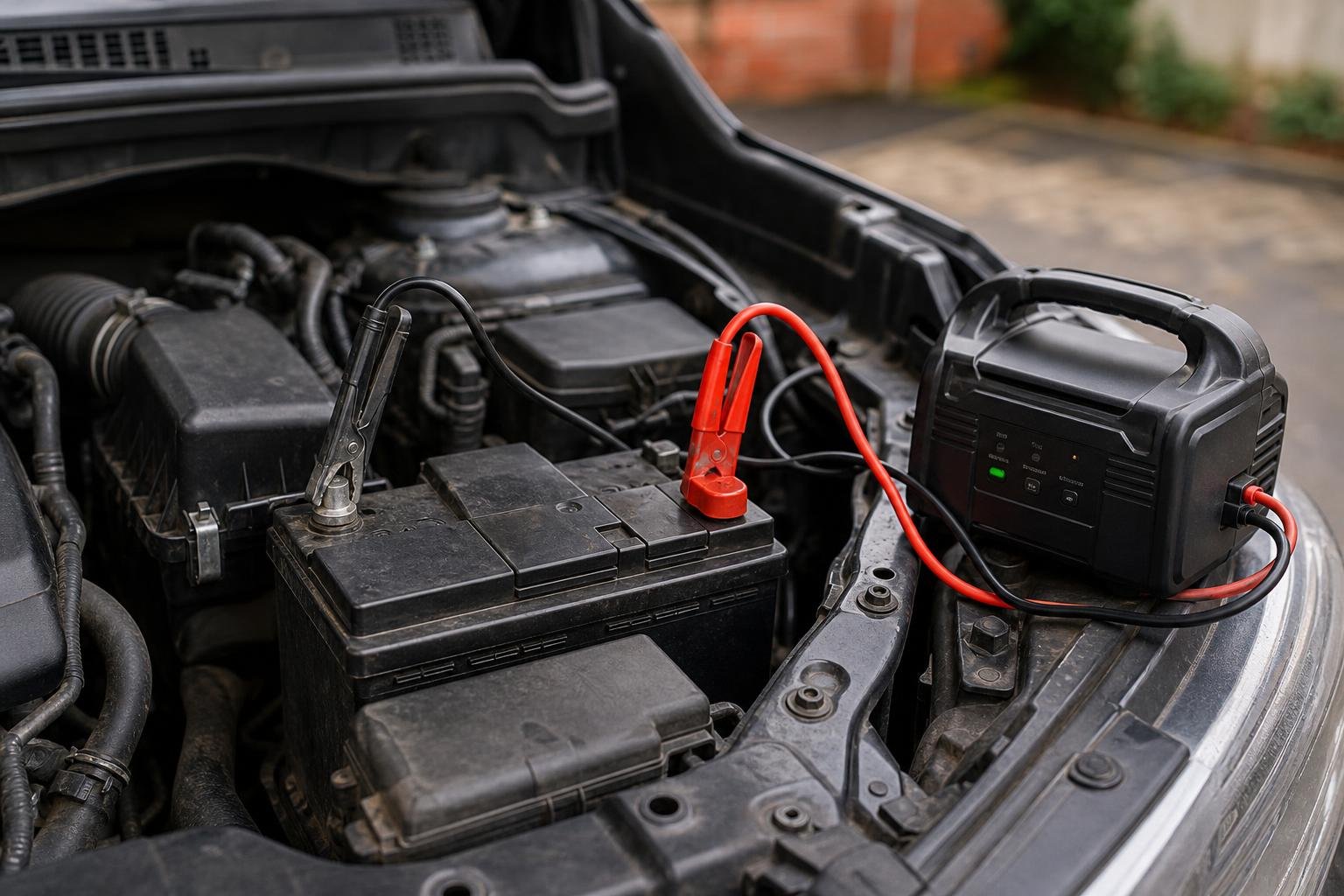

A dead car battery does not always mean it needs to be replaced. If the vehicle has been sitting unused for weeks or months, a charger can often restore the battery without disconnecting the terminals or removing it from the vehicle.
Battery chargers range from less than $50 to more than $200 and typically replenish the battery gradually over several hours. Before connecting one, however, the battery must be located and the charger should be used according to its manufacturer’s instructions.
Locate the battery and charger connections
In many older vehicles, the battery is mounted in the engine bay and is easy to identify. Newer models may place it beneath a plastic cover, while some vehicles locate the battery elsewhere. The Alfa Romeo Giulia Quadrifoglio, for example, has its battery in the trunk rather than under the hood.
Once the battery has been found, make sure the charger is switched off and unplugged before attaching the leads. Connect the red lead to the battery’s positive terminal. The black lead can be attached to the negative terminal, particularly when the battery is completely drained, but connecting it to a suitable chassis ground is generally the safer approach.
Why the chassis connection is preferred
On almost all modern vehicles, the negative battery terminal is connected directly to the chassis. The vehicle’s frame effectively serves as a shared electrical return path, reducing the need for separate return wires throughout the car.
Because of that design, the charger’s black lead can be connected to the chassis instead of directly to the negative battery terminal. A direct connection to the negative terminal can create a spark and, in rare circumstances, potentially cause an explosion, although the source notes that such an event is unlikely.
After both leads are secure, turn on the charger and allow it to operate while following the manufacturer’s directions. Charging generally takes several hours, so the process is intended for drivers who can leave the vehicle stationary while the battery replenishes.
Other options for infrequently driven cars
A portable jump-start pack provides a faster alternative when the immediate goal is to start a vehicle. These packs are generally more expensive than standard chargers but can supply enough power to start a car without waiting for a full charge.
Owners who rarely drive their vehicles may instead benefit from a trickle charger. These devices keep a battery topped up between drives, and more advanced models can remain connected indefinitely while monitoring the battery’s natural discharge and adding charge as needed.
Some chargers combine both functions. The source describes the Noco Genius 2X2 as a device that works as a battery charger and a trickle charger while maintaining two car batteries at the same time.


0 Comments