
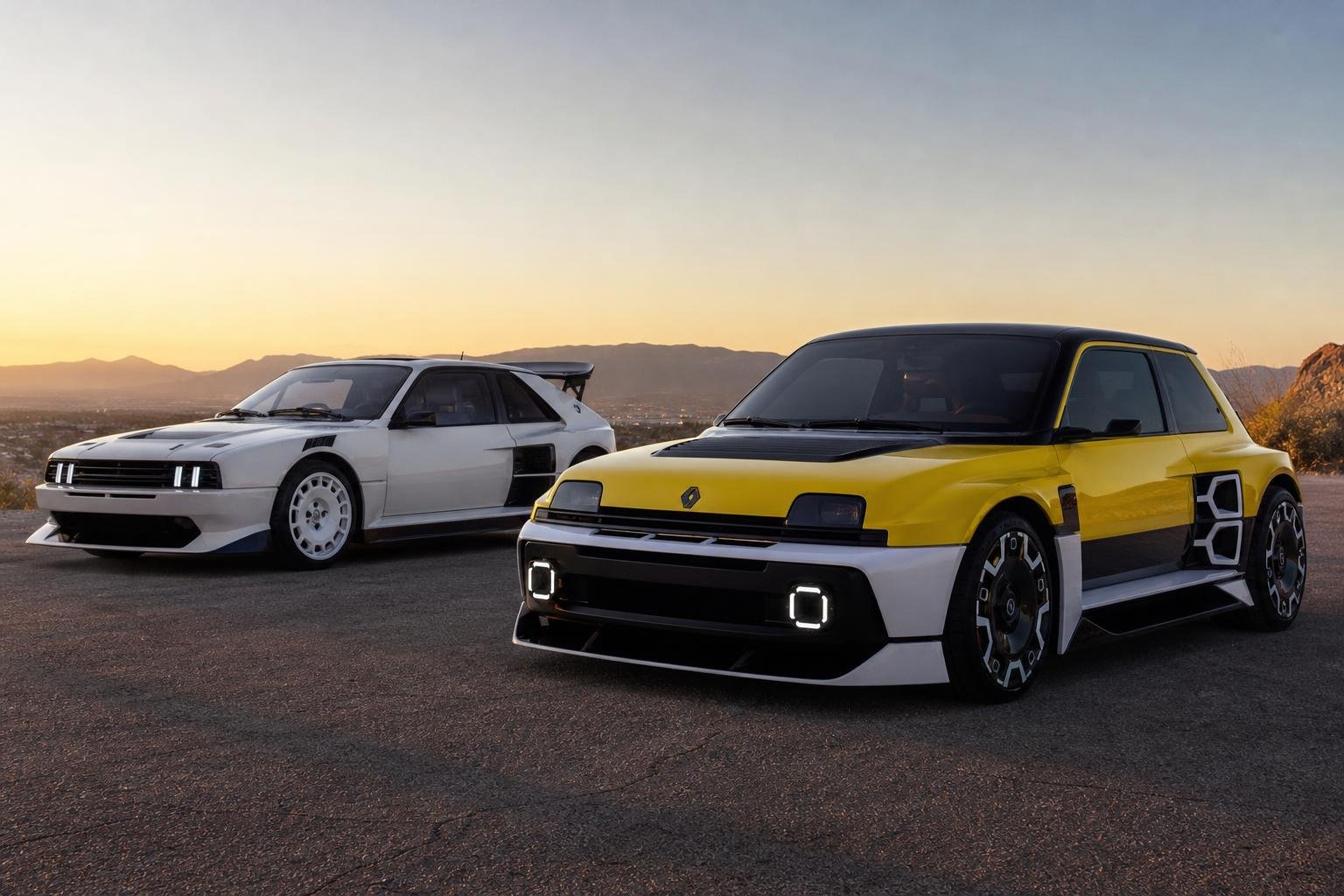

Renault and Peugeot have revived the spirit of their iconic Group B rally cars with two electric performance models. The Renault 5 Turbo 3E and Peugeot e-T16 reinterpret the mid-engine, rear-drive Renault 5 Maxi Turbo and all-wheel-drive Peugeot 205 T16 as wide-bodied, battery-powered hyper hatches.
The comparison remains based on published specifications and images rather than back-to-back testing. Renault introduced the Turbo 3E as a concept in 2022 before developing it into a limited-production model for 2025, while Peugeot presented the e-T16 concept in 2026. The Peugeot could potentially reach production in 2027.
Different approaches to the same legacy
The Renault is positioned as a flagship electric performance model connecting the classic R5 Turbo with the modern R5 E-Tech. The Peugeot, meanwhile, previews a possible high-performance version of the 208 hatchback expected in 2027. Both retain the three-door configuration associated with their historic predecessors, despite the five-door layouts common among today’s production superminis.
Visually, the R5 Turbo 3E draws heavily from the original Renault. Its design combines retro-inspired proportions with modern LED lighting, aerodynamic elements and 20-inch alloy wheels. The Peugeot takes a more contemporary route, but its greenhouse, red detailing and box-shaped taillights reference the 205 T16. Full-width three-slot LED graphics at the front and rear are intended to become a signature feature for future Peugeot models.
Both cars feature wide fenders with integrated vents, large bumper openings, prominent splitters, deep side skirts, substantial rear diffusers and roof-mounted spoilers. The Peugeot uses 21-inch wheels and wider rear tires, giving it a slightly larger footprint than the Renault.
Electric power replaces Group B combustion engines
Rather than replicating the original cars with rear-mounted combustion engines, the new models use electric drivetrains and floor-mounted batteries to support a similar performance-focused layout.
The Renault is built around a bespoke aluminum tubular chassis developed by Alpine. Its 70-kWh battery is mounted in the floor, helping produce a 43:57 weight distribution. Like the original R5 Turbo, the electric successor sends power to the rear wheels.
Two electric motors produce a combined 555 horsepower, or 410 kW and 563 PS. Renault quotes a 0-to-100-km/h sprint of less than 3.5 seconds, while the car’s stated weight is 1,450 kilograms.
The Peugeot uses Stellantis’ STLA One architecture and preserves the all-wheel-drive concept of the 205 T16. Three electric motors deliver a combined 816 hp, equivalent to 600 kW and 827 PS. The e-T16 is claimed to reach 100 km/h from rest in 2.5 seconds.
Its battery has an 85-kWh capacity and is described as sufficient for three consecutive laps of the Nürburgring. Peugeot has not published an exact curb weight, but its stated power-to-weight ratio of less than 2 kg per horsepower suggests a figure of approximately 1,632 kg.
Both cars are said to support rapid charging. The Renault can charge from 15 to 80 percent in roughly 15 minutes, while the Peugeot can reportedly go from 10 to 80 percent in about the same time when connected to a suitable charger.
Two-seat interiors with rally-inspired controls
The two models share a two-seat cabin, heavily bolstered bucket seats and brightly colored roll cages. Each also includes a vertical hydraulic handbrake designed to help drivers initiate slides through tight corners.
The Renault’s interior is closer to a conventional production car. It uses a standard-style steering wheel and a digital cockpit derived from the R5 E-Tech. Peugeot takes a more experimental approach with its Hypersquare steering wheel, integrated display and ultra-wide 21-inch digital instrument panel.
There is also a practical difference between the cars. The Renault includes a conventional boot, whereas the Peugeot’s rear body section tilts open to expose its electric motors and suspension components. It is not yet clear whether that feature would remain on a production version.
Production plans and pricing
The Renault 5 Turbo 3E is limited to 1,980 units and has a starting price of €160,000, listed in the source as approximately $180,000. It can be ordered in Europe, the United Kingdom, the Middle East, Japan and Australia, with first deliveries expected in 2027.
The Peugeot e-T16 remains a concept, although the brand’s boss has confirmed that it could develop into a production model as early as 2027. For now, the Renault is the more established offering, while the Peugeot represents a possible future interpretation of the 205 T16 formula.
0 Comments