
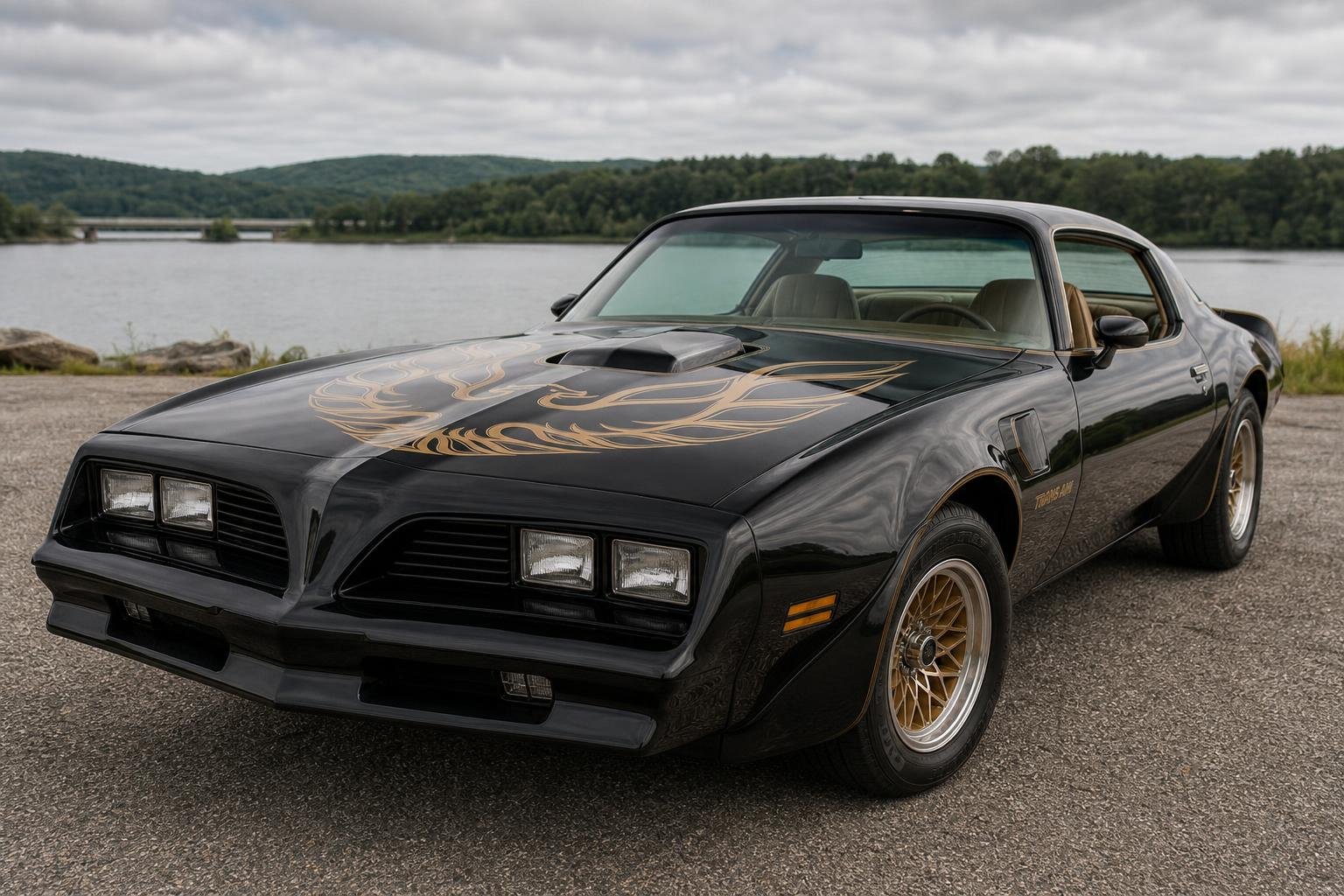

The large bird graphic that became one of the Pontiac Firebird Trans Am’s defining features is widely known as the “screaming chicken” or, less commonly, the “rising phoenix.” Pontiac itself used a much simpler name: the Trans Am Hood Decal.
The graphic was not part of the original 1967 Firebird’s design. That car used a smaller bird emblem with its wings lowered and its beak closed. The emblem reportedly resembled motifs found in Hopi Native American jewelry and later provided the foundation for the more dramatic artwork associated with the Trans Am.
From a clay model to a rejected design
Bill Porter, Pontiac’s head of design, developed the more elaborate bird while the 1970 Firebird was being worked on. He added broad wings and gold feathers, drawing inspiration from the colorful Tiffany vases in his collection.
Porter was eager to see the idea on the car, so he printed the graphic and attached it to a full-size clay model. However, the design initially appeared to be finished before it had a chance to reach production. According to Porter’s 2024 account to Original MotorCar, GM design chief Bill Mitchell saw the graphic and strongly disliked it.
The proposal resurfaced several years later when GM designer John Schinella found Porter’s design and refined it. Schinella then presented the idea to Mitchell again, this time applying a gold version of the graphic to the hood of a black Trans Am. The choice was intended to echo the gold graphics on Mitchell’s black motorcycle, and Mitchell approved the design.
The Trans Am Hood Decal debuts
Pontiac introduced the graphic as an option on the 1973 Firebird Trans Am. It cost $55 and quickly became popular, helping turn the hood artwork into one of the model’s most recognizable visual signatures.
The initial decal measured 45.5 inches wide and 44.5 inches long. For 1978, Pontiac increased it to 47 inches wide and 55 inches tall. The bird’s head was also repositioned so it faced toward the passenger side rather than pointing toward the driver.
The larger design became standard equipment on 1979 Trans Am models, excluding the 10th Anniversary edition. Pontiac increased the pattern slightly again for the 1980 model year and created a distinct version for the turbocharged Firebird models.
The graphic’s later years
The design became prominent enough during the late 1970s that Ford developed its own large hood graphic for the Mustang King Cobra, using a golden snake in place of Pontiac’s bird.
The third-generation Firebird, which arrived in 1982, continued to offer the distinctive decal, although the artwork was smaller than the versions used on earlier Trans Ams. As interest in the graphic declined, Pontiac removed it from the lineup for the 1988 model year.
Although enthusiasts continue to use colorful names such as “screaming chicken” and “rising phoenix,” Pontiac’s official terminology was far more straightforward. The feature that helped define generations of Firebird Trans Ams was simply the Trans Am Hood Decal.


0 Comments