
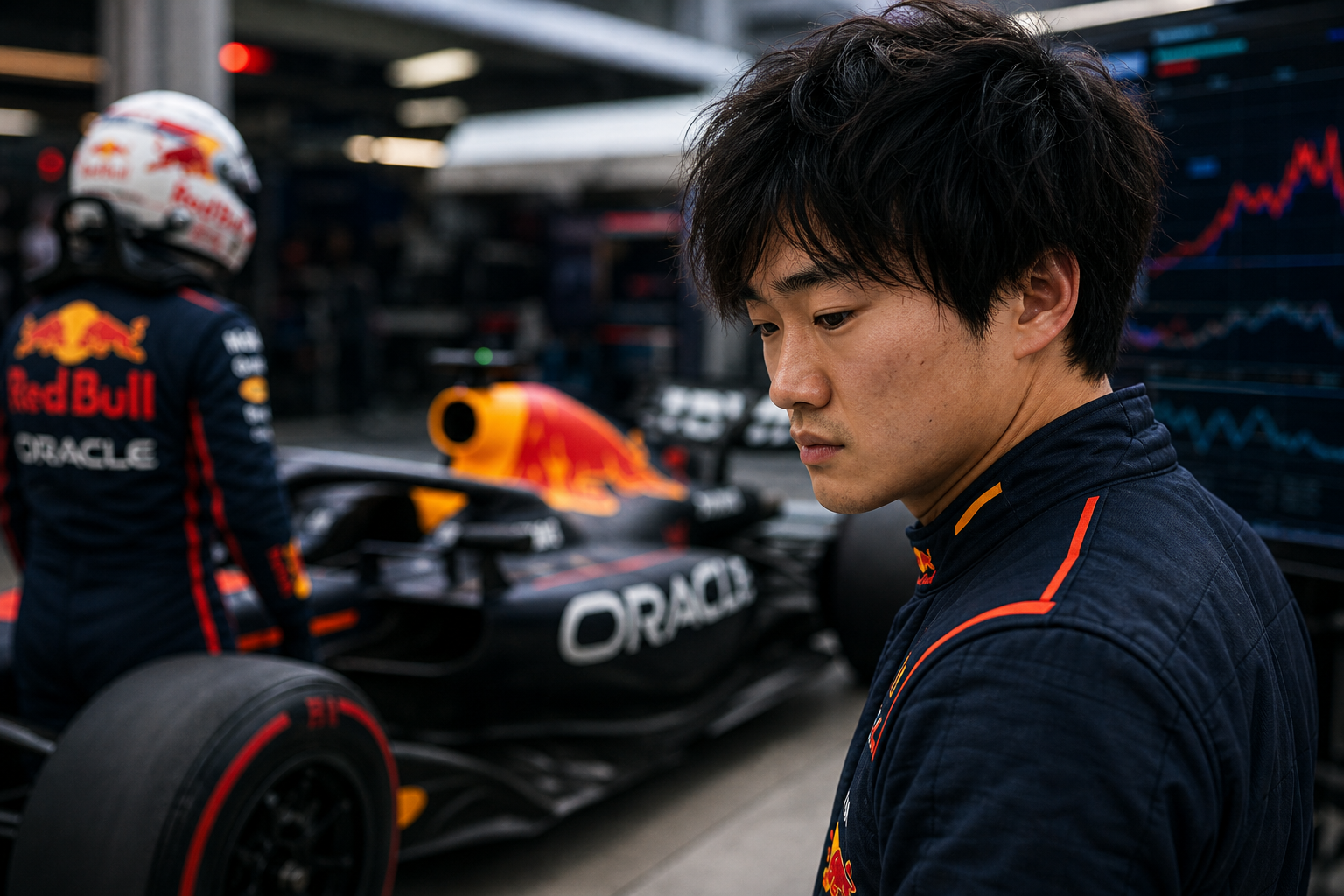

It is rare to see a driver alongside a championship contender finish as far down as 17th in the Formula 1 standings, but that is where Yuki Tsunoda found himself after joining Max Verstappen at Red Bull in 2025. The result was unusual even by modern F1 standards, and it raised an obvious question: why did a driver with Tsunoda’s experience fail to get on top of a car that has helped Verstappen define this era of the sport?
The answer lies in how specific Red Bull’s cars have become. The team’s recent machinery has been built around Verstappen’s preferences, and while that approach has produced enormous success at the sharp end, it has also created a difficult environment for any second driver stepping into the garage. Tsunoda’s case has made that tension especially visible, because the gap to Verstappen was not simply a matter of raw pace. It was also about getting the car into the narrow operating window Red Bull demanded.
A difficult benchmark beside Verstappen
Red Bull has spent years developing a Formula 1 car that works exceptionally well for Verstappen’s driving style. That has been a key part of the team’s title-winning run, but it also means the car can be unforgiving if a driver prefers a different balance or needs a wider setup range. Tsunoda arrived with a reputation as a quick, aggressive racer, yet the transition to Red Bull exposed how much a driver can struggle when the car’s characteristics are so closely tied to a single benchmark.
Finishing 17th in the drivers’ championship alongside a title contender is a stark illustration of that problem. It suggests not just poor race results, but a season in which Tsunoda never consistently found the confidence or consistency required to extract performance over a grand prix distance. In Formula 1, that usually means the issue is deeper than a single qualifying session or a few unlucky races.
Why the Red Bull car can be so hard to master
Red Bull’s current design philosophy has made the team extremely effective, but it has also produced one of the sport’s most demanding cars to drive. Modern F1 machinery is already highly sensitive, and the latest generation of ground-effect cars can punish any imbalance in handling. For a driver entering that environment midstream, the challenge is not just adapting to the speed of the car, but understanding how it responds at the limit and how to keep the tyres alive through a race stint.
That matters because a car built around one driver’s requirements can feel natural to that driver and opaque to everyone else. Verstappen has shown a remarkable ability to exploit a front-end-limited, highly precise car, but other drivers may need more rear stability or a broader window through corners and tyre phases. When the setup range is narrow, it becomes harder to chase lap time without introducing instability elsewhere.
Tsunoda’s difficulties therefore speak to a broader truth about modern Formula 1: a car can be fast enough to win races while still being exceptionally awkward for anyone outside its development path. The better the team is at maximizing one driver’s strengths, the harder it can become to produce a second car that is easy to drive and consistently competitive.
Second-seat pressure at Red Bull
Red Bull has long faced scrutiny over the performance of its second seat, and Tsunoda’s 2025 season fits into that ongoing pattern. The team has repeatedly paired Verstappen with drivers who arrived with strong credentials but struggled to replicate their previous form once inside the Red Bull system. That does not necessarily mean the drivers lacked talent. More often, it means the car and team structure make the step up unusually difficult.
For Tsunoda, that context is important. A driver can look very different in a car that suits his natural rhythm compared with one that demands constant adaptation. In a closely matched midfield, a driver who is only a few tenths off the sweet spot can fall several places down the order. Against Verstappen, the margin for error is even smaller because the reference point is so extreme.
What Tsunoda’s season says about Red Bull’s development path
There is also a development story here. Red Bull has not only built a car around Verstappen’s preferences; it has continued refining that concept because it works for the team’s lead driver. That is logical from a championship perspective, but it creates a clear trade-off. The more the car evolves in one direction, the less likely it is to suit a broader range of drivers.
That balance is one of the most difficult problems in Formula 1. Teams want the fastest possible car, not the most universally friendly one. Yet when the second driver cannot approach the lead driver’s pace, the team loses strategic flexibility, struggles to exploit both cars in races, and risks carrying a large performance gap inside the garage. Tsunoda’s 2025 campaign brought that issue into sharp focus once again.
The scale of the challenge in modern Formula 1
The closest recent comparison cited for Tsunoda’s position is Felipe Massa, who sat 16th eight rounds into the 2012 season while Fernando Alonso was fighting at the front for Ferrari. That kind of split is rare because top teams usually expect both cars to score regularly. When one driver is near the top of the championship and the other is buried far below, it usually points to a car-driver mismatch rather than a simple drop in form.
That is what makes Tsunoda’s Red Bull season noteworthy. It was not merely a disappointing run for one driver; it was a reminder of how specialized Formula 1 cars have become and how little room there is for adjustment when a team’s development direction is built around a single superstar. Red Bull has benefited enormously from that approach, but Tsunoda’s 2025 campaign showed its cost with unusual clarity.
Whether the team can make future cars more accessible to a wider range of drivers remains an open question. For now, Tsunoda’s season stands as one of the clearest examples of how hard it can be to step into the seat next to Verstappen and make the package work on merit alone.

0 Comments