
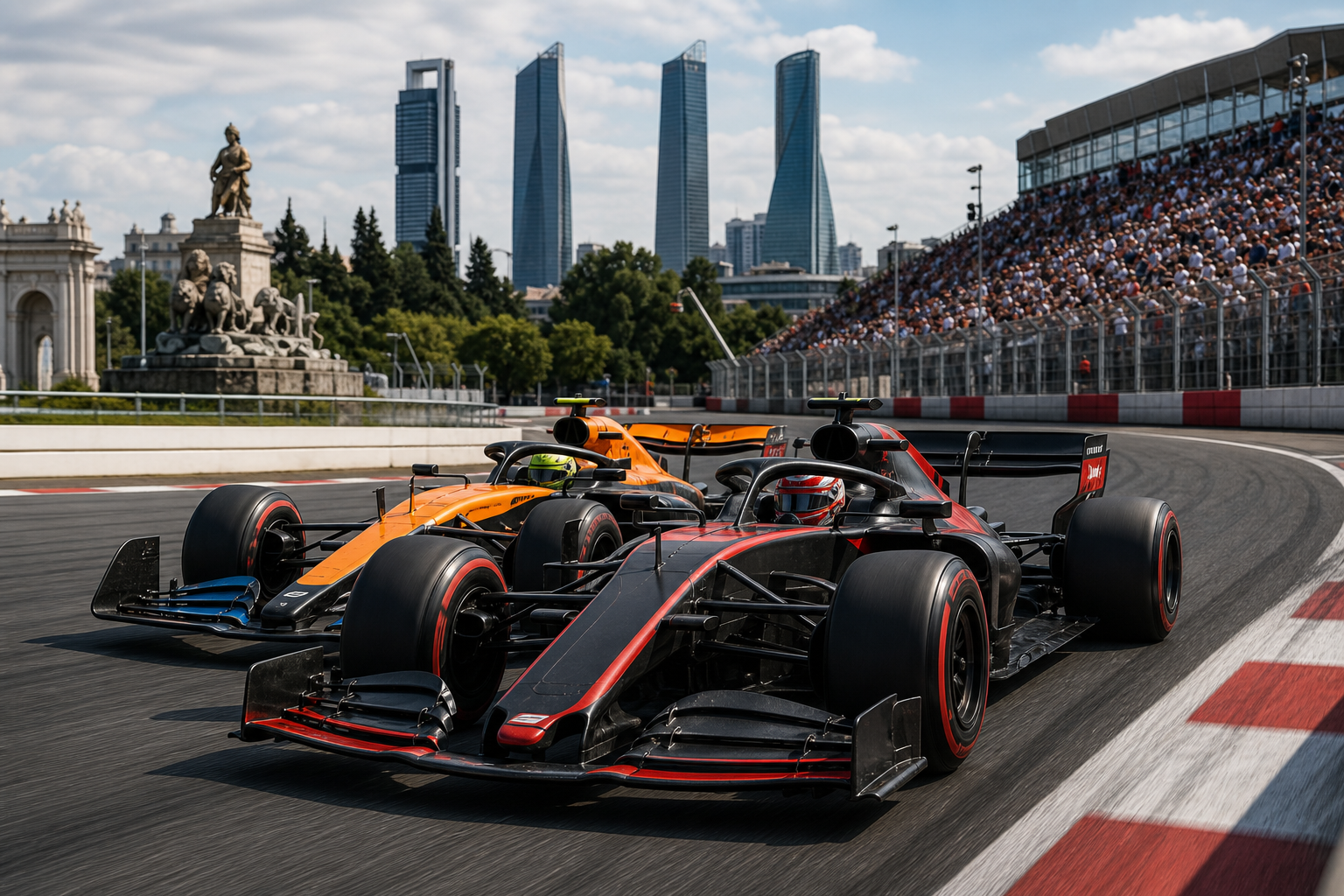

Formula 1’s ongoing overtaking debate has a habit of circling back to the same target: the circuit. When a new venue is discussed, criticism often follows that the layout will be too tight, too technical, or too dependent on clean air to produce racing. But former Jordan and Jaguar technical director Gary Anderson says that diagnosis is too simple. If F1 wants more passing, the sport needs to look beyond track design and confront the technical package, tyre behaviour and race strategies that shape what happens on Sundays.
That point matters now because new venues such as Madrid’s planned Madring will inevitably be judged through the lens of overtaking. Yet Anderson’s argument is that even if a circuit offers more natural opportunities to attack, it won’t automatically deliver wheel-to-wheel racing if the cars themselves still struggle in dirty air or if the tyre and aero characteristics discourage close following.
Circuit design gets the blame, but it isn’t the whole story
F1 track layout is the most visible part of the overtaking conversation, which is why it draws so much criticism. Tight corners, short straights and heavy braking zones can all make passing harder, and circuits built around street infrastructure often look especially vulnerable to that criticism before a car has turned a wheel.
But Anderson’s view is that the industry can exaggerate the importance of layout alone. Even on circuits with obvious passing zones, the modern Formula 1 car remains large, aerodynamically sensitive and difficult to follow closely. If the car behind loses too much front-end grip in turbulent air, the best braking zone in the world won’t solve the problem. The driver still has to arrive with enough control and confidence to make the move stick.
That’s why the debate around a new venue like Madring is more nuanced than simply asking whether the circuit includes enough straights. The more relevant question is how the whole race package will behave there: how the tyres warm up, how much downforce the cars shed in traffic, and whether drivers can stay close long enough to commit to a pass.
What actually shapes overtaking in modern F1
Anderson’s comments point toward the broader technical reality of today’s championship. Formula 1 cars have been designed to produce huge cornering loads, but that comes with a cost. When following another car closely, the airflow disruption can rob the chasing driver of front downforce, which then affects turn-in, tyre life and confidence under braking. The result is that a car may be fast enough in clean air without being able to attack effectively in a race pack.
Tyres are part of the same issue. F1 has spent years trying to balance performance and raceability, but if a tyre is too sensitive to overheating, drivers are forced into management rather than sustained attack. If it is too robust, strategic variety can disappear and pace differences may become harder to convert into overtakes. The sport has repeatedly found that overtaking is not just about one element being “better” or “worse”; it’s about how car, tyre and circuit interact over a stint.
That interaction is why race design discussions often end up at the same technical cul-de-sac. A circuit can create an overtaking zone, but if the following car overheats its front tyres after two laps in traffic, the move may never be on. Likewise, if DRS assistance is required too heavily, the pass can feel artificially dependent on one predictable section of track rather than on genuine racecraft.
Why Madring will be judged differently from the start
Any new Formula 1 venue arrives with expectations attached, but a city-centre or semi-street style circuit tends to be judged even more harshly. Madrid’s Madring will be scrutinized not just as a new race location, but as a test case for whether modern F1 can still create interesting racing on a layout that may not be built like a classic permanent circuit.
That means the debate will not stop at corners and straights. Observers will want to know whether the layout supports overtaking under braking, whether the corner radii encourage defensive driving without completely shutting the door, and whether the overall rhythm of the lap creates enough chances for strategy to matter. If the race proves processional, the circuit will likely take the blame first. Anderson’s point is that the car formula may deserve a larger share of it.
This is especially relevant because Formula 1’s recent ground-effect era has already shown how hard it is to make cars follow closely even after regulation changes intended to improve the spectacle. The problem isn’t simply one of adding a longer straight or widening a corner exit. The whole aerodynamic platform determines how much a driver can attack while staying within the operating window of the tyres.
The limits of designing overtaking into a lap
F1 circuit designers have long tried to build passing opportunities into new venues. That can include longer braking zones, tighter hairpins at the end of straights or sequences that encourage drivers to compromise exit speed. These ingredients can help, but they don’t guarantee action.
A car that can’t stay within a few tenths of the one ahead through medium-speed corners will struggle to arrive in range for the pass, no matter how well the braking zone is designed. Conversely, a car that is strong in dirty air can exploit even a modest overtaking section. In other words, the same corner can produce very different results depending on the cars running through it.
That’s what makes Anderson’s argument credible. As a former technical director, he knows the limits of what circuit design alone can achieve. A good layout can help create opportunities, but it cannot fully override the aerodynamic and tyre characteristics that define modern Formula 1.
Why the discussion matters beyond one race
The significance of this debate goes beyond Madrid. Formula 1 is now selling itself globally as a sport that can deliver both speed and racing, and every new event becomes part of that promise. If a circuit is dismissed before it is even raced, the conversation often stops at aesthetics or geometry. But if overtaking is genuinely the goal, the sport has to consider how the rules, cars and tyres shape the racing product before assigning blame to the circuit map.
That does not mean all tracks are equal or that layout is irrelevant. Some circuits are clearly better suited to wheel-to-wheel racing than others. But Anderson’s stance is a useful reminder that the modern Formula 1 overtaking problem is layered. A track like Madring may be designed to help, yet whether it succeeds will depend just as much on what the cars do in traffic as on where the braking markers are placed.
For fans, the practical takeaway is straightforward: if the racing falls short, the circuit alone probably won’t be the full explanation. In Formula 1, overtaking is built — or blocked — by the whole package.

0 Comments