
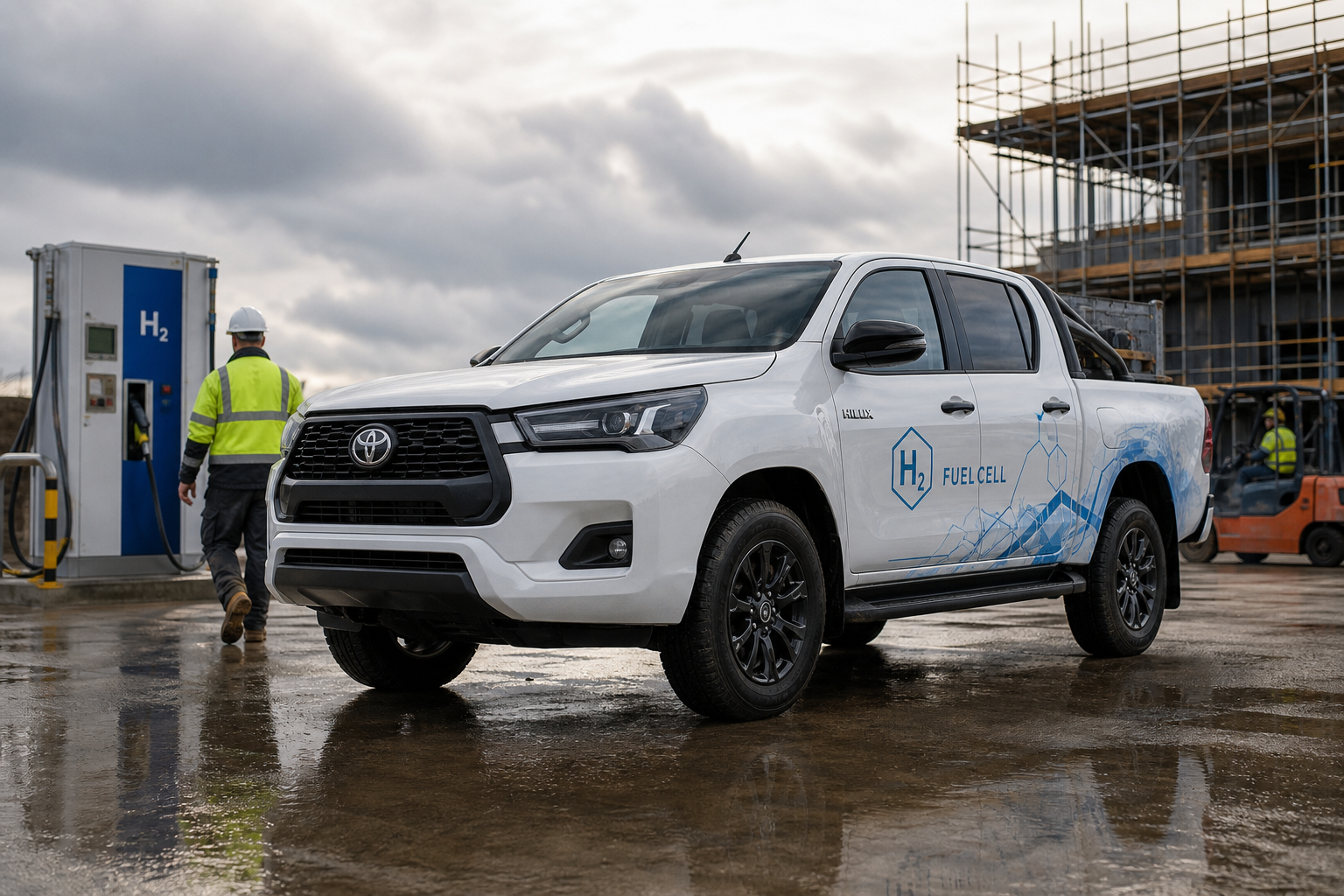

Toyota has quietly confirmed something that sounds a bit futuristic and deeply practical at the same time: a hydrogen-powered Hilux will enter production in 2028, aimed at European fleet buyers. And before anyone rolls their eyes and mutters about science projects, the numbers are at least grounded in reality. The pick-up is said to manage 248 miles of range, tow properly, and refill in about five minutes.
That last figure is the killer argument, at least on paper. Hydrogen fuel-cell vehicles don’t ask fleets to sit around for hours waiting for a battery to recover, which is why Toyota keeps circling back to the technology for working vehicles. If you run vans or pick-ups on a tight schedule, a five-minute top-up is a far less awkward proposition than arranging overnight charging for a ute-sized beast that’s spent the day hauling tools, pallets or whatever else the accountants insist is “essential business use”.
The other important detail is the target market. This isn’t being positioned as a lifestyle toy for people who want a muddy accessory for their ski chalet. Toyota is talking about European fleets, which tells you exactly where it sees hydrogen making sense: duty cycles, predictable routes, centralised refuelling and vehicles that need to get back to work quickly. It’s a very different sales pitch from the one used for electric pick-ups, which still tend to involve a fair amount of charging-plug optimism and spreadsheet acrobatics.
Why Toyota keeps returning to hydrogen
Toyota has spent years defending hydrogen while much of the industry has been busy pretending battery-electric is the only show in town. That has made it look stubborn at times, but also oddly prescient in the commercial-vehicle space. For passenger cars, hydrogen has struggled badly with infrastructure and economics. For fleets, especially those operating from a depot, the equation is at least more believable.
The Hilux is a sensible vehicle for this sort of experiment because it already lives in the real world. It is not a glamorous machine, which is part of its genius. This is a pick-up bought by people who actually use the thing, often in unpleasant weather, across rough ground, with tools, tow loads and deadlines all piled into the equation. If hydrogen is ever going to earn its keep beyond glossy demonstrations, that’s the sort of vehicle it needs to fit into.
Toyota has also been here before. The company has long viewed hydrogen not as a single solution, but as another tool for markets where batteries are awkward, charging time is painful or range requirements are inconsistent. Whether the wider industry agrees is beside the point; Toyota has never been shy about pursuing its own line of thought, which is either admirable persistence or corporate mulishness depending on the day.
What the Hilux FCEV needs to prove
On the face of it, the promised figures are decent enough. A 248-mile range is not absurd for a working vehicle, especially if the refuelling time really is close to the advertised five minutes. Strong towing capability is also key, because a pick-up that can’t drag a trailer without sulking is about as much use as a kettle in a power cut.
But the real challenge is not the brochure. It’s the infrastructure. Hydrogen refuelling is still sparse across much of Europe, and without a network that fleets can rely on, even the best-engineered fuel-cell pick-up becomes a very polished inconvenience. Toyota knows this, of course. That is why the launch is being framed around fleets rather than private buyers, where depot-based fuel provision can make the concept far less daft.
There is also the old fuel-cell catch-22: vehicles need stations, stations need vehicles, and everyone wants someone else to pay first. Lovely business if you enjoy committee meetings, not quite so lovely if you’re trying to build an actual market. Toyota’s bet appears to be that commercial fleets, especially those under pressure to decarbonise without wrecking productivity, may be the first group willing to make the leap.
Why the Hilux matters more than a concept car
Concepts are cheap. Manufacturers are brilliant at wheeling out shiny objects, slapping a dramatic name on them and then quietly forgetting the whole thing when the marketing budget moves on. A production Hilux FCEV due in 2028 is more serious. The Hilux is one of Toyota’s most important global nameplates and one of the best-known working vehicles on earth. If Toyota is prepared to put hydrogen into that model line, even in a fleet-focused form, it suggests the company believes there is an actual business case rather than just a useful press release.
It also gives the Hilux another layer of identity. The truck has built its reputation on durability, simplicity and the sort of mechanical honesty that buyers in this segment tend to value. Hydrogen doesn’t replace that reputation; it tests whether Toyota can graft a rather more complicated energy system onto a vehicle people trust to do a job day after day.
That will be the interesting part. Not the concept render, not the fuel-cell jargon, not the usual industry chant about sustainability over a moody desert backdrop. It’s whether Toyota can take one of the most workmanlike vehicles it builds and make hydrogen feel like a practical powertrain rather than an engineering curiosity in a hard hat.
If it works, the Hilux FCEV could become one of the most believable arguments yet for hydrogen in commercial transport. If it doesn’t, well, Toyota will at least have confirmed what many already suspect: in the real world, refuelling speed alone is not enough. There has to be somewhere to put the pump first.

0 Comments