
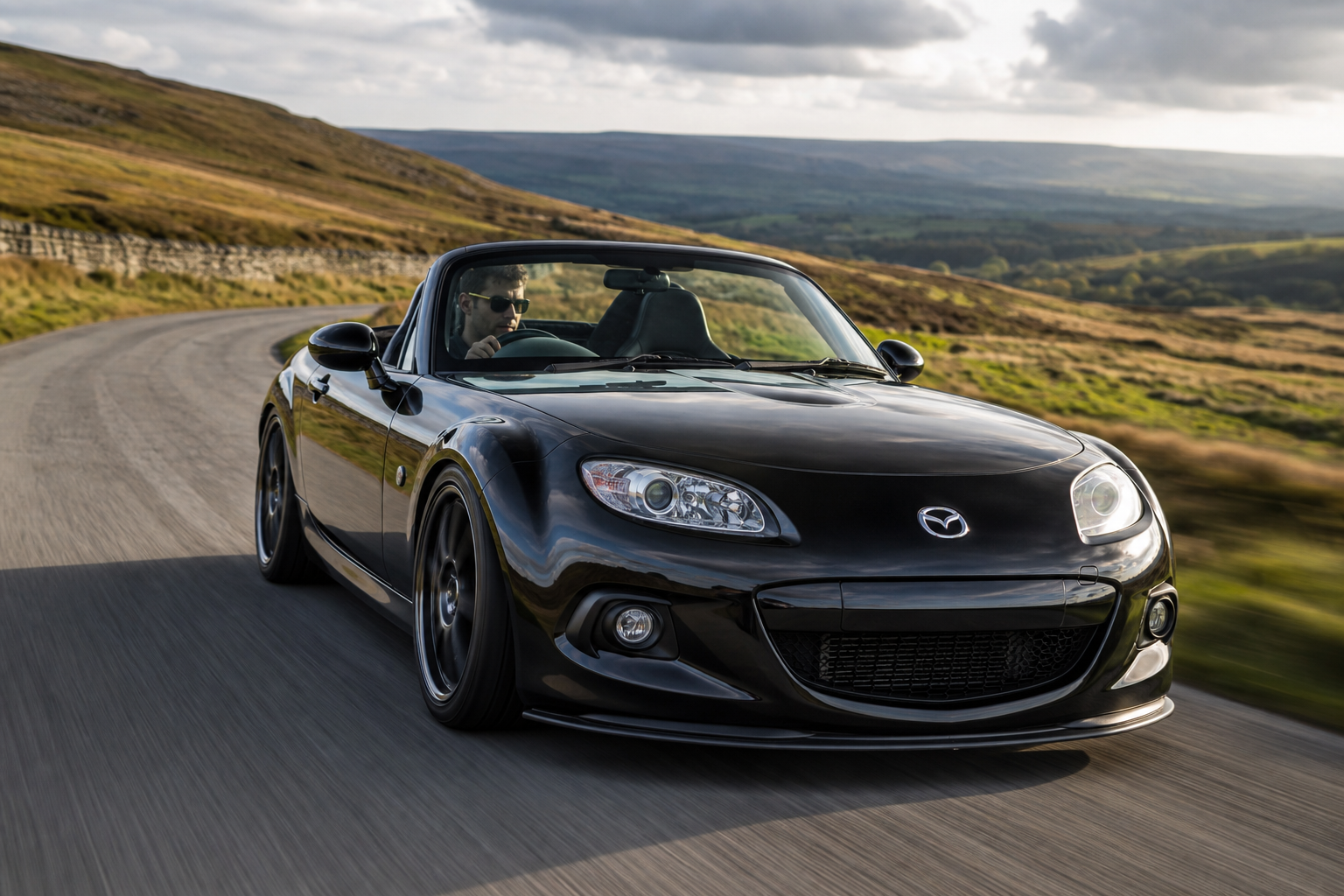

The third-generation Mazda Miata has always lived in the shadow of its predecessor. The NA has the pop-up headlights and the cultural immortality. The NB is the tidy, slightly sharper one. The newer ND is lighter, cleaner, and generally gets invited to the fashionable parties.
The NC, meanwhile, is often treated as the Miata that happened to arrive wearing a little extra body fat. That is a touch unfair, but the car has never enjoyed the same affection as the others. Rocketeer, a U.K.-based specialist, has found a rather entertaining way to alter the conversation: fit a naturally aspirated V-6 and produce roughly 300 horsepower without turning the roadster into a heavyweight.
The NC Miata’s Most Interesting Problem
When the NC-generation Miata arrived for the 2006 model year, it brought more space, more equipment, and a larger 2.0-liter four-cylinder engine to the familiar rear-wheel-drive formula. It was still compact and fundamentally simple, but it was no longer quite as dainty as the original car.
That extra size brought practical benefits. The NC has a more usable cabin, a roomier trunk, and a platform capable of handling more power than the early cars. It also created the central complaint: compared with an NA or NB, the NC can feel less delicate. The steering and chassis remain entertaining, but the car does not always deliver the same sense of mechanical mischief at ordinary speeds.
Adding a V-6 sounds like the least subtle solution imaginable. It is also rather clever. A Miata does not need enormous power to be quick, but the factory NC’s four-cylinder can leave owners wanting more, particularly when the car is being used on track or alongside modern performance machinery. Rocketeer’s conversion attacks that shortfall without abandoning the basic recipe that makes the Miata appealing.
Why a V-6 Makes Sense Here
Rocketeer’s conversion centers on a 3.0-liter V-6 related to the engine family used by Jaguar. In naturally aspirated form, the installation is capable of producing around 300 hp, depending on the specification and tune. That is a substantial jump over the roughly 170 hp delivered by the U.S.-market NC Miata’s original 2.0-liter engine.
The headline figure is impressive, but the more important detail is the claimed weight. Rocketeer’s objective is to add power without adding a large amount of mass, keeping the finished car close to the weight of the standard Miata. That matters because the Miata’s charm has never depended on brute force. It depends on responsiveness, modest dimensions, and a chassis that gives the driver something to do.
A big turbocharger would make a dramatic dyno graph, followed by a dramatic wait while the boost arrives. A compact, naturally aspirated V-6 offers a different character. There is more displacement, a broader spread of torque, and the sort of soundtrack that a four-cylinder Miata cannot really fake, no matter how enthusiastically an exhaust company describes its mufflers.
The conversion also preserves the key layout: engine up front, drive sent to the rear wheels, and a manual transmission at the driver’s command. That is important. The point is not to turn the NC into a straight-line novelty. It is to give the existing chassis the engine it arguably deserved from the beginning.
More Power Does Not Automatically Mean a Better Miata
There is a catch, because there is always a catch when someone puts a substantially larger engine into a small sports car. The Miata’s original appeal comes from balance and accessibility. With around 300 hp on tap, throttle discipline becomes considerably more relevant, and the driver will reach the limits of the tires, brakes, suspension, and differential much sooner.
That does not make the conversion a bad idea. It simply changes the car’s operating range. A standard NC can be hustled along a winding road without immediately becoming antisocial. A V-6 example would have enough muscle to make straights meaningful and corners arrive with rather more urgency. The car would still be compact, but the driver would need to use the extra performance with some restraint. This is generally preferable to building a machine that spends its life shouting about potential while moving at the speed of a mildly irritated shopping cart.
The claimed weight parity is therefore crucial. If the conversion added several hundred pounds, the extra output would be doing little more than compensating for the new mass. Keeping the car near its original weight gives the engine a genuine purpose. The power-to-weight ratio improves, but the nimble character that makes the Miata worth modifying does not have to disappear.
The Engineering Challenge Is Bigger Than the Engine
Installing a V-6 is not merely a matter of making the engine physically fit and then congratulating everyone involved. The cooling system, wiring, exhaust, engine management, fuel delivery, accessory drives, and transmission interface all need to cooperate. Cars are surprisingly ungrateful when their components are asked to communicate with unfamiliar neighbors.
There is also the question of how the additional output reaches the road. A 300-hp Miata puts far greater demands on its clutch, differential, driveshaft, axles, and tires than the factory four-cylinder car. The NC platform is a sensible starting point because it was sold with more substantial hardware than the earliest Miatas, but a serious conversion still needs to be engineered as a complete package rather than an engine transplant with decorative optimism.
That is where a specialist build can make more sense than a backyard swap. The appeal of Rocketeer’s approach is not merely that it produces a large number on a dynamometer. It is that the company has developed a conversion around a specific car, with the packaging and supporting systems treated as part of the project. That distinction separates a usable performance roadster from an expensive mechanical argument.
Why the NC Is a Good Donor
The NC Miata is an increasingly interesting base for modification precisely because it has been overlooked. Early cars have become collector curiosities, while the ND remains the obvious choice for buyers who want a new Miata. The NC sits between those two worlds: old enough to be attainable, modern enough to use regularly, and mechanically straightforward enough to reward serious upgrades.
Its larger dimensions also help. There is more room for engine-related packaging than in an NA or NB, and the platform’s extra capability makes a high-output conversion less absurd than it would be in a much older car. The NC’s reputation for being the heavier Miata suddenly becomes less damaging when the additional mass is paired with an engine that can properly exploit the car’s capacity.
That is the delicious irony of the project. The very traits that made some enthusiasts dismiss the NC—its size, its broader road-car ambitions, and its less delicate feel—also make it an attractive foundation for a V-6 sports car. What looked like bloat starts to resemble headroom.
A Performance Upgrade Without Supercar Nonsense
Rocketeer’s offering is also interesting because it appears to sit in a more approachable space than many boutique performance conversions. The original source material describes the car as not being priced out of reach, which is important in a world where even mildly exotic modifications can quickly wander into six-figure territory.
That does not make a V-6 NC inexpensive. A professionally engineered conversion will still involve substantial parts, labor, and tuning, and the donor car itself must be in suitable condition. But the idea is more grounded than buying a rare factory special or building a full competition car. The result could be a usable, manual, rear-wheel-drive roadster with serious performance and none of the ceremony demanded by a supercar.
It also avoids one of the less appealing habits of modern performance cars: making speed feel remote. A lightweight, naturally aspirated sports car with a manual transmission gives the driver a clearer relationship with the machinery. There are no layers of launch-control software, drive-mode menus, or baffling screens asking whether one would like the steering to feel “sportier.” There is an engine, a clutch, a shifter, and a road. Frankly, that is plenty of administration.
Could This Finally Make the NC the Miata to Have?
It would be wrong to suggest that every NC owner needs a V-6. The factory car remains a fine roadster because its modest power encourages momentum driving, and not everyone wants to manage 300 hp in a short-wheelbase convertible. More output also means greater demands on consumables and supporting components, while the conversion’s value depends heavily on the quality of the installation.
But Rocketeer’s car addresses the NC’s biggest enthusiast complaint with unusual precision. It adds the performance the platform can use, keeps the weight under control, and retains the rear-wheel-drive, manual-transmission character that makes the Miata such a durable favorite.
The NC may never displace the NA in the sentimental rankings. Nothing will make those pop-up headlights less charming, short of a regulatory committee and a very large hammer. Yet a 300-hp V-6 conversion gives the third-generation car a compelling new identity: not the forgotten middle child, but the Miata with enough engine to make its extra size feel like a feature rather than an apology.
0 Comments