
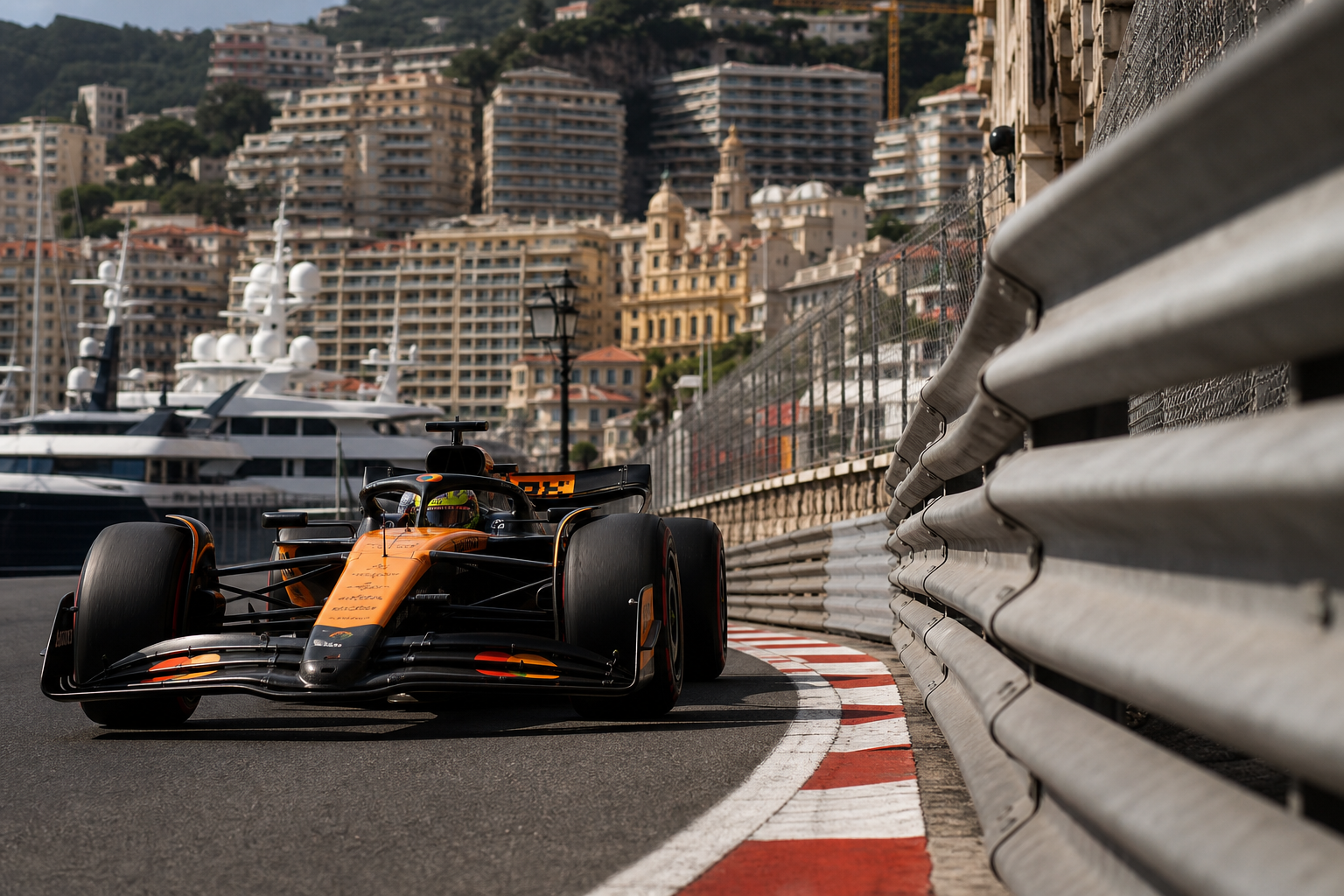

Lando Norris has warned that turning the Monaco Grand Prix into a sprint weekend will make the weekend far less forgiving for drivers who rely on extra running to settle in. In a circuit where confidence, rhythm and precision matter more than raw pace, cutting available track time increases the pressure immediately.
Monaco’s margins are already tiny
Monaco has long been the most uncompromising venue on the Formula 1 calendar. The barriers are close, the asphalt offers limited grip evolution, and overtaking remains one of the sport’s most difficult tasks. That combination means drivers spend much of the weekend learning how much they can trust the car in each corner, from the first laps on Thursday practice through qualifying and the race.
For Norris, the move to a sprint format changes the way that process works. On a conventional Monaco weekend, teams and drivers use the longer build-up to find braking references, refine suspension and tyre preparation, and gradually push closer to the edge. When one of the practice sessions disappears, there is less opportunity to ease into that flow. A small mistake can have a bigger consequence, and a driver may never get the chance to recover the confidence lost from a brush with the wall or a poor set-up direction.
Why Monaco is different from other sprint venues
F1 sprint weekends are already a challenge at tracks where the main priority is maximising one-lap pace and adapting quickly. Monaco is different because there is almost no margin for improvisation. At circuits with wider run-off or more overtaking opportunities, a driver can afford to spend part of the weekend learning the car’s behaviour and still recover. In Monte Carlo, that luxury is largely gone.
Track evolution also plays a much larger role than at many other venues. The surface can improve rapidly as more rubber goes down, which means the balance and grip available on Friday morning may be noticeably different by the time qualifying arrives. Teams usually want as much data as possible to understand how the tyres respond over short and longer runs, especially because Monaco places unusual demands on tyre warm-up and mechanical grip. Reducing track time narrows the amount of information available to engineers and drivers alike.
Why extra running matters to driver confidence
Norris’ concern is not just about lap times. At Monaco, confidence is a performance tool. Drivers need to know exactly how close they can run to the barriers through places such as Sainte Devote, the Swimming Pool complex and the final corner. That confidence is built through repetition, and repetition is what a sprint weekend takes away.
In practice, even a driver at the top level can take several laps to rebuild the sense of commitment required to attack a lap properly. If the car is difficult on the limit, the usual process is to make small adjustments and gradually lean on the front axle or the rear end a little harder. A compressed format makes that process less methodical. The risk is that drivers arrive at qualifying still trying to understand the car rather than already exploiting it.
What it means for teams and strategy
Teams will also have less room to experiment. Monaco set-up decisions often involve trade-offs between ride height, kerb compliance, traction out of slow corners and the confidence needed to place the car within millimetres of the barrier. When there is limited running, each set-up change becomes more valuable and potentially more costly if it sends the car in the wrong direction.
That increases the importance of simulator work and pre-weekend preparation, but Monaco has always been the kind of circuit where the real track can still surprise teams. The bumps, low-speed traction demands and narrow layout make it difficult to reproduce perfectly away from the circuit. A sprint weekend therefore shifts even more responsibility onto preparation before the cars reach Monte Carlo.
A format that suits some venues better than others
F1’s sprint concept was designed to add competitive action across the weekend, but not every circuit reacts to the format in the same way. Tracks with more overtaking opportunities or broader track limits can absorb the reduced practice time more comfortably. Monaco is built around precision rather than flexibility, which is why Norris’ warning feels especially relevant.
For the sport, the question is whether the added spectacle of a sprint race compensates for the loss of the gradual build-up that has traditionally defined the Monaco weekend. For drivers, the answer is more immediate: less track time means fewer chances to explore the car’s limits before the session that matters most.
At Monaco, that can turn a weekend into a single mistake-prone shot at perfection.


0 Comments