
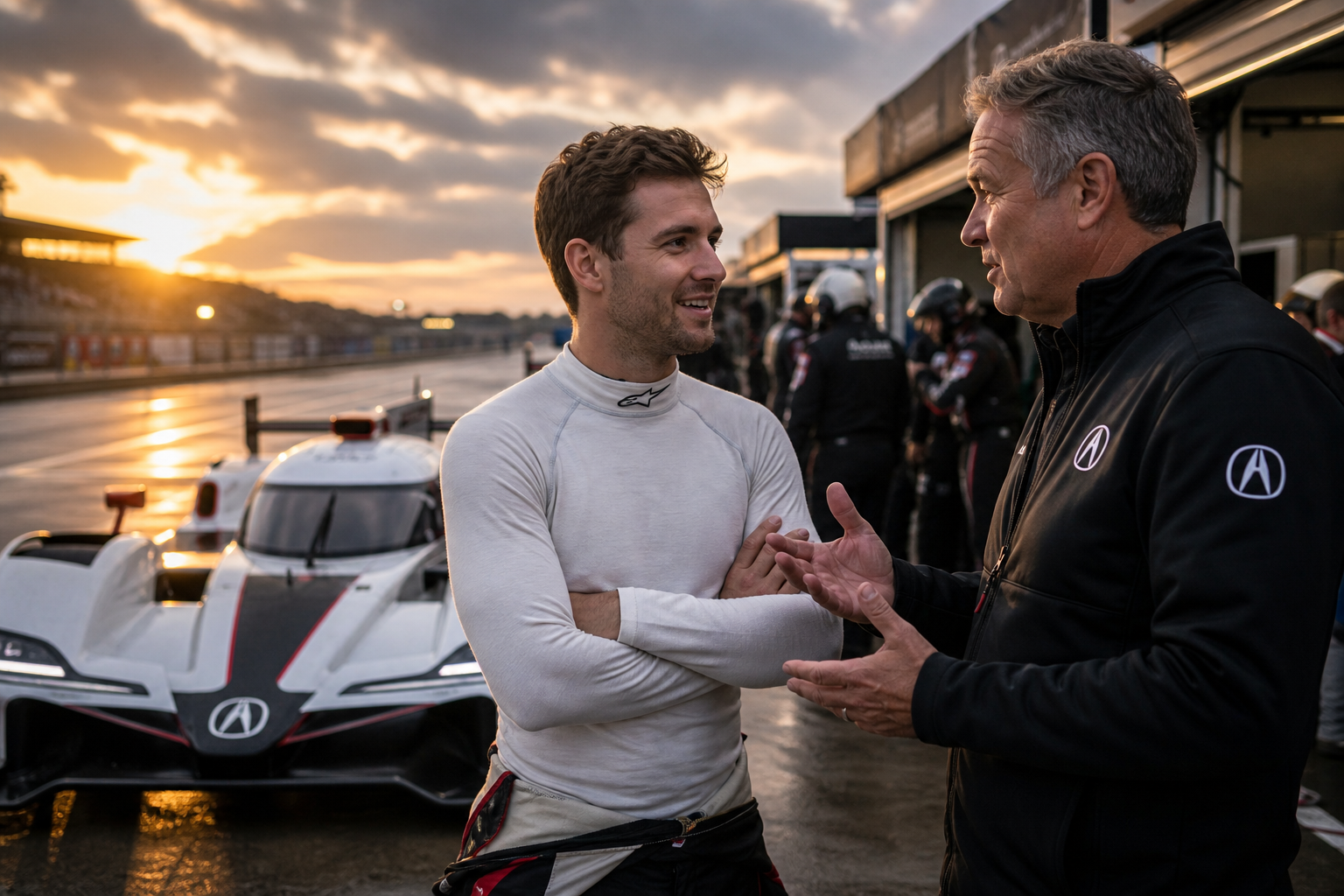

In top-level sports car racing, driver moves are often explained in terms of lap time, results, and manufacturer strategy. But for Nick Yelloly’s switch from BMW to Acura, the story also has a more personal dimension. His decision to leave BMW after the 2024 IMSA WeatherTech SportsCar Championship season was not just a career move; it was shaped by trust, direct communication, and a relationship with David Salters that clearly mattered beyond the usual professional formalities.
That detail says a lot about modern prototype racing. These are not just cars with carbon-fiber bodies and hybrid systems; they are long-term development projects built around people. Drivers, engineers, technical directors, and program managers all influence success, and in endurance racing, continuity and confidence often matter as much as outright pace. Yelloly’s path from BMW to Acura is a reminder that the most important decisions in the paddock are frequently made away from the spotlight.
The role of relationships in endurance racing
Endurance racing is unlike sprint competition. A driver may spend hours in the same car, working through traffic, tire life, fuel strategy, and changing track conditions while also feeding engineers the information needed to improve the package over a race distance. In that environment, a strong relationship with the people shaping the program can be invaluable.
Yelloly’s direct call to Salters reflects a level of trust that is especially important in prototype racing. Teams and manufacturers often move drivers around based on broader program needs, but a known working relationship can make a new opportunity feel less like a gamble and more like a continuation of proven collaboration. For a factory-level driver, that can be a powerful factor when weighing the next step in a career.
It also underscores something fans do not always see: the off-track culture of a race program can be just as important as the machine itself. A competitive seat in IMSA’s top class is valuable, but if a driver believes he is joining a group where communication is straightforward and technical direction is clear, the move becomes easier to justify.
Why Acura matters in the IMSA GTP landscape
Yelloly’s arrival at Acura places him in one of the key manufacturer battles in the IMSA GTP class, which is now the headline category in American sports car racing. The class brings together factory-backed prototypes from multiple brands under a ruleset designed to balance performance while still leaving room for each manufacturer to express its own engineering identity.
Acura has become one of the more established names in the modern GTP field, with its program operated by Honda Racing Corporation USA. For drivers, joining a factory effort like Acura means becoming part of a broader engineering and brand strategy rather than simply racing a single car. It also means working with a team structure built around long-term development, race execution, and the demands of endurance events such as Daytona, Sebring, and Petit Le Mans.
For competitors, the appeal is obvious: a factory seat offers visibility, technical support, and the chance to play a real role in shaping the car’s development. For Yelloly, the move opens a new chapter in the highest tier of North American sports car racing.
What the move says about Yelloly’s career direction
Yelloly’s transition from BMW to Acura is notable because it suggests a driver who is looking beyond short-term convenience. Factory racing careers are built on timing, confidence, and reputation, and a move like this indicates that he values a program where he can be integrated quickly and contribute meaningfully.
Drivers in prototype racing are judged on much more than race results. They must adapt to evolving vehicle platforms, understand the nuances of tire and fuel management, and work within manufacturer priorities that may span multiple championships. A driver who has already earned trust with technical leadership can often transition more smoothly into a new environment, because much of the communication framework is already in place.
In that sense, Yelloly’s move is a practical example of how careers are built in modern motorsport. The best opportunities are not always the loudest; sometimes they are the ones that fit the people as well as the machinery.
The wider significance for manufacturer racing
One of the most interesting aspects of manufacturer racing is that personnel changes often reveal how seriously brands approach continuity. Engineers and drivers come and go, but successful programs tend to retain a clear technical identity and a shared working method. When a team such as Acura brings in a driver with a pre-existing relationship to a senior leader, it is effectively investing in familiarity as much as speed.
That matters because prototype racing is a development game as much as a competition. A driver who can communicate effectively about balance, tire behavior, and setup changes helps the team make better decisions under pressure. The payoff is not always immediate, but over the course of a season, that kind of alignment can influence everything from qualifying pace to race-day consistency.
It is also a reminder that the factory sports car paddock remains one of the most relationship-driven corners of motorsport. Unlike spec series, where machinery is more equalized, manufacturer programs rely on people who can translate data into performance and maintain momentum across a long season.
What fans should watch next
For followers of IMSA, Yelloly’s Acura switch adds another layer of interest to the GTP class. The field is already defined by close manufacturer competition, and driver lineups can be as important as car development in determining which program gains an edge. A new signing can alter the tone of a team instantly, especially when the driver arrives with familiarity, confidence, and factory-level experience.
Fans should also pay attention to how quickly a driver like Yelloly settles into the Acura environment. In endurance racing, adaptation can be measured in small but meaningful ways: how quickly a driver gets comfortable with the car’s balance, how naturally he communicates with engineers, and whether the partnership starts producing strong results in both qualifying and race stints.
Those details may not always make headlines, but they often decide whether a driver change becomes a simple roster update or the foundation for a successful campaign.
Conclusion
Nick Yelloly’s move from BMW to Acura is more than a routine factory transfer. It highlights how much modern sports car racing depends on trust, communication, and the personal connections that sit behind the technical operation. In a category where every detail matters, those relationships can be just as valuable as horsepower or strategy.

0 Comments