
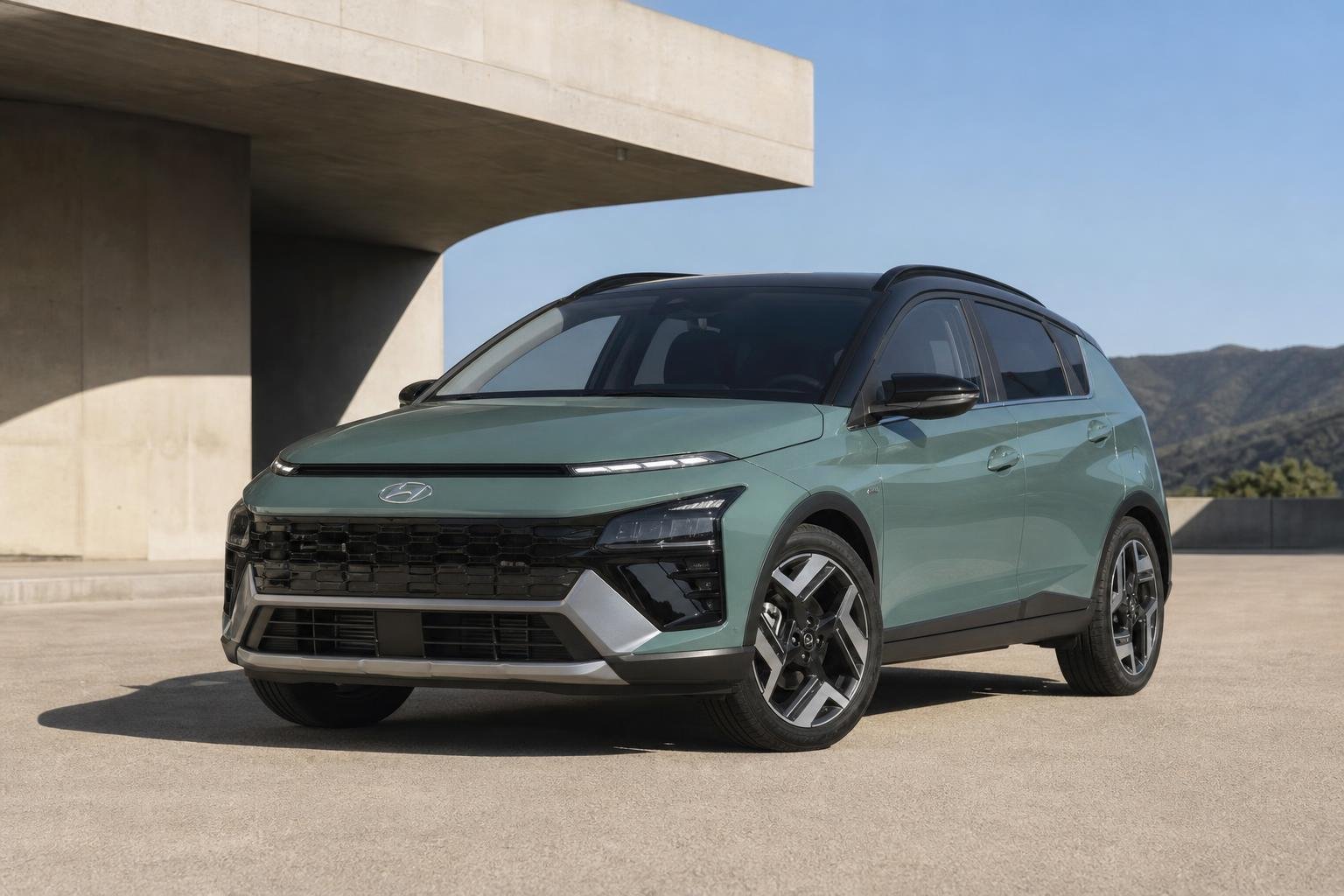

Hyundai has revealed a thoroughly redesigned Bayon at the Paris Motor Show, giving its smallest European SUV a more substantial exterior, a slightly longer wheelbase and a hybrid powertrain option for the first time.
The new Bayon moves away from the softer appearance of the previous model with styling influenced by Hyundai’s “Art of Steel” design language. The changes follow a 2024 facelift but represent a much more extensive redesign, intended to give the crossover a stronger road presence.
Tucson-inspired exterior design
Key styling details include hockey stick-shaped daytime running lights, a higher hood line and more pronounced, box-shaped fender flares. The Bayon name is displayed in large lettering beneath the Hyundai badge on the tailgate.
An N Line version will also be offered for the first time. It adds a sportier body kit, 18-inch wheels and twin tailpipes, while the interior receives N-specific details including red stitching and metal pedals.
The revised proportions make the Bayon appear larger than its predecessor. Its wheelbase grows by 0.8 inches, or 20 millimeters, to 102.4 inches, or 2,600 millimeters. Hyundai also lists several available features that are more commonly associated with larger vehicles, including dual 12.3-inch displays, surround-view parking cameras, ventilated seats and a panoramic roof.
Updated cabin technology
Available equipment includes Hyundai’s Digital Key 2 system, which allows a smartphone to unlock and start the vehicle, along with a Bose premium audio system. The center console retains a bank of physical controls, although the climate functions use touch-sensitive buttons.
The new Bayon does not appear to receive Hyundai’s newer Pleos operating system. It is also not offered with all-wheel drive, meaning every version remains front-wheel drive despite the crossover’s more rugged exterior design.
Three powertrain choices
The entry-level engine is a 1.0-liter, four-cylinder T-GDI producing 89 horsepower, or 90 PS. Buyers can choose between a six-speed manual transmission and a seven-speed dual-clutch automatic.
A higher-output version of the same engine produces 114 hp, or 115 PS, while retaining the same transmission choices. Hyundai lists a 0-to-62-mph time of 10.8 seconds for this version, compared with 14.1 seconds for the base model.
The most significant mechanical addition is a 1.6-liter hybrid system producing 136 hp, or 138 PS. It is paired exclusively with a six-speed dual-clutch automatic transmission. Drivers can adjust the level of regenerative braking using steering-wheel shift paddles.
Hyundai confirms that the hybrid components reduce available trunk space, but the vehicle’s curb weight and performance figures have not yet been provided.
The redesigned Bayon is scheduled to reach Hyundai dealers in Europe in early 2027. It will not be sold in the United States, where the Kona remains Hyundai’s smallest model.
0 Comments