
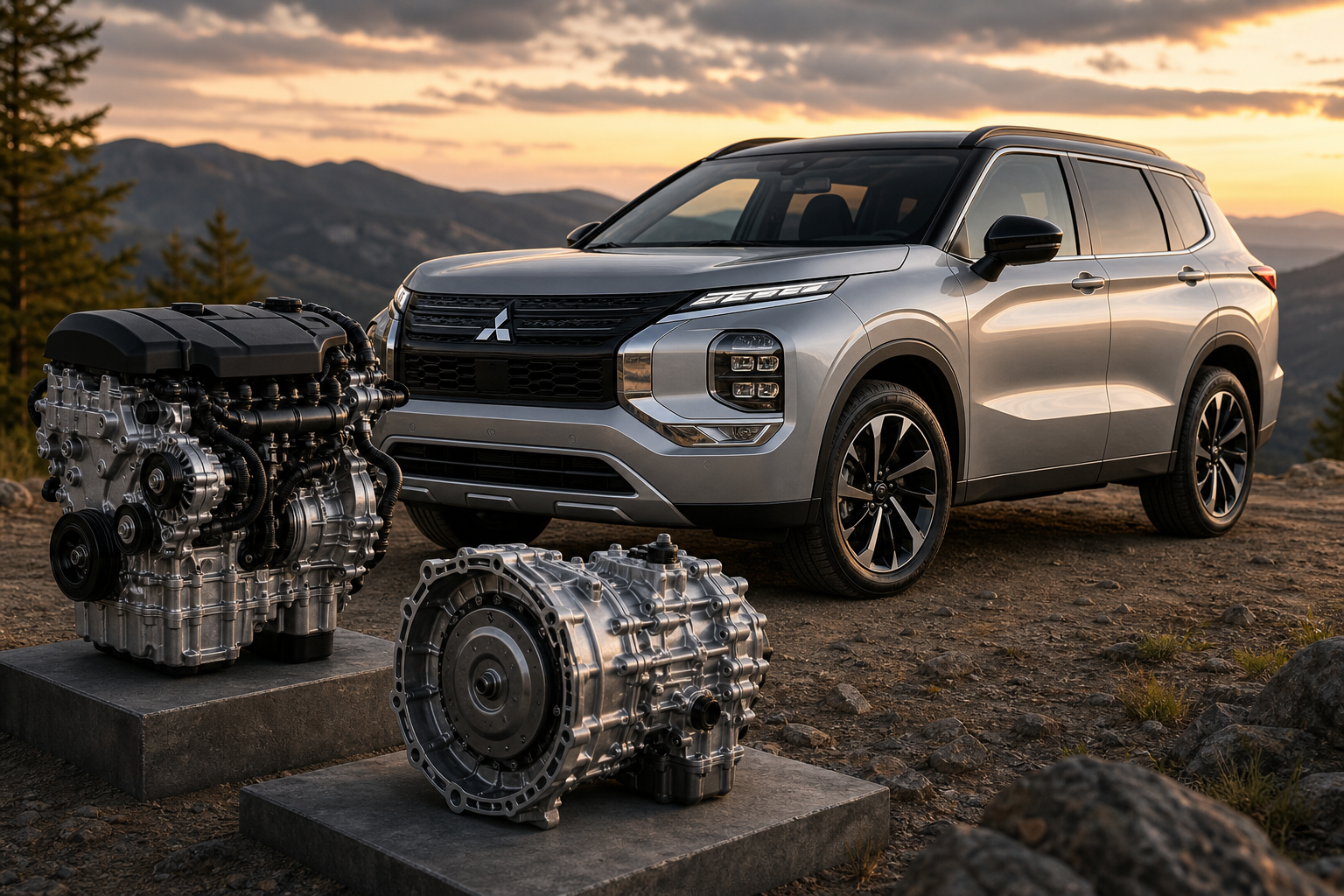

Mitsubishi is preparing a new SUV that will arrive alongside two new engines and transmissions developed and built entirely in-house, a signal that the company is taking greater control over one of the most important parts of any modern vehicle: the powertrain.
On the surface, a new SUV launch is familiar territory. But the decision to pair it with a fully in-house engine and transmission program matters more than it might first appear. For buyers, it can affect everything from how the vehicle drives to how it is serviced and how Mitsubishi positions the model against tougher competition. For the brand, it also reflects a push toward more independence in an industry where many manufacturers increasingly share components, platforms, and drivetrains.
Why in-house powertrains matter
Engines and transmissions shape a vehicle’s character more than almost any other component. They influence acceleration, refinement, fuel use, towing ability, long-term maintenance, and even the way the vehicle feels in everyday driving. By developing both components internally, Mitsubishi can better tune the SUV to suit its intended role rather than relying on a supplier package designed for a wider range of products.
That kind of control can be especially important for an SUV, where buyers tend to expect a broad spread of abilities. Some will want strong low-speed response for urban use, while others will care more about highway comfort, cargo hauling, or all-weather confidence. A dedicated powertrain allows engineers to match the engine and gearbox calibration more closely to the vehicle’s size, weight, and market positioning.
It also gives the company more freedom in future updates. An in-house powertrain can be revised, adapted, or electrified more easily over time than a setup built around externally sourced hardware. In a market moving steadily toward hybridization and greater efficiency, that flexibility can be strategically valuable.
The role of the new SUV in Mitsubishi’s lineup
Mitsubishi’s SUV lineup has long been central to its global identity, with the brand often leaning on rugged, practical vehicles rather than trying to compete head-on in every segment. A new SUV backed by proprietary engines and transmissions suggests that Mitsubishi wants this model to do more than simply fill a space in the showroom. It may need to serve as a volume seller, a technology showcase, or both.
That matters because the SUV market remains one of the most competitive parts of the industry. Buyers compare not only styling and equipment, but also engine smoothness, automatic transmission behavior, fuel economy, cabin space, infotainment quality, and warranty coverage. To stand out, Mitsubishi will need the new model to feel cohesive from the drivetrain up.
What buyers should expect from an in-house engine and transmission program
Although full technical details have not been outlined here, an in-house development approach usually aims to improve the relationship between engine output and transmission response. In practical terms, that can mean cleaner shifts, better throttle response, and a more natural feel when accelerating from a stop or passing on the highway.
For SUV buyers, those characteristics are more than academic. A transmission that hunts for gears or feels hesitant can make a vehicle tiring in daily use, especially in traffic or on hilly roads. Likewise, an engine that feels weak at low revs or overly busy at cruising speeds can undermine comfort. Mitsubishi’s challenge will be to deliver a powertrain that feels well matched to the vehicle’s mission.
There is also the question of efficiency. Modern SUVs are expected to balance performance with sensible fuel consumption, and manufacturers now have to achieve that without making the vehicle feel underpowered. An internally developed transmission can help by keeping the engine in its most effective operating range more often, although real-world results will depend on final tuning and vehicle weight.
Design and practicality remain central to the SUV equation
While the powertrain story is important, it is only one part of the equation. Buyers looking at a new SUV will also judge the vehicle on how well it fits into family life, commuting, and longer trips. Interior packaging, seat comfort, cargo space, visibility, and easy-to-use controls remain core selling points in this class.
Mitsubishi has often targeted practical value in its SUVs, and that should matter here too. A well-executed SUV does not need to be the most luxurious or the quickest in the segment; it needs to offer a sensible blend of space, usability, and operating cost. If the new model is intended to compete broadly, the cabin will need to be straightforward, robust, and thoughtfully laid out.
The powertrain decision may also influence packaging. A transmission designed in-house can be optimized around the vehicle’s underbody and drivetrain layout, potentially helping engineers preserve cabin or cargo space. In a segment where families compare every inch of rear-seat room and luggage capacity, that kind of efficiency can be meaningful.
Competitive pressure in a crowded segment
The SUV market is now crowded with alternatives from nearly every major manufacturer, including vehicles that emphasize efficiency, others that lean into ruggedness, and many that try to offer a little of both. Mitsubishi’s new SUV will need a clear value proposition to earn attention.
Against mainstream rivals, the key battlegrounds are likely to be price, equipment, durability, and everyday ease of use. If the in-house engines and transmissions prove smooth and dependable, Mitsubishi could have a useful advantage in long-term ownership confidence. If not, buyers will quickly notice, because the segment is full of polished alternatives.
For enthusiasts and industry observers, the more interesting angle is how this model fits into Mitsubishi’s broader technical direction. Building engines and transmissions internally is a resource-intensive move, and it suggests a willingness to invest in core engineering rather than relying entirely on shared solutions. That can be a positive sign for a brand looking to sharpen its identity.
Ownership and reliability considerations
For most SUV buyers, reliability and ease of service are just as important as headline power figures. A drivetrain built and calibrated by the same company can sometimes simplify development and support, especially if the manufacturer is able to align parts supply, service documentation, and software updates more closely.
That said, new hardware always brings the usual launch-phase questions. Early-build vehicles can reveal calibration issues or component teething problems that only emerge once the car is in wide use. Buyers interested in a first-year model should pay close attention to warranty coverage, dealer support, and any history the brand has with similar powertrain architectures.
Used buyers, later on, will likely judge the new SUV by the same standards that define the segment as a whole: how well it ages, whether the transmission remains smooth over time, and how costly it is to maintain once the factory warranty has expired. Those are often the factors that determine whether an SUV becomes a dependable used buy or one to approach carefully.
Why this launch matters
Even without full technical specifications, the announcement of a new SUV tied to two in-house powertrains tells us something important about Mitsubishi’s priorities. The company appears to be investing in control, consistency, and long-term flexibility rather than outsourcing key mechanical elements.
That approach can help a brand create a more distinct vehicle, especially in a market where so many SUVs share similar formulas. If the final product delivers a well-tuned drivetrain, sensible packaging, and the kind of value Mitsubishi buyers expect, it could become an important model for the brand’s future.
For now, the most notable takeaway is simple: this is not just another SUV launch. It is also a statement about how Mitsubishi wants to engineer its next generation of vehicles.
Conclusion
Mitsubishi’s upcoming SUV is noteworthy not only because it adds another contender to a crowded segment, but because it arrives with two new in-house engines and transmissions. That gives the brand greater control over performance, refinement, and long-term product development — all crucial factors in today’s SUV market.


0 Comments