
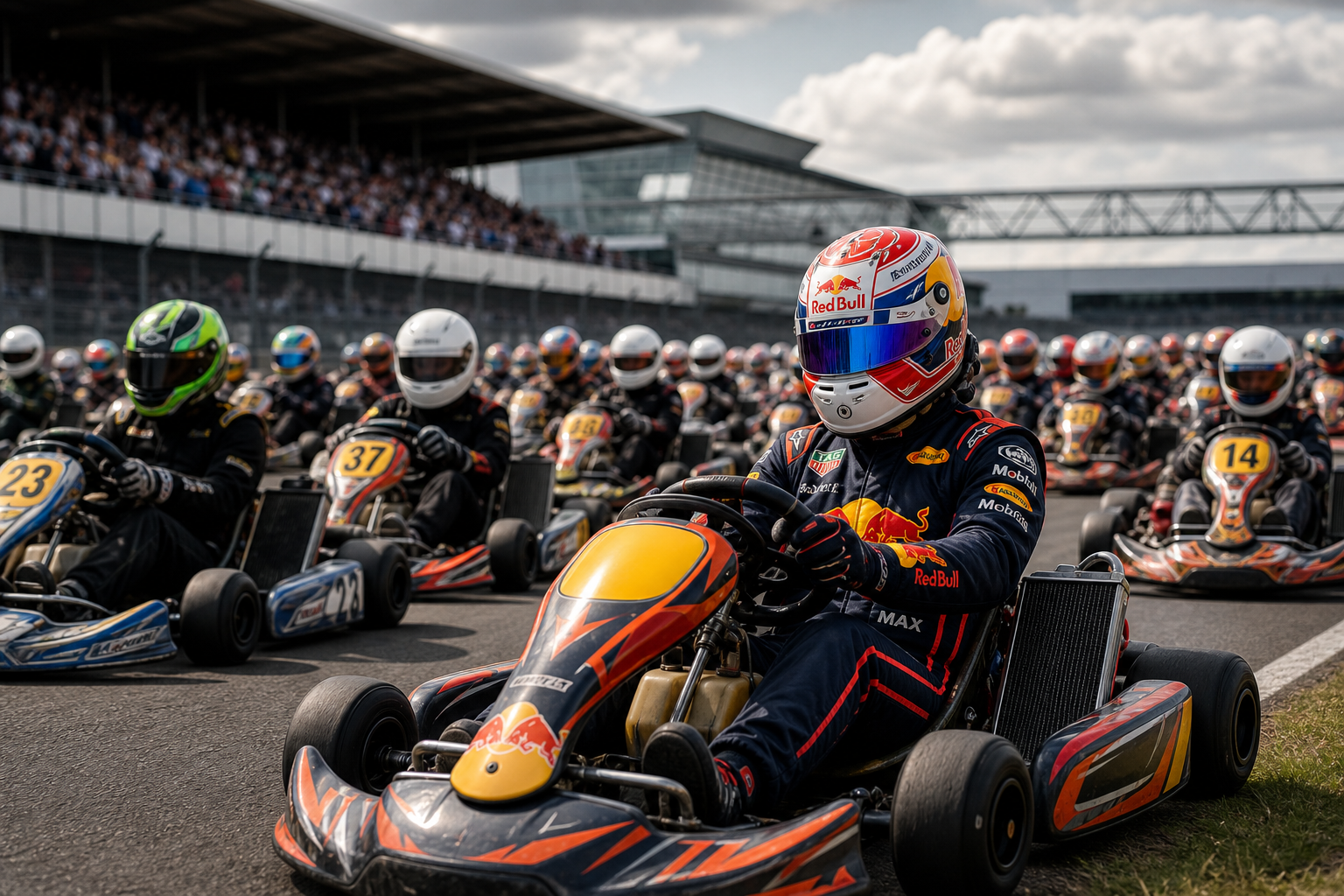

Formula 1’s biggest stars are usually judged by lap times, racecraft and nerves under pressure. At Silverstone, Max Verstappen was asked to do something a little different: start from the back of the grid and work his way through a field of 100 celebrity karters in a one-off Red Bull event designed as much for entertainment as it was for speed.
The result was exactly the kind of controlled chaos that makes motorsport promotion so effective. Verstappen, already one of the most recognisable drivers in the world, turned a playful karting challenge into another display of instinct, precision and traffic management. The concept itself mattered too. Karting remains the foundation of modern racing, and events like this show just how much skill is still required even when the machinery is simple and the stakes are low.
A karting format built for spectacle
Red Bull’s “Max vs 100” format was straightforward but eye-catching: a single elite driver starting from the back against a large group of celebrity participants at Silverstone. That setup created a race that was less about outright lap time and more about finding space, reading traffic and making passes without contact. In that sense, it echoed the logic of junior motorsport more than the drama of a typical exhibition race.
The appeal of the event came from the contrast between competence and crowd pressure. In a field of 100, there is little room for indecision. Even in karts, the opening laps can become a lesson in survival, especially when drivers of mixed experience all converge on the same corner. Verstappen’s task was to navigate that traffic efficiently, minimizing mistakes while using superior racecraft to recover positions.
Why karting still matters at the top level
Karting is often where professional drivers first learn the fundamentals that later define a racing career: braking late without overdriving, keeping momentum through corners, positioning the kart to defend or attack, and reacting instantly to changing circumstances. That is one reason karting-based challenge events continue to resonate with fans. They strip away the technical complexity of Formula 1 and leave the driver exposed to the essentials.
For Verstappen, that background is especially relevant. Like most top-level racers, his early path to single-seaters and eventually Formula 1 was built on karting. Watching him move through a huge field at Silverstone was therefore less about novelty and more about seeing the same underlying instincts that helped shape his career. The kart may be simple, but it still rewards clean inputs, spatial awareness and the confidence to commit.
Silverstone as a fitting backdrop
Silverstone has long been one of motorsport’s most recognisable venues, and even in a lighter format it remains a meaningful stage. The circuit’s racing heritage gives any event added weight, and its association with high-speed competition makes it a natural home for a headline-grabbing challenge involving a Formula 1 world champion. For British fans, the location also adds another layer of familiarity, since Silverstone is central to the country’s motorsport identity.
Although this was not a grand prix, the setting helped elevate the event beyond a simple promotional stunt. In a sport where atmosphere often matters as much as timing data, familiar circuits and distinctive formats can turn a one-off showpiece into something that feels connected to the wider racing culture.
What the event says about driver skill
Any large-grid karting race asks a different set of questions than a single-lap qualifying run. Speed still matters, but only within the limits of clean decision-making. A driver has to judge when to attack, when to wait, and how much risk to take when other competitors around them may be less predictable. That makes the challenge almost tactical, especially in a crowded pack.
Verstappen’s success in the event highlighted a point that applies across motorsport: raw pace is only one part of the equation. The best drivers tend to process situations faster than the rest of the field. They see gaps earlier, place the kart more accurately and make fewer unnecessary corrections. In a race with 100 participants, those small advantages quickly add up.
Why the format works for audiences
For fans, a 100-kart grid creates immediate visual drama. There is always movement, always a battle for position and always the possibility of a surprise. It is easy to follow in broad terms, even if the fine details become chaotic. That makes it ideal for a modern audience that may not watch full-length motorsport races but will engage quickly with a high-concept event.
It also gives the featured driver a clear narrative. Starting from the back creates a built-in challenge that casual viewers can understand instantly. Every place gained feels earned, and every overtake is part of the story. That makes the event easier to market and more satisfying to follow than a standard parade or celebrity race.
Red Bull’s talent for motorsport entertainment
Red Bull has long understood that motorsport coverage does not have to be limited to conventional race weekends. The company has built a reputation for producing attention-grabbing exhibitions, unusual challenges and unconventional content that keeps its drivers visible outside the Formula 1 season or between grands prix. “Max vs 100” fits neatly into that approach.
These events are effective because they combine genuine competition with a lighter tone. The audience gets a charismatic star, a recognizable location and a format that is easy to explain in a few seconds. In a media landscape crowded with short-form content, that kind of structure has obvious value. It also helps reinforce Verstappen’s image as a driver capable of handling almost any racing situation, even when the setting is playful rather than elite.
Why enthusiasts will care
For dedicated automotive and motorsport fans, the appeal goes beyond celebrity participation. Karting has always been the purest form of racing in many respects: light machinery, close competition and the driver exposed to every mistake. Seeing a world champion operate in that environment is a reminder of how much of racing depends on fundamentals rather than exotic hardware.
The event also offers a useful counterpoint to Formula 1 itself. At grand prix level, everything is wrapped in aerodynamics, strategy and engineering complexity. In karting, there is nowhere to hide. That contrast helps explain why these challenges continue to attract attention. They reduce motorsport to its most accessible form while still allowing fans to see the sharpest drivers at work.
Final thoughts
Max Verstappen’s win in Red Bull’s “Max vs 100” event at Silverstone was more than a quirky headline. It was a reminder that racing skill is still most visible when the tools are simple and the field is crowded. In a chaotic karting environment, the same qualities that define elite single-seater racing still matter: judgment, patience, timing and confidence.
For fans, the event delivered exactly what it promised: entertainment with a genuine competitive edge. For Verstappen, it added another demonstration that the instincts required to win at the top of motorsport begin long before a Formula 1 car is involved.

0 Comments