
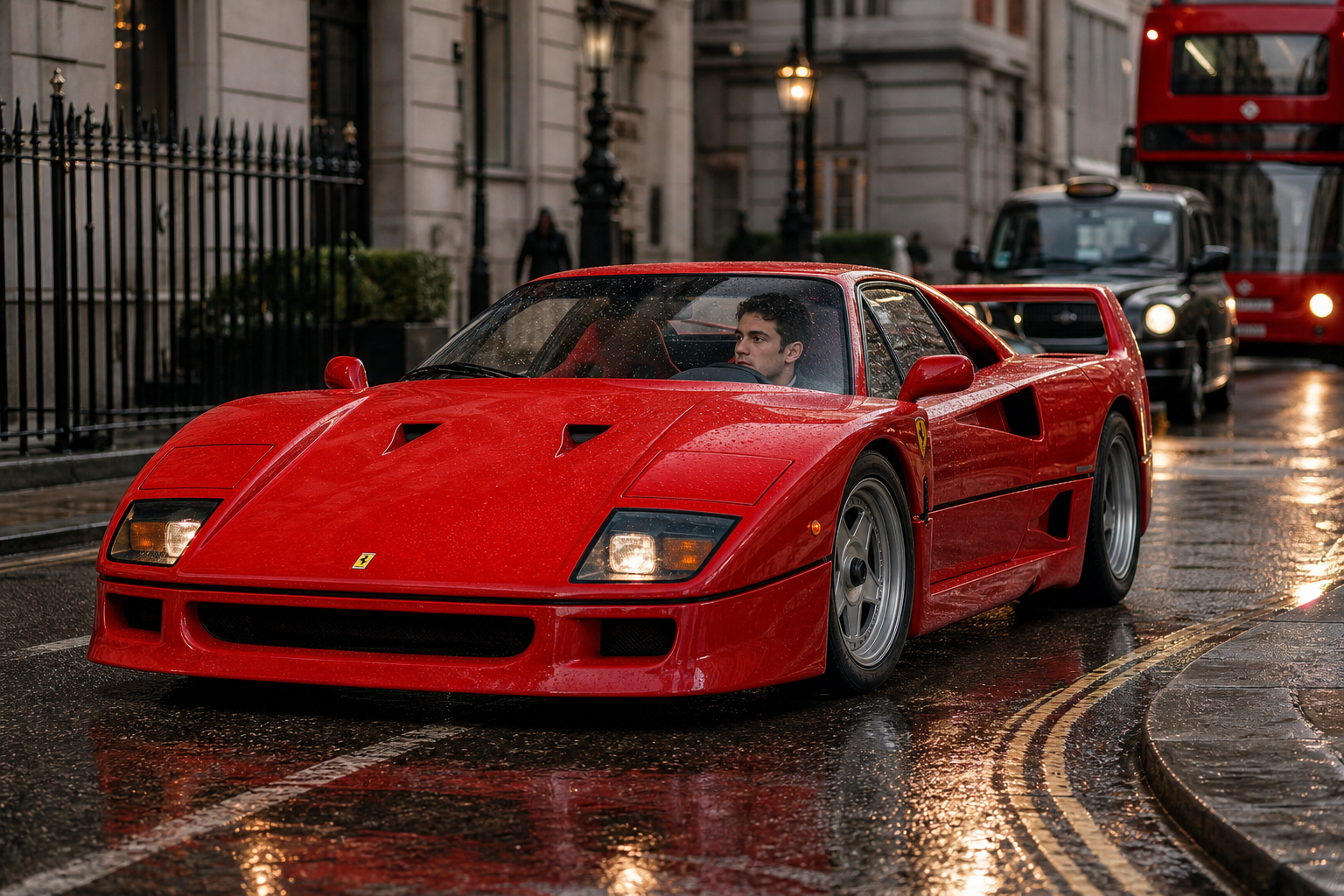

Lando Norris has been seen back behind the wheel of his Ferrari F40 in London, a sighting that confirms the iconic supercar has returned to the road after a crash earlier in 2025. For a car as rare and celebrated as the F40, any incident attracts attention. Seeing it out again, and apparently in use, is the reassuring part.
The F40 returns after a difficult start to the year
Norris’s F40 was damaged in January 2025 on the roads outside Monaco while he was away. According to the account that emerged after the incident, a friend was driving at the time when the car lost traction exiting a left-hand corner and made contact with a barrier. The damage was enough to put the car out of circulation for a period, but the latest London sighting suggests the restoration or repair work has been completed and the Ferrari is back in service.
That matters because the F40 is not just any valuable classic. It is one of Ferrari’s most revered road cars, a machine that still carries enormous weight among collectors and enthusiasts more than three decades after production ended. Built to celebrate Ferrari’s 40th anniversary, the F40 became the last road car personally approved by Enzo Ferrari and one of the defining supercars of its era.
Why the Ferrari F40 remains such a significant car
Launched in 1987, the F40 arrived with an uncompromising specification that helped cement its reputation. Ferrari used a twin-turbocharged 2.9-litre V8, a lightweight chassis, minimal sound deadening and a deliberately stripped-back cabin to create a car focused on speed and mechanical intensity rather than comfort. Period figures quoted for the car included 478 hp, which was extraordinary for the time and enough to propel the F40 into supercar folklore.
Its rawness is a big part of the appeal. There’s no modern stability control, no sophisticated driver aids and no attempt to make the car behave like a grand tourer. The F40 asks a driver to pay attention, which is one reason it remains so highly regarded by collectors who prefer a machine with a direct, analogue character. It’s also why a moment of carelessness on a public road can become expensive very quickly.
Scarcity and value make any incident noteworthy
Part of the reason the Monaco crash drew so much attention is the F40’s status as a limited-production Ferrari. Fewer than 1,400 examples were built, and surviving cars tend to occupy serious money in today’s market. Even modest repairs can become significant due to the cost of genuine parts, the challenge of preserving originality and the need for specialist bodywork on a car with this kind of value.
That makes the London sighting more than a celebrity-car moment. It is a sign that one of Ferrari’s landmark models has been returned to road use rather than left as a damaged collector’s item. For enthusiasts, that’s the preferable outcome, especially with a car designed to be driven and experienced rather than sealed away indefinitely.
A rare public appearance for a modern F1 champion’s classic Ferrari
Norris has built a reputation not only as one of Formula 1’s leading drivers but also as someone with an obvious appreciation for interesting road cars. The F40 fits neatly into that image. It’s an old-school Ferrari with genuine motorsport-derived character, a car that rewards commitment and punishes sloppiness in equal measure.
Seeing it on the streets of London also serves as a reminder that even the most cherished classics are not immune to the realities of road use. Mechanical sympathy, proper preparation and careful driving matter just as much with a 1980s halo Ferrari as they do with any other high-performance car. In the F40’s case, the stakes are simply much higher.
For a car that has spent much of its life as a poster icon, the return to the road is the important part. The F40 was built to be driven, and after a headline-grabbing detour in early 2025, it appears Norris’s car is doing exactly that again.


0 Comments