
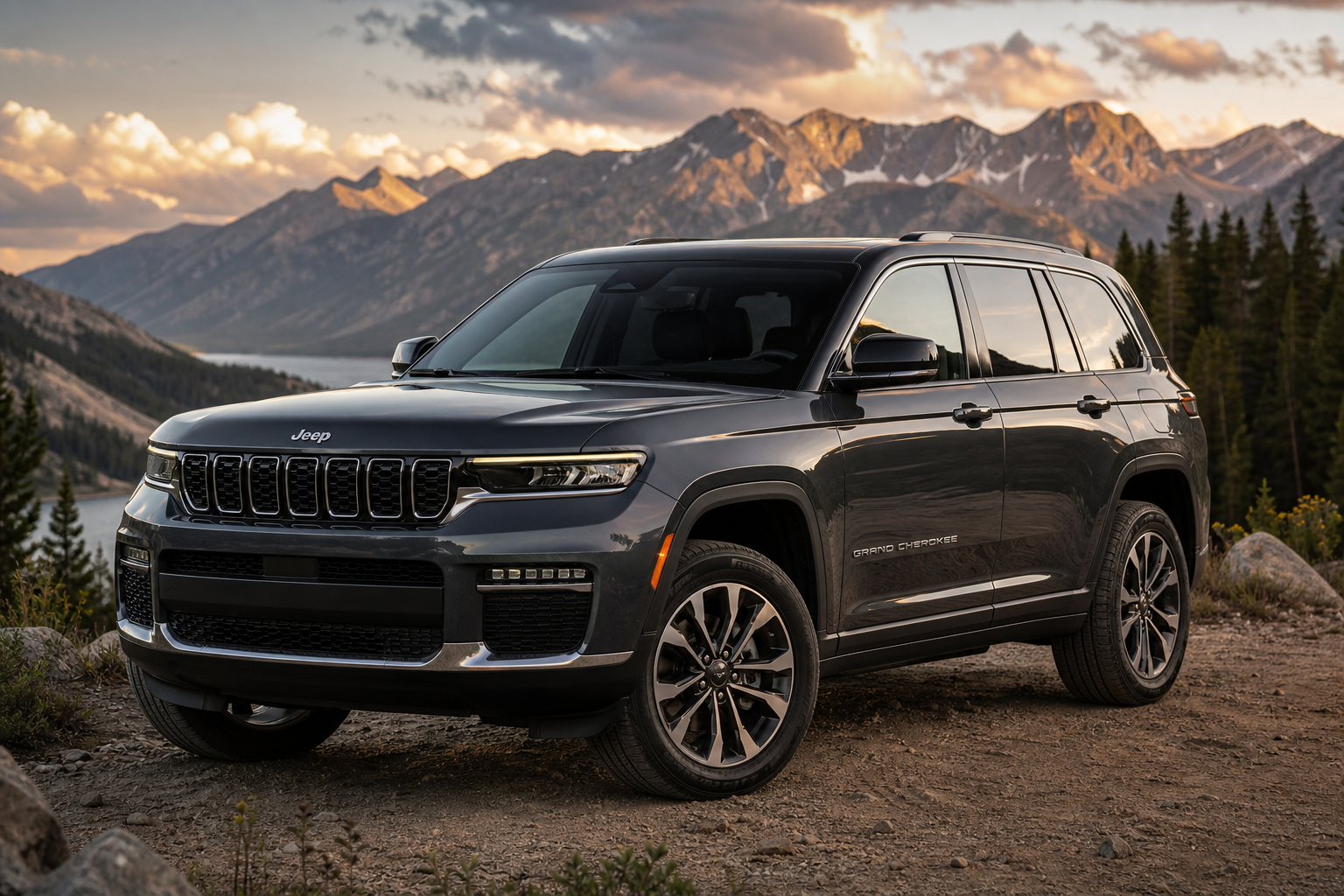

The Jeep Grand Cherokee could be getting the engine its size and mission have been quietly asking for: Stellantis’ Hurricane inline-six. If the plan reaches production for the 2028 model year, the big Jeep would gain substantially more muscle than the current V-6 and turbocharged four-cylinder offerings, with towing capacity expected to benefit as well.
That is the useful bit of news. The less useful bit is that the details remain thin. Jeep has not announced final output, pricing, fuel-economy figures, availability, or a confirmed launch date. Still, the possibility makes mechanical sense. The Grand Cherokee is a substantial two-row SUV, and while the Pentastar V-6 has served it faithfully, “faithful” is not always the same as “brimming with enthusiasm.”
Why the Hurricane Six Fits the Grand Cherokee
The Hurricane is Stellantis’ modern turbocharged inline-six engine family, developed to provide V-8-like performance without actually being a V-8. The engine is offered in different tunes and applications across the company’s larger vehicles, including Jeep and Ram products. Its defining traits are forced induction, strong torque, and a configuration naturally suited to smooth power delivery.
An inline-six is also a rather elegant mechanical solution. Its cylinders fire in an inherently balanced arrangement, which helps produce the sort of silky response traditionally associated with larger luxury engines. Add turbocharging and modern engine management, and there is ample opportunity to deliver useful torque at low and midrange speeds rather than forcing the driver to rev the engine into next Tuesday.
That matters in a Grand Cherokee because its engine has to do more than move the SUV away from stoplights. It may be asked to haul passengers, luggage, a trailer, or all three at once. The current V-6 can handle ordinary family duties, but a stronger six-cylinder would give the Grand Cherokee more reserve when merging onto a freeway, climbing a grade, or pulling a loaded trailer.
More Towing Muscle, Without the V-8 Question
The source of this report specifically points to an improvement in towing capacity. Jeep has not yet revealed how much additional capacity the Hurricane-powered Grand Cherokee would gain, so any precise figure would be guesswork dressed in a tie.
Even without a number, the engineering logic is straightforward. A turbocharged inline-six can produce considerably more torque than a naturally aspirated V-6, and that torque is the currency that matters most when an SUV is dragging weight uphill. The transmission, cooling system, driveshafts, axles, brakes, and suspension would all need to be calibrated for the extra output, but the basic purpose is clear: make the Grand Cherokee a more convincing tow vehicle without resorting to a traditional V-8.
That could give Jeep a useful middle ground. The Grand Cherokee would remain more manageable and less extravagant than a full-size three-row SUV, while offering more capability than the entry-level powertrains. It is the sort of upgrade that sounds less glamorous than a wild horsepower claim but is far more relevant to someone actually using the vehicle.
How It Would Sit Above the Current Engines
The Grand Cherokee currently uses the familiar Pentastar V-6, while the lineup also includes a turbocharged inline-four application. The V-6 is simple in concept and well understood, but its naturally aspirated layout does not produce the same low-speed shove as a modern turbocharged engine with substantially greater displacement and output.
The turbo four-cylinder brings a different set of advantages, including a smaller footprint and the potential for better efficiency. It also has to work harder in a large SUV, particularly when the vehicle is fully loaded or towing. The Hurricane six would therefore be positioned as the premium combustion option: more effortless than the four-cylinder and more powerful than the V-6.
That does not mean it will automatically be the sensible choice for every buyer. A larger turbocharged engine brings greater complexity and, depending on calibration and driving conditions, potentially higher fuel consumption. A buyer who spends most of the week commuting alone may find the smaller engine perfectly adequate. Someone regularly towing a boat or enclosed trailer will have a stronger argument for the six.
The Grand Cherokee’s Powertrain Strategy Is Getting More Complicated
Jeep’s broader powertrain strategy already reflects the awkward transition taking place across the industry. Manufacturers are trying to offer better efficiency, electrification, strong performance, and serious towing ability at the same time. These goals do not always get along particularly well. A large SUV that can tow confidently is unlikely to behave like a compact economy car, no matter how enthusiastically the brochure discusses efficiency.
The Hurricane inline-six gives Stellantis another way to cover that spread. It preserves a gasoline-powered option for customers who want range, quick refueling, and familiar long-distance usability, while producing the sort of performance once associated with a V-8. For Jeep, that is especially useful because the Grand Cherokee sits between mainstream family transportation and genuine off-road hardware. It needs enough muscle to justify its size without turning every version into a fuel-consuming extravaganza.
What Has Not Been Confirmed
There is no confirmed horsepower figure, torque rating, towing number, price, trim level, or production specification for the proposed 2028 Grand Cherokee application. It is also unclear whether the inline-six would be offered across the lineup or reserved for higher trims and four-wheel-drive models.
The final engine tune will matter. Stellantis has used different versions of the Hurricane six, and a Grand Cherokee calibration could prioritize smoothness, towing durability, or outright acceleration depending on Jeep’s target. Cooling and transmission tuning will be just as important as the headline output. A big number on a specification sheet is entertaining; sustained performance while towing through heat is rather more useful.
For now, the prospective Hurricane-powered Grand Cherokee looks like a logical answer to a familiar complaint. The current SUV has the size and capability to make better use of a stronger engine, and the inline-six offers that extra muscle without requiring Jeep to bring back a traditional V-8. If the 2028 model arrives as suggested, the Grand Cherokee may finally have a powertrain that feels properly matched to its ambitions rather than merely adequate to its curb weight.
0 Comments