

{
“parameters”: {
“resource”: “post”,
“operation”: “create”,
“title”: “=Hyundai Plans Level 2+ Driver-Assist Tech for 2028 as It Builds Toward Full Autonomy”,
“additionalFields”: {
“content”: “=
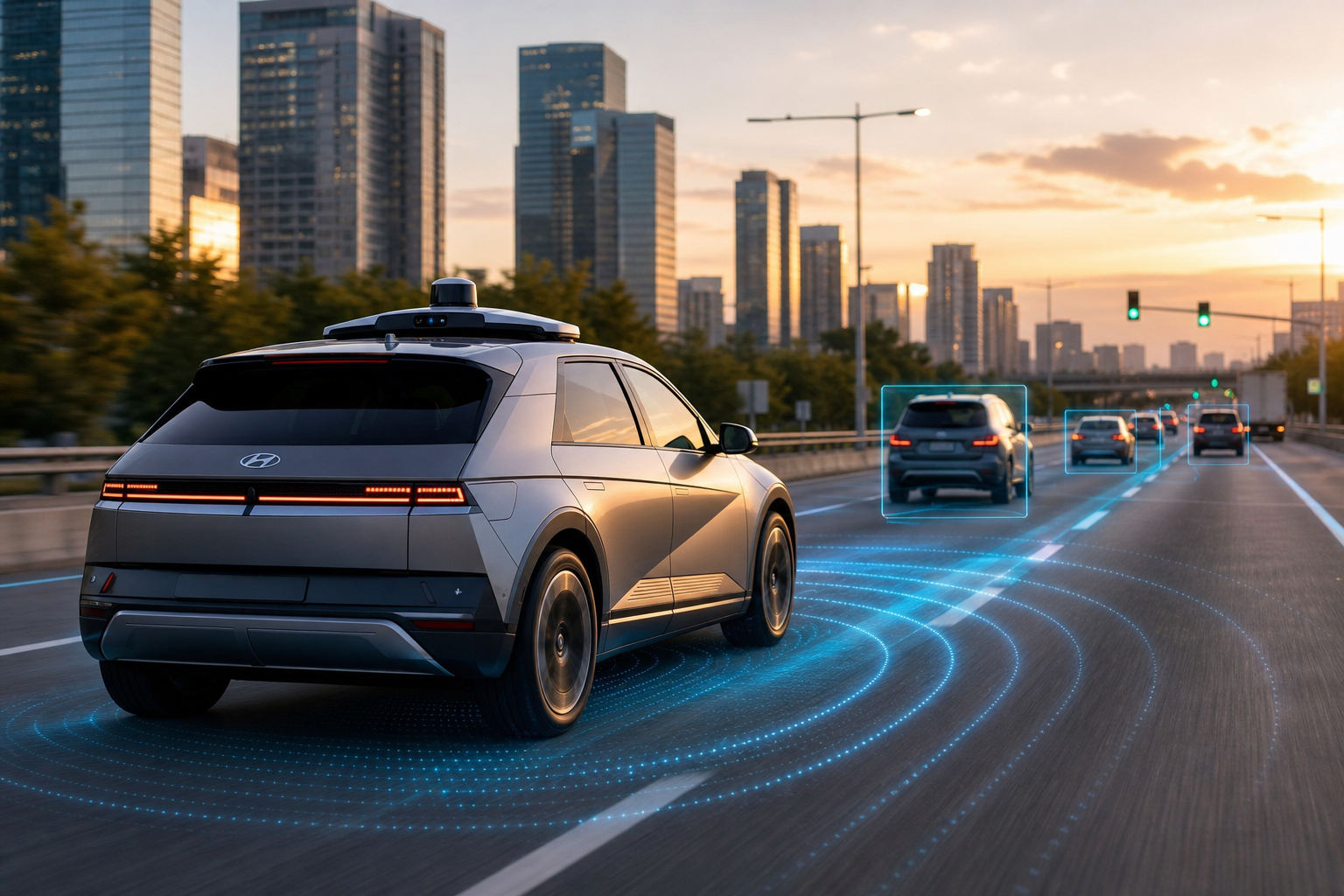
Hyundai is taking another measured step toward automated driving, with a plan to introduce a Level 2+ system in 2028 before pushing further into higher-level autonomy. The timing matters because it shows the company is still treating autonomous technology as a gradual engineering program rather than a single leap, and it also reveals how much Hyundai intends to lean on real-world driving data to get there.
That data-gathering piece is central to the strategy. Hyundai wants to collect driving information and feed it into its autonomous-development pipeline, using the kind of large-scale learning process now common across the industry. For carmakers working on advanced driver assistance and self-driving systems, the challenge is not just building software that works in a controlled environment. It’s teaching that software to handle the unpredictable behavior of traffic, weather, road markings, intersections, and human drivers.
What Level 2+ Means in Practice
The term Level 2+ is important because it sits between conventional driver assistance and more ambitious autonomous systems. It generally refers to an enhanced version of today’s partial automation setups, with stronger lane-centering, adaptive cruise control, and more capable driver monitoring or hands-free functions depending on how the system is defined and approved in a given market. The driver still remains responsible, but the car can take on a broader share of routine tasks than a standard Level 2 package.
For Hyundai, a Level 2+ rollout in 2028 would fit the industry pattern of building customer familiarity with increasingly capable systems before moving to higher levels of autonomy. That approach also makes technical and commercial sense. It allows manufacturers to refine sensing, mapping, software validation, and machine-learning tools on production vehicles while keeping the regulatory and liability burden closer to today’s familiar driver-assistance framework.
Why Data Collection Matters
Autonomous systems improve through exposure to real-world scenarios, and that’s where Hyundai’s data strategy becomes significant. Test tracks and simulations are essential, but they can only model so much. Road closures, sudden cut-ins, lane fades, ambiguous signage, and odd local driving habits are the sort of edge cases that teach a system how to behave when a situation falls outside the idealized lab environment.
Hyundai’s plan to harvest driving data suggests the company is trying to accelerate that learning cycle. The larger the data set, the more varied the training material available to the software teams working on perception, prediction, and decision-making. That doesn’t guarantee a breakthrough on its own, but it is the foundation for any serious autonomous program. No manufacturer can shortcut the development process if it wants a system that can operate reliably across a wide range of real roads.
Hyundai’s Broader Autonomous Ambitions
The move also fits Hyundai’s wider technology direction. Like other major global manufacturers, the company has been building out a portfolio of driver-assistance features with the long-term goal of moving toward more autonomous capability. That progression usually starts with lane-keeping and adaptive cruise, expands into more integrated highway-driving functions, and eventually feeds into the hardware and software architecture needed for higher levels of automation.
For Hyundai, the appeal is not limited to engineering prestige. Advanced driver-assistance systems are increasingly part of the competitive baseline in mainstream and premium segments alike. Buyers now expect more than simple emergency braking and blind-spot monitoring. They want the car to reduce workload on commutes and highway trips, and manufacturers that can deliver polished, dependable systems have a real advantage in product perception.
The company’s 2028 target also gives it time to align the necessary pieces: sensor packages, compute power, software calibration, validation procedures, and the regulatory approvals that will vary by market. That matters because a system that works in one region can’t simply be copied and pasted into another. Road geometry, lane marking quality, traffic laws, and driver behavior all influence how an automated driving feature is designed and launched.
The Road Ahead Is Still Incremental
Hyundai’s timeline suggests the company is not rushing to promise full autonomy before the technology is ready for the real world. A Level 2+ system in 2028 would still leave the driver in the loop, but it would represent a meaningful step toward a more capable automated future. The bigger challenge, as always, is turning data into a system that feels natural, consistent, and trustworthy when it leaves the controlled environment of development and lands in everyday traffic.
That is where the next few years will matter most. If Hyundai can use its growing data set to sharpen the performance of its advanced driver-assistance technology, the company will be better positioned for the longer transition toward higher-level autonomy. For now, the 2028 plan shows a manufacturer laying groundwork carefully rather than chasing headlines.
“,
“status”: “publish”,
“featuredMedia”: “=419”
}
},
“type”: “n8n-nodes-base.wordpress”,
“typeVersion”: 1,
“position”: [
0,
0
],
“name”: “Create a post”,
“credentials”: {
“wordpressApi”: {
“name”: “SaperAuto.com WordPress API Connector”
}
}
}
0 Comments