
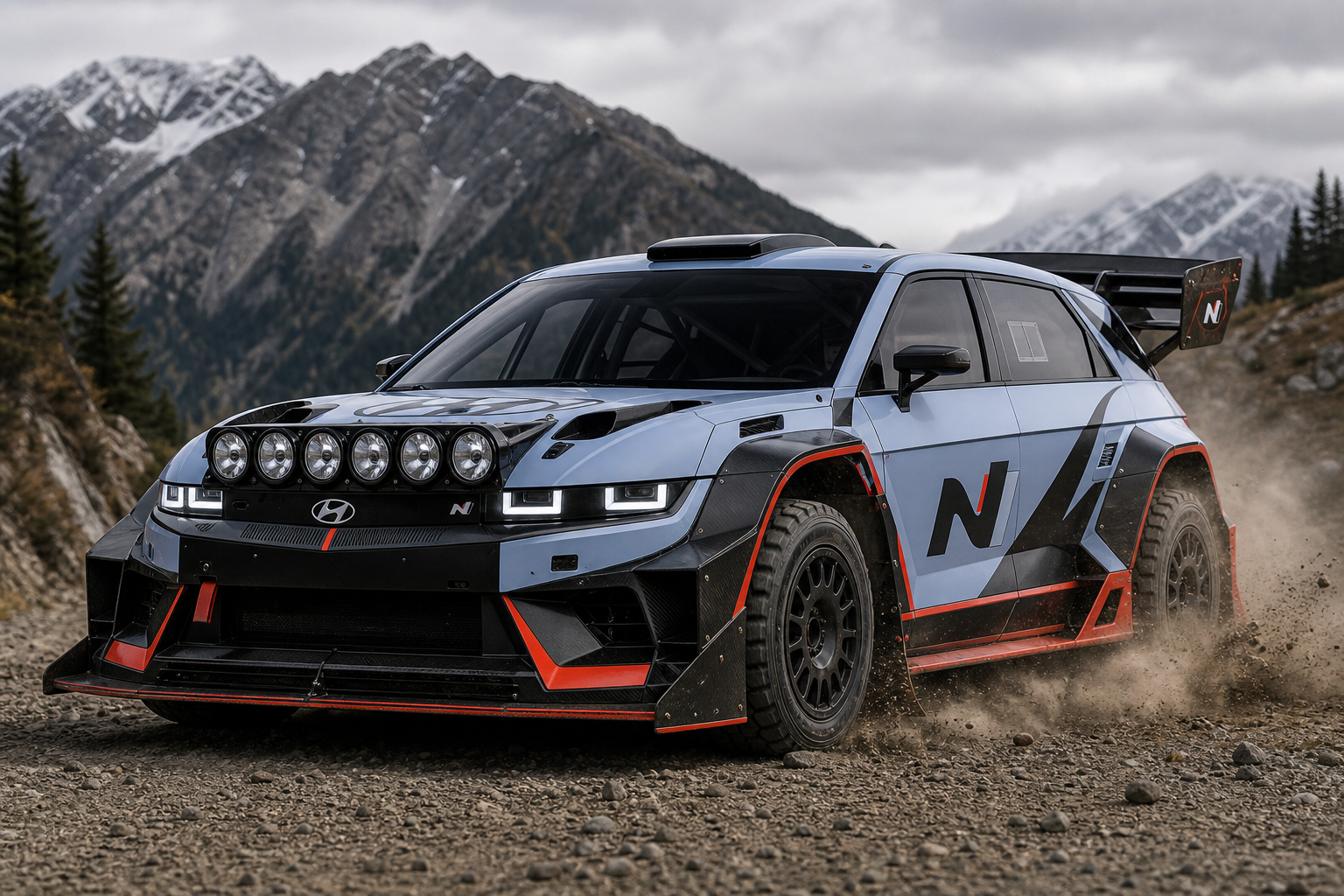

The Hyundai Ioniq 5 N is already one of the more outrageous performance EVs on sale, but digital artist Khyzyl Saleem has pushed the concept into much wilder territory. His latest rendering transforms Hyundai’s electric hot hatch into a Group B-inspired rally car, complete with extreme aerodynamics and a motorsport stance that looks ready for loose surfaces, even if the real car is built for track duty and road use.
A familiar performance EV, reimagined for rally fans
Hyundai’s N division has spent the last few years building a reputation for cars that feel intentionally mischievous rather than polished to death, and the Ioniq 5 N is the clearest expression of that strategy so far. It combines a dual-motor all-wheel-drive layout, aggressive chassis tuning, and software features aimed at making an EV feel more involving on circuit. Saleem’s design takes those cues and exaggerates them into something that looks like it has been developed for a privateer WRC program.
The base car matters here because it already has the proportions that suit a radical body kit. The Ioniq 5’s boxy silhouette, short overhangs and upright cabin give designers plenty to work with. In stock N trim, it’s a striking road car. In Saleem’s hands, it becomes a much more theatrical rally special, one that leans heavily into the legacy of Group B machinery without trying to imitate any single car directly.
Group B cues without the nostalgia trap
The Group B era is still the reference point for wild rally design. Flaring arches, oversized wings, exposed aero and absurdly serious bodywork defined that period, and Saleem has borrowed those ingredients liberally. The result is a design language that feels familiar to anyone who knows the Lancia Delta S4, Audi Sport Quattro S1 or Peugeot 205 T16, while still being anchored by the Ioniq 5’s modern EV structure.
Rather than simply slapping rally lights on an EV crossover and calling it a day, the rendering appears to reshape the car around the idea of competition use. The stance is lower and more aggressive, the bodywork wider, and the overall presentation far more focused than the production car. It’s the kind of fantasy build that works because it respects the drama of rally history while taking full advantage of the Ioniq 5 N’s already unconventional personality.
The appeal of Hyundai’s N platform
Hyundai has been steadily broadening the appeal of its N performance sub-brand, and the Ioniq 5 N sits at the center of that push. Unlike a traditional hot hatch, it doesn’t rely on an engine note, manual gearbox or limited-slip differential to create character. Instead, it uses electric power, sophisticated software and aggressive calibration to make the driving experience feel more visceral than many buyers expect from an EV.
That gives designers and enthusiasts room to imagine what the car could become in a motorsport context. Hyundai already has a serious rally pedigree through its World Rally Championship program, and the brand’s performance division has the engineering credibility to make an image like this resonate. Saleem’s concept is not a prediction of an actual rally program, but it does tap into a brand identity that Hyundai has spent years building.
Why this rendering stands out
Digital renderings of performance cars are everywhere, but not all of them say anything interesting about the underlying machine. This one does. The Ioniq 5 N is unusual because it is a heavy, high-riding EV that somehow behaves like a proper enthusiast car, and the rally treatment highlights that contradiction. It asks a simple question: if Hyundai wanted to take its most extreme EV and turn it into a competition-style icon, how far could it go?
Saleem’s answer is: very far. The aero package pushes the car into concept territory, but it doesn’t feel disconnected from the source material. Instead, it amplifies the parts of the Ioniq 5 N that already make it distinctive. That’s a stronger idea than simply lowering the ride height and adding a wing, because it treats the car as a platform for something much more ambitious.
What it says about the Ioniq 5 N
The fact that the Ioniq 5 N can support this kind of reinterpretation says a lot about Hyundai’s design and product strategy. The car is not just a fast EV with some N badges attached; it has a visual identity and technical character strong enough to inspire alternative futures. In an era when many performance EVs risk looking interchangeable, that’s a useful distinction.
Whether Hyundai ever decides to build a proper rally-inspired electric project remains to be seen. For now, Saleem’s rendering exists as a convincing piece of automotive imagination, and one that suits the Ioniq 5 N better than many more literal conversions would. The car’s squared-off shape, motorsport-leaning personality and all-wheel-drive hardware make it an unusually good candidate for this sort of fantasy, which is probably why the idea lands so well.

0 Comments