
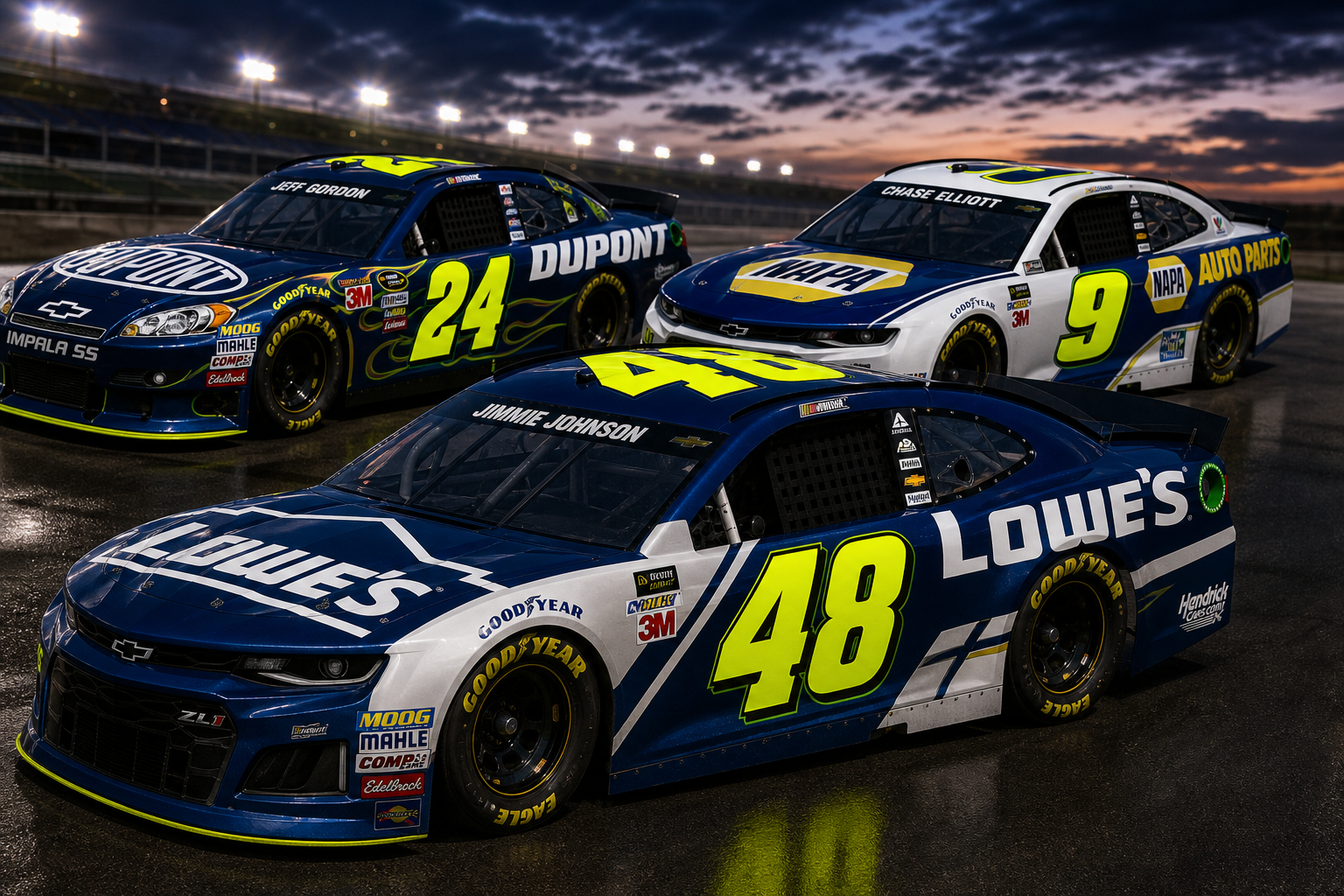

Hendrick Motorsports is preparing to reconnect with one of the most recognizable visual cues in NASCAR history: the neon yellow car numbers that became part of its championship identity. The team hasn’t formally detailed every piece of the plan, but the move points to a deliberate nod to the eras when its most successful cars were instantly identifiable from a distance.
That yellow number treatment is closely tied to some of the most dominant stretches in modern Cup Series history. Jimmie Johnson’s five straight championships from 2006 through 2010 all came with the bright No. 48 on the door of his Hendrick Chevrolet. Jeff Gordon’s four Cup titles were also earned with a yellow No. 24, and Chase Elliott’s championship run carried the same visual signature. For a team that has built a large part of its brand around continuity, the return of that number style is more than a cosmetic tweak. It reaches back into one of the most successful identities in stock car racing.
A look that became part of Hendrick’s winning era
In NASCAR, paint schemes come and go quickly, but certain details stick in memory because they were attached to dominant teams and marquee drivers. Hendrick’s neon yellow numbers fit that description. They were easy to spot under track lighting, they stood out on television, and they became inseparable from some of the organization’s biggest accomplishments.
The team’s success with that presentation helped make it a visual shorthand for winning. Fans could recognize a Hendrick car even before reading the sponsor on the hood. That kind of brand consistency matters in a series where liveries often change from race to race and where visual identity can become part of a team’s legacy.
Why a number color matters in NASCAR
To casual observers, a number color might sound like a small detail. In NASCAR, it’s anything but. Numbers are central to the sport’s identity, and teams often use font, placement, outline, and color to build recognition across seasons. Hendrick’s yellow numbers worked because they were bold without being complicated. They also gave the team a consistent visual element across different drivers and sponsorship eras.
That consistency is one reason the look is remembered so clearly. Gordon, Johnson, and Elliott each came to the program in different moments and under different competitive circumstances, but the number treatment tied their cars together in the public imagination. When a team maintains that kind of visual thread over decades, the design becomes part of its history, not just its graphics package.
The significance of a 2027 return
Bringing the neon yellow numbers back for 2027 suggests Hendrick wants to acknowledge that history rather than treat it as something confined to the past. NASCAR teams often lean heavily on heritage when the sport’s visual language shifts, and this is a natural place for Hendrick to do it. The organization has won more races and championships than any other team in NASCAR history, so its design choices carry extra weight.
For the team, reviving the yellow numbers can serve multiple purposes at once. It reconnects current programs with championship-winning years, reinforces brand recognition, and gives the next generation of Hendrick cars a visual link to the organization’s most decorated chapters. In a sport where identity is built as much by what fans remember as by what they see on track, that matters.
Part of a broader legacy
Hendrick’s history is built on more than one iconic car, but the neon yellow number era stands out because it crossed multiple drivers and several championship cycles. That kind of continuity is rare in modern NASCAR, where sponsorship changes, manufacturer updates, and shifting liveries can make team branding feel fragmented from year to year.
The expected 2027 return also reflects how NASCAR teams increasingly treat heritage as an asset. Fans respond strongly to designs that recall championship seasons or defining eras, and teams know that familiar visual cues can create an immediate connection. In Hendrick’s case, the yellow numbers are tied to some of the most successful years any organization has ever produced, which makes the choice especially fitting.
Even without the full details of how the numbers will be reintroduced, the intent is clear. Hendrick Motorsports is reaching back to one of its most successful and recognizable design traditions, and that alone will make the 2027 season worth watching closely, not just for the results sheet but for the way its cars look when they roll onto the track.

0 Comments