
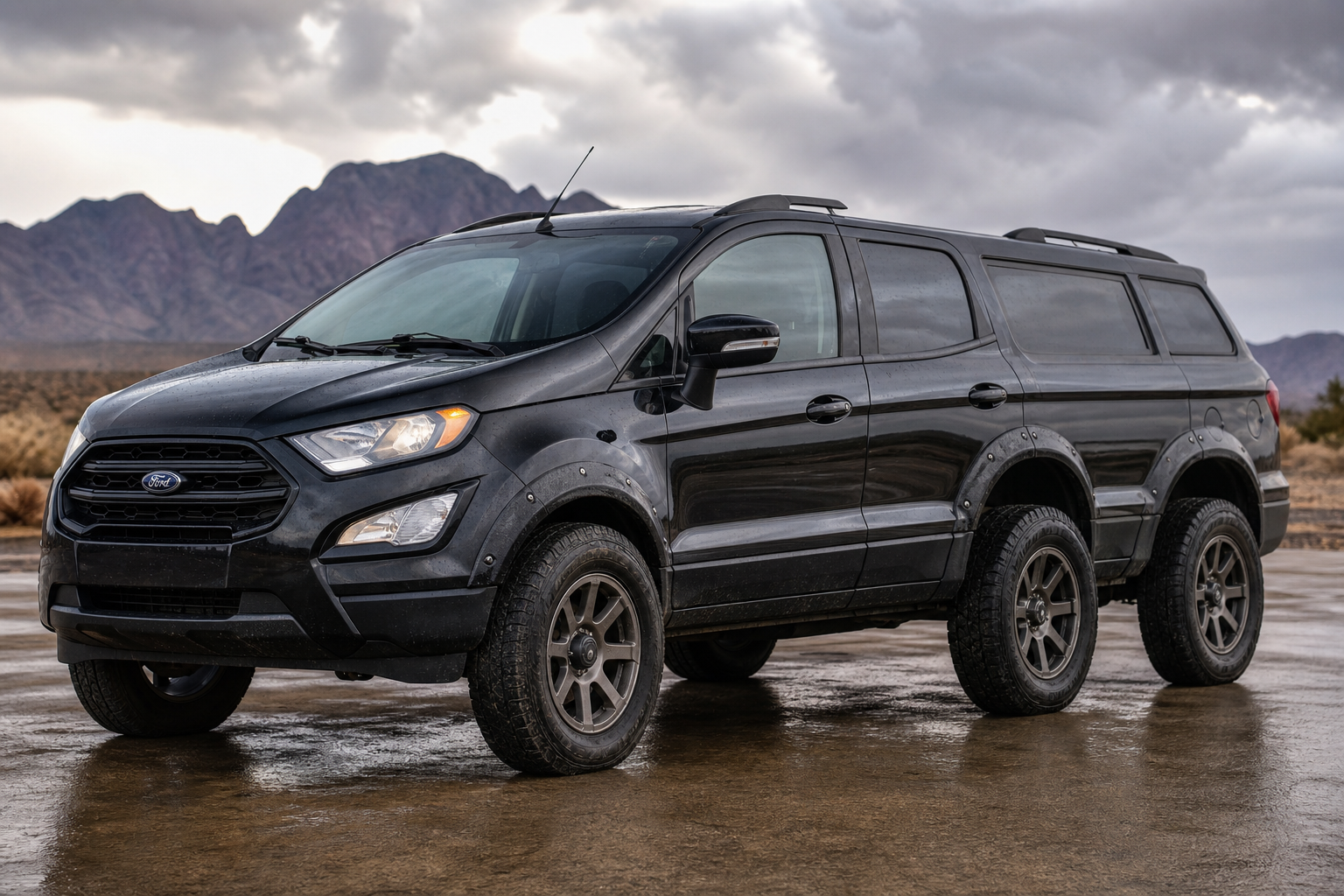

A Ford EcoSport that looks built for a different planet
The Ford EcoSport has always been a modest, urban-minded subcompact crossover, the kind of vehicle designed to blend into traffic rather than dominate it. The example now heading to auction takes that formula and turns it on its head. Listed as a Ford EcoSport Titanium, this one-off build has been transformed with a third axle, heavily stretched bodywork, and a rebuilt salvage history, creating one of the more unusual crossover conversions to surface in a public sale.
It is not the sort of EcoSport anyone would mistake for a factory special. The proportions alone make that clear. A standard EcoSport is a short, upright, two-row crossover with a conventional two-axle layout. This truck-like custom version extends the body and adds an extra set of wheels, giving it the stance of a showpiece or promotional oddity rather than a practical commuter.
What makes this EcoSport different
The headline feature is the third axle, which instantly changes the vehicle’s visual and mechanical character. Even before looking closely at the body, the extra wheels create the impression of a custom fabrication project built around novelty and visual impact. The stretched bodywork ties the conversion together, pushing the EcoSport far beyond the dimensions and layout of the production model.
While the source material does not provide a full technical breakdown of the conversion, the result is obvious: this is no lightly modified crossover. Any vehicle with a reworked chassis profile, extended body sections, and an added axle reflects substantial fabrication work. That kind of build typically means the original platform has been altered well beyond standard bolt-on customization.
For a model like the EcoSport, which was originally positioned as an affordable, compact utility vehicle, the transformation is especially striking. Ford sold the nameplate as a simple, value-oriented crossover intended for daily transportation, not as a base for extreme custom work. The Titanium trim reference suggests the donor vehicle started life as a higher-spec version of the EcoSport, but the conversion has completely changed its identity.
Built from a salvage vehicle
Another notable detail is the vehicle’s rebuilt salvage history. That matters because it signals the EcoSport was once written off or significantly damaged before being restored and modified. Salvage-title vehicles often attract buyers for project potential, lower entry cost, or unusual provenance, but they also require more careful inspection than a standard used car.
In this case, the salvage status is part of the story rather than a footnote. The rebuilt title explains how a vehicle like this could become the basis for such an unconventional conversion. For buyers, it also frames the car’s value in a very different way from a clean-title EcoSport. This is not a conventional retail crossover with predictable ownership expectations; it is a custom, rebuilt vehicle whose appeal depends heavily on the buyer’s tolerance for unusual engineering and prior damage history.
The EcoSport’s original role makes the build even stranger
The Ford EcoSport was never a large or especially flamboyant vehicle in stock form. It occupied the entry level of the crossover market, where packaging, affordability, and efficiency mattered far more than outright presence. In that context, this three-axle version stands out precisely because it is so far removed from the car Ford originally engineered.
That contrast is part of the draw. The EcoSport’s conventional shape makes the conversion look even more dramatic than if the donor had been a larger SUV or truck. The standard body lines were intended to be neat and compact; stretched across a longer platform with an extra axle, they become almost surreal. It is the kind of build that relies on the familiarity of the original vehicle to deliver its visual impact.
Ford discontinued the EcoSport in the U.S. after the 2022 model year, though it lived on in other markets for longer. Even in regions where it was more common, it was rarely a vehicle associated with custom fabrication scenes. That makes the auction listing a niche curiosity, but one that illustrates how ordinary vehicles can be repurposed into extreme show builds when originality matters more than rationality.
No-reserve auction adds uncertainty
The fact that the EcoSport is being offered in a no-reserve auction makes the listing even more interesting. Without a reserve, the vehicle will sell to the highest bidder regardless of where bidding ends. That can attract attention from collectors of oddball customs, fabricators, and buyers looking for a one-off conversation piece.
At the same time, a no-reserve sale introduces a degree of risk for anyone considering the truck as an actual purchase rather than a novelty. A heavily modified, rebuilt-salvage vehicle can be difficult to value in conventional terms. Its worth depends less on model-year depreciation curves or trim-level desirability and more on the quality of the fabrication, the completeness of the rebuild, and how much the next owner wants something no one else has.
That’s especially true with a conversion this far outside the norm. A stock EcoSport appeals to buyers who want an affordable, easygoing small crossover. This one appeals to an entirely different audience: people interested in custom fabrication, unusual salvage rebuilds, or simply collecting vehicles that defy easy categorization.
Why builds like this keep showing up
One reason vehicles like this continue to surface is that modern crossovers provide accessible donor material for custom projects. They are common, relatively compact, and often available from salvage auctions after collision damage or insurance losses. That combination makes them attractive starting points for builders who want to create something attention-grabbing without beginning from scratch.
The EcoSport is particularly suited to that kind of reinvention because its basic silhouette is simple and its packaging doesn’t leave much room for ambiguity. Once the body gets extended and another axle is added, the vehicle’s identity changes immediately. What started as a practical city crossover becomes a rolling custom exercise, and the original purpose of the platform fades into the background.
Whether the finished product is viewed as an art piece, a promotional prop, or just a curiosity depends on the buyer. What’s certain is that it won’t be mistaken for a factory-built Ford, and that may be the entire point. In a market where most used crossovers blend together, a three-axle EcoSport with a rebuilt title guarantees one thing: no one will forget seeing it.
0 Comments