
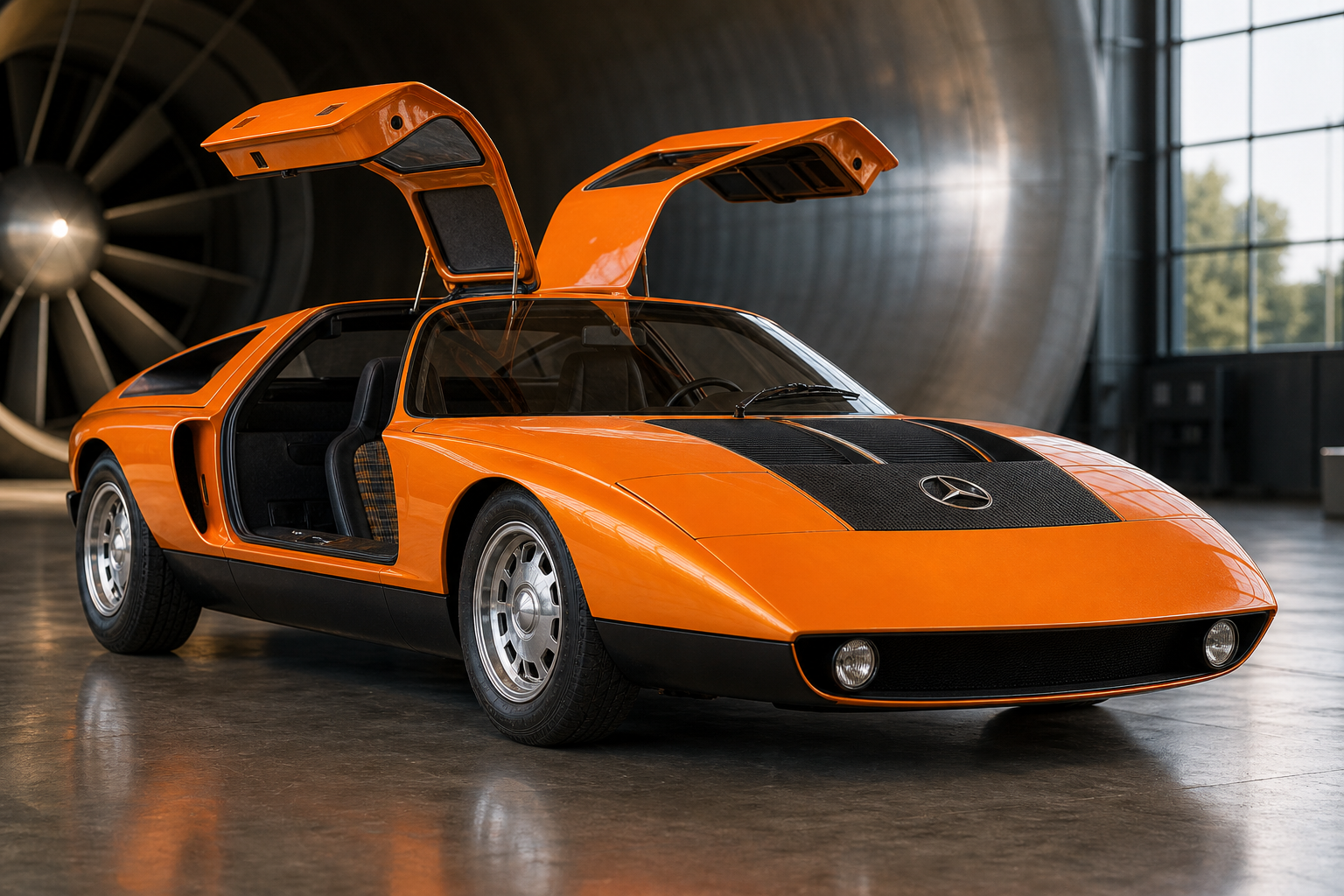

Mercedes-Benz has never been shy about using a show car to test an idea, but few experiments in its history captured the public imagination like the C 111. Conceived as a rolling laboratory rather than a production model, it served as a platform for advanced engineering work at a time when the brand was exploring future powertrains, aerodynamics, and lightweight construction. More than five decades later, the car remains one of the most recognisable Mercedes prototypes ever built.
What makes the C 111 especially compelling is that it was never meant to be a museum piece. It was developed to be driven, measured, modified, and driven again. That purpose gives it a very different kind of significance from a conventional concept car. The C 111 was not merely a styling exercise; it was a serious technical test bed that reflected Mercedes-Benz thinking at a moment when the industry was searching for the next major leap forward.
A Prototype Built to Explore the Future
The C 111 emerged during an era when manufacturers were experimenting with alternative engine concepts and new approaches to efficiency. Mercedes used the car to investigate technologies that could shape its road cars later on, and the model became particularly famous for its association with rotary-engine development. Its wedge-shaped body and low-slung proportions made it look like something from science fiction, but the underlying mission was highly practical.
Rather than freezing the design in one form, Mercedes revised the C 111 repeatedly. That flexibility is part of what gave the car such a long life. As the company’s engineering priorities evolved, so did the prototype. The result was a succession of versions that explored different mechanical ideas while retaining the same dramatic visual identity.
Design: A Shape That Still Feels Futuristic
The C 111’s design remains one of its most striking attributes. Its smooth, cab-forward silhouette, low nose, and compact tail give it a distinctly purposeful appearance. The proportions are all about reducing drag and visually expressing speed, yet the car also carries a kind of sculptural elegance that helps it transcend its era.
Because it was built as an engineering platform, the bodywork was not shaped for ornament. Every line serves the car’s aerodynamic and packaging goals, which is part of why the design has aged so well. Even now, the C 111 looks less like a nostalgic concept and more like a prototype from a future that never quite arrived.
The upward-opening doors add theatre, but they also underscore the car’s showpiece status. They are the kind of detail that ensures the C 111 makes an immediate impression even before the engine is started. In a museum setting it can seem almost too pristine to drive; on the road, that same design gives the car a sense of presence that few prototypes can match.
The Engineering Mission Behind the Icon
Mercedes built the C 111 to learn. That simple idea explains why the car matters so much to enthusiasts and historians. The company used it to examine ideas that were not yet ready for production but could influence future cars in subtler ways. In that sense, the C 111 was less about a single final specification and more about the process of experimentation itself.
The most famous early examples were linked to rotary-engine development, reflecting the era’s interest in compact, high-revving powertrains. Later iterations moved the story forward as Mercedes continued to refine the car and its role. The enduring fascination comes from the fact that the C 111 was never static; it documented a period of rapid change in automotive thinking.
What It Feels Like to Drive a Rolling Experiment
Getting behind the wheel of the C 111 is different from driving a normal classic car or even a conventional prototype. The experience is shaped as much by the car’s purpose as by its age. It has the atmosphere of a machine built to be observed and analysed, yet it is still a genuine driver’s car in the sense that it communicates its mechanical character clearly.
Because the C 111 was developed for testing, it does not present itself as a polished production-ready package. Instead, it feels deliberate, mechanical, and focused. The seating position is low, the cockpit is compact, and the surrounding bodywork reinforces the sense that the driver is sitting deep within a technical exercise in motion. That intimacy is part of the appeal.
Any drive in a car like this is as much about context as performance. The excitement does not come from chasing modern benchmark figures; it comes from experiencing the kind of engineering ambition that production cars often conceal. The C 111’s reputation is built on that tension between concept and reality.
Why the C 111 Still Matters Today
At a time when many manufacturers use concept cars mainly as styling statements, the C 111 stands apart because it was genuinely functional. It reminds us that some of the most important prototype work in automotive history happened in cars designed to look extraordinary. Its significance lies in the fact that Mercedes treated it as a tool, not just a spectacle.
That approach helped make the C 111 a lasting reference point for the brand. It is often remembered for its dramatic appearance, but its true importance comes from the way it represents Mercedes-Benz engineering culture: disciplined, experimental, and willing to invest in ideas that might not reach showrooms immediately.
For enthusiasts, the car also highlights a wider truth about automotive history. The most memorable prototypes are often those that combine technical ambition with a strong visual identity. The C 111 does both. That is why it continues to draw attention in a way that many far newer concept cars do not.
Collectors, Museums, and the Problem of Irreplaceability
As with many significant prototypes, the C 111 now exists in a space between motoring history and industrial art. Its value is not measured in the way a used production car would be. Instead, its significance comes from rarity, provenance, and its place in the story of Mercedes engineering. That makes it an object of enormous interest to museums and brand collections.
For most buyers, ownership is not a realistic proposition, but that does not make the car irrelevant to the broader market. On the contrary, vehicles like the C 111 influence the desirability of brand heritage, help define the public image of a manufacturer, and remind collectors why certain prototypes become legendary. They are the physical evidence of a company taking risks.
It also raises an important point about preservation. Cars built as testbeds are often used hard and changed frequently, which means surviving examples become more valuable as historical artifacts. In that respect, the C 111 is more than a prototype; it is a record of Mercedes-Benz’s experimental phase in real time.
How It Fits Into Mercedes-Benz History
The C 111 occupies a unique place in Mercedes-Benz history because it bridges the gap between the brand’s conservative production image and its more adventurous engineering side. Mercedes has long been associated with durability, precision, and technical authority, but the C 111 reveals a willingness to push beyond the expected. It shows that the company was not only refining existing ideas but also testing alternatives that might reshape the future.
That matters because it broadens the understanding of the brand. The C 111 is often remembered alongside the most visually daring prototypes of its era, yet it carries a distinctly Mercedes approach: methodical, rigorous, and informed by engineering rather than whim. It is a concept car with an engineer’s brief behind it.
Conclusion
The Mercedes-Benz C 111 endures because it was more than a dramatic shape under glass. It was a serious laboratory on wheels, built to explore ideas that could influence the future of the brand. Seen today, it remains one of the most important and intriguing prototypes Mercedes ever created, combining technical purpose with unforgettable design.
That combination is why the C 111 still matters. It is a reminder that the most fascinating cars are often the ones that were built to ask questions rather than provide answers.


0 Comments