
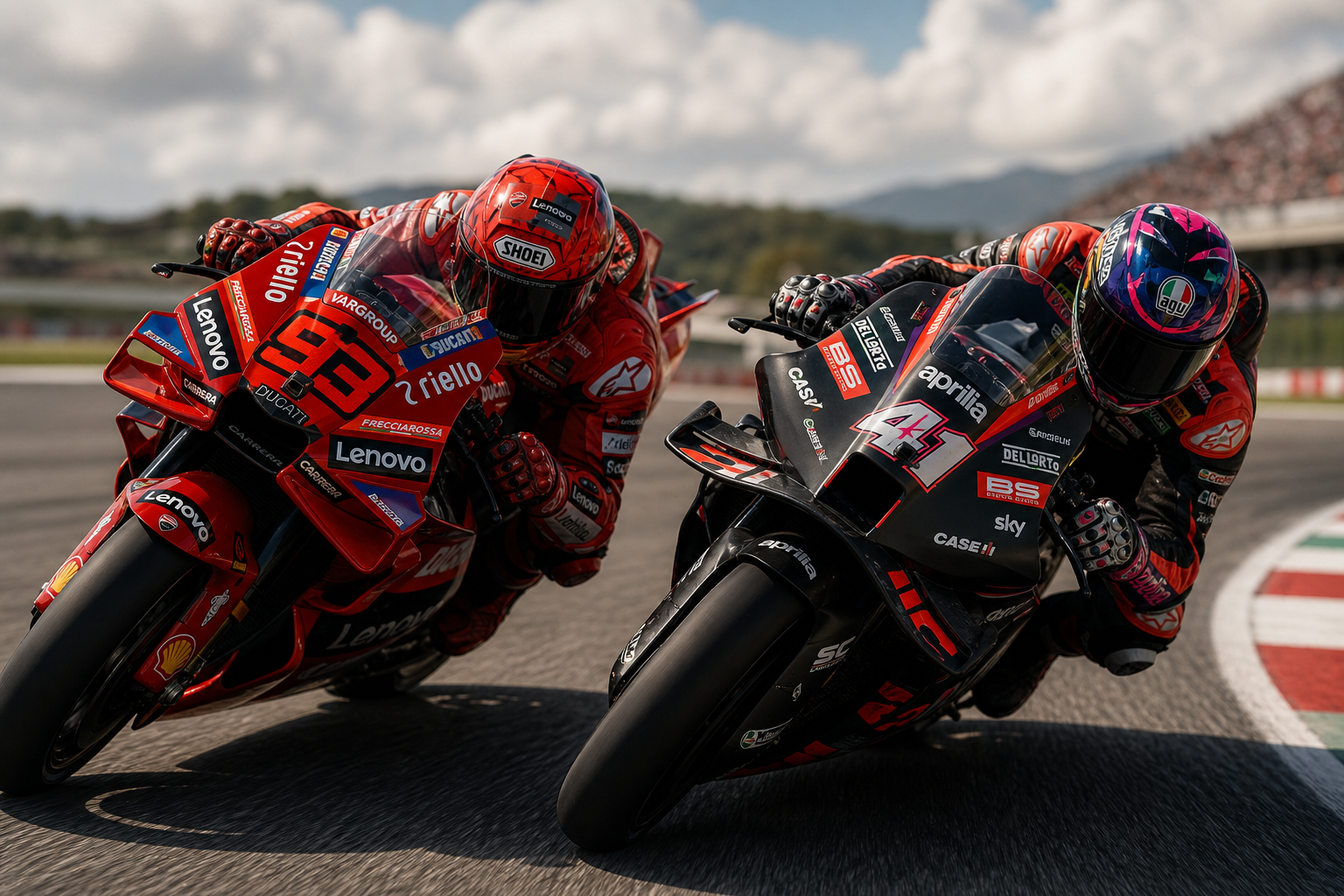

Fabio Di Giannantonio thinks the difference between Ducati and Aprilia in MotoGP is being made less by track layout than by the riders who put the bikes there. As the 2026 season continues to swing between the two Italian brands, the VR46 rider believes the current split in form says as much about execution as it does about engineering.
A battle shaped by style as much as machinery
Ducati and Aprilia have emerged as the two Italian reference points in the current MotoGP season, but their strengths have not been identical. Aprilia’s RS-GP has looked particularly effective at circuits with long, flowing corners, where corner speed and stability matter. Ducati’s GP26, by contrast, has been stronger in stop-and-go sections, where braking performance, traction and drive off slower bends can decide a lap.
That kind of split naturally encourages track-by-track theories. A smooth, fast circuit should suit one bike; a tighter, more technical layout should suit the other. Di Giannantonio is not dismissing that entirely, but he does not think it tells the whole story. In his view, the riders themselves are playing a bigger role in how the balance between the two manufacturers appears from weekend to weekend.
Why Di Giannantonio is pushing back on the track theory
The idea that certain circuits automatically favor one bike over another is an easy one to draw, especially when the season produces contrasting results at different venues. But MotoGP is rarely that neat. Setup direction, tire usage, race conditions and rider style all influence whether a bike looks dominant on a given Sunday.
Di Giannantonio’s point is that the current Ducati-Aprilia comparison may be too often reduced to a simple track-characteristics argument. The underlying machinery still matters, of course, but the ability of a rider to exploit a bike’s strengths, mask its weaknesses and adapt to a changing race weekend can be just as important. That is especially true when both manufacturers are operating at a level where the margins are small.
For Ducati, the benchmark remains high because the Bologna-based brand has spent years refining a package that delivers strong acceleration and braking performance across a wide range of circuits. Aprilia has responded with a machine that has become increasingly competitive in areas where its chassis and cornering traits can be fully used. The result is a contest that can look like a stylistic matchup on paper, but often becomes a test of who adapts best once the lights go out.
Marc Marquez is changing the conversation
Di Giannantonio also pointed to Marc Marquez as a key reason the debate has taken on a different tone. Marquez has a reputation for making the bike work in situations where others may struggle, and his performances have helped mute some of the arguments about which manufacturer has the better package in isolation.
That matters because one rider can alter the perception of an entire project. If a star rider consistently produces strong results on a bike that appears less suited to the circuit, it becomes harder to claim that the track alone is deciding the outcome. Marquez’s presence has effectively raised the level of comparison inside Ducati’s garage and across the paddock, making it more difficult for rivals to separate rider effect from machine advantage.
For Aprilia, that raises the pressure to find an answer that goes beyond theoretical circuit fit. The RS-GP has shown enough pace to be taken seriously, but MotoGP’s current competitive order often comes down to how well a rider can maximize the package across a complete weekend rather than at one type of corner or another.
What the Ducati-Aprilia split says about modern MotoGP
The Ducati vs. Aprilia discussion reflects a broader reality in grand prix racing: manufacturers can build bikes with distinct strengths, but those strengths rarely exist in isolation. The riders, engineers and race strategy all shape how those traits appear under race pressure.
That is one reason why the current season has remained difficult to read in simple terms. Ducati’s GP26 may be the stronger tool in certain situations, while Aprilia’s RS-GP may have the edge elsewhere, yet the final order can still change depending on who is riding, how the weekend develops and how well the team responds to changing conditions. Di Giannantonio’s view is essentially that MotoGP has become too competitive to reduce to a circuit map.
For fans, it also adds another layer to one of the season’s most interesting manufacturer storylines. Ducati and Aprilia are not just developing different bikes; they are also being interpreted through the performance of very different riders. That makes the comparison less straightforward, but also more revealing. In MotoGP, the fastest package on one weekend is not always the one that was theoretically best suited to the track on paper.
A rivalry that depends on execution
Di Giannantonio’s stance does not deny that the two bikes have different characteristics. It does, however, put the emphasis where MotoGP insiders often place it: on execution. A competitive bike still needs the right rider to unlock it, and a fast rider can make a package look far better than its rivals expected.
With Ducati and Aprilia continuing to trade strengths, that combination of engineering and riding talent is likely to remain the real deciding factor. The circuit may influence the shape of the battle, but it is the rider who usually finishes it.
0 Comments