
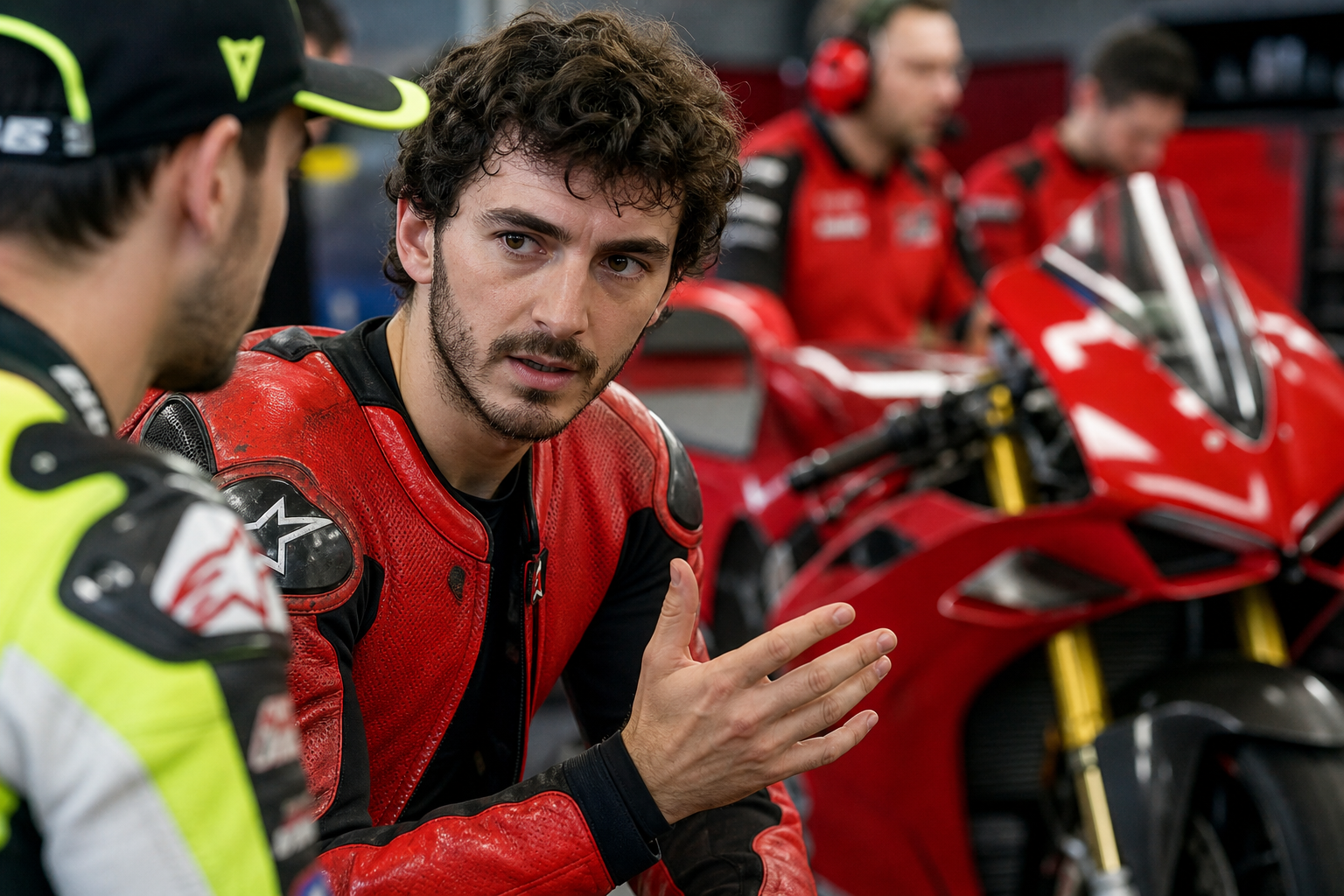

Francesco Bagnaia has pushed back strongly against a viral video that made it appear as though Ducati was blocking him from making changes to his bike, saying his remarks were lifted out of context and distorted by social media.
The factory Ducati rider’s clarification comes in the wake of another difficult weekend at Misano, where his performance once again drew attention in a season that has not gone to plan. Footage shared by Spanish broadcaster DAZN showed Bagnaia speaking in the TV pen with VR46 rider Fabio di Giannantonio, and a brief clip from that exchange quickly spread online.
According to Bagnaia, the problem was not the conversation itself but the way it was edited and interpreted. In a sport where riders constantly work through setup details, electronics, tyre behaviour and chassis balance, a few seconds of audio can be enough to create a misleading impression. Bagnaia was keen to make clear that the viral version of the exchange did not reflect the full conversation.
His reaction is understandable. MotoGP riders are often candid immediately after sessions and races, especially when they are trying to explain a performance issue to engineers, team members or fellow riders. Those comments are usually technical, specific and tied to the immediate problems on track. Stripped of that context, they can sound far more dramatic than intended. In this case, Bagnaia said his words had been “completely taken out of context.”
Why the clip spread so quickly
The modern MotoGP media environment means any offhand comment can travel faster than the race result itself. Broadcast microphones, paddock cameras and social media accounts routinely capture unscripted moments, and the shorter the clip, the easier it is for audiences to read their own meaning into it.
That is especially true with a manufacturer as closely watched as Ducati. The Bologna-based company has built its reputation on deep technical strength, aggressive development and a rider lineup that is dissected from every angle. When one of its factory stars appears frustrated, the assumption is often that there is a deeper internal story behind it.
Bagnaia’s situation is also amplified by the expectations that come with being a two-time MotoGP world champion and one of Ducati’s headline riders. He is not just another rider working through a setup problem; he is one of the men expected to lead the factory effort. That naturally increases scrutiny when results dip.
Misano adds pressure to an already difficult run
The Misano weekend itself only added to the tension. Another disappointing race outcome meant Bagnaia left the event without the kind of result that would quiet the speculation around him. In MotoGP, a poor weekend rarely stays isolated for long, particularly when it follows a run of inconsistent form.
Misano is also a special venue in the Ducati world. It sits close to the company’s home base and tends to draw intense attention from Italian fans, the manufacturer’s personnel and the broader paddock. That makes underperformance there feel even more exposed than it would at a more neutral circuit.
For a rider in Bagnaia’s position, that can create a frustrating cycle: the results are scrutinized, the comments are magnified, and every public interaction becomes part of the narrative. His insistence that the video misrepresented what he meant is therefore less a defensive flourish than an attempt to correct a storyline before it hardens into accepted fact.
Technical debate is part of the job
What makes the episode believable as a misunderstanding is how naturally it fits the way MotoGP riders talk about their machines. Setup work in the premier class is rarely simple, and riders spend huge amounts of time discussing front-end feel, rear grip, engine delivery, ride height, aerodynamics and tyre performance with their crews.
Those conversations can sound blunt even when they are entirely routine. A rider might say a bike needs adjustment, that a direction isn’t working or that a particular change is being limited by the package. Without the full exchange, it is easy for a technical complaint to sound like an accusation.
That is why Bagnaia’s response matters. He is not denying that Ducati and its riders are trying to solve problems; he is disputing the suggestion that he was accusing the factory of preventing him from improving the bike. In a paddock where engineering detail is everything, that distinction matters.
What it means for Ducati and Bagnaia
Ducati’s factory team has become the benchmark in MotoGP, but that status also means its internal dynamics are always under the microscope. If one rider is struggling, the conversation quickly turns to whether the machine suits him, whether the development path has shifted, or whether another rider has extracted more from the same base package.
Bagnaia’s clarification doesn’t resolve the performance questions surrounding his season, and it doesn’t change the reality that his Misano weekend was another one to forget. But it does cut off one of the more sensational interpretations that emerged from the broadcast clip.
For Ducati, the more relevant issue remains getting its champion rider back to the level expected of a factory leader. For Bagnaia, the priority is to separate the technical work from the noise around it. In MotoGP, that distinction can disappear quickly when a short video clip starts circulating online.
What the episode shows most clearly is how easily a rider’s private, technical discussion can be turned into a public storyline. Bagnaia says that is exactly what happened here.


0 Comments