
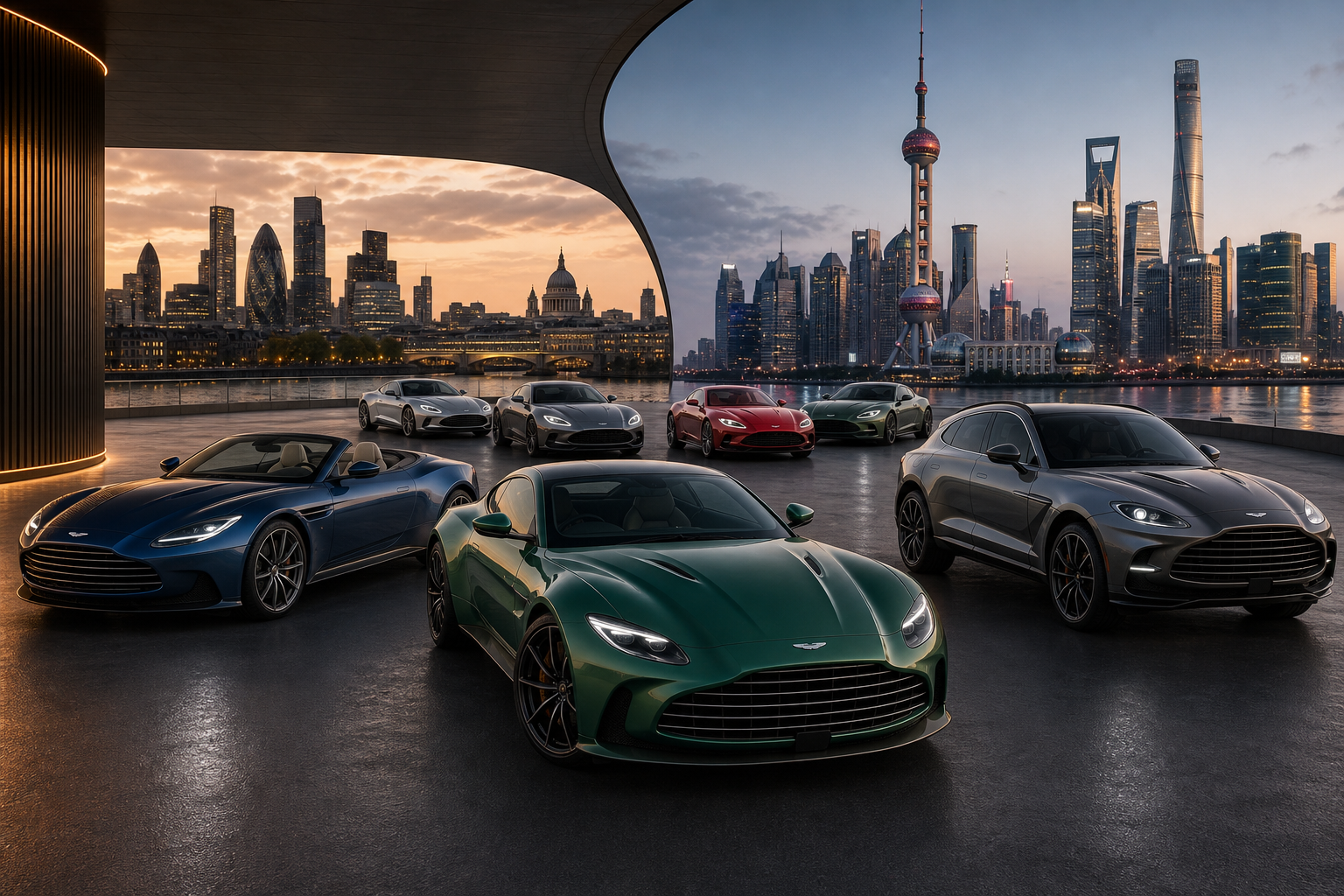

Aston Martin is preparing one of its broadest new-product offensives in years, with seven new models headed for Western markets and six tailored for China. The company’s latest planning signals a sharper focus on regional demand, model turnover and the sort of high-value niches where Aston Martin has long tried to compete.
A broader strategy behind the next wave of cars
The headline numbers are striking on their own, but the more interesting detail is what they say about Aston Martin’s priorities. Rather than relying on a small range of halo cars and incremental updates, the British manufacturer appears to be building a more deliberate product cadence aimed at keeping its lineup fresh in the most important global markets.
For a brand that sells on exclusivity, design and performance rather than volume, timing matters. New models are not only about replacing old ones; they are also about maintaining relevance against a field that now includes everything from electrified grand tourers to increasingly sophisticated super-SUVs. Aston Martin’s plan suggests it wants to stay visible across multiple segments instead of leaning too heavily on a single hero model.
Why the Western market still matters most
The seven-car program for Western markets indicates that Europe and North America remain central to Aston Martin’s business. These are the regions where the company has the strongest brand recognition among performance-car buyers, and where traditional Aston Martin cues still carry weight: long-hood proportions, luxury interiors, and V8 or V12 powertrains tuned for fast-road use rather than outright track-day extremism.
That matters because the Western market also tends to reward breadth. Buyers at the top end of the market now expect more than one expression of a brand’s identity. A coupe, a convertible, a limited-run special edition, a DB-badged grand tourer and a more practical performance SUV can all serve different audiences without diluting the badge, provided the engineering and design are consistent.
China’s growing importance for prestige brands
The six models earmarked for China reflect a reality that every premium automaker now has to address: the Chinese market is not just large, it is distinct. Luxury-car buyers there often respond to different body styles, equipment levels and interior packaging priorities than customers in Europe or the U.S. Wheelbase, rear-seat comfort, connectivity and comfort features can matter as much as outright performance.
For a company like Aston Martin, that means some vehicles may need to be adapted more carefully than others. Even when the underlying platform is shared, the specification strategy can differ by region. The number of models planned for China suggests the brand is not treating it as an afterthought, but as a core part of its global product mix.
What this says about Aston Martin’s product cadence
Aston Martin has spent years balancing the tension between heritage and modernization. Its cars are expected to feel special, but they also have to meet contemporary expectations around technology, emissions compliance, and daily usability. Launching seven Western-market cars and six China-specific models implies a wider refresh cycle that could include next-generation versions, derivatives of existing cars, and market-specific variants.
That approach is consistent with how the performance-luxury segment is evolving. Limited-run and derivative models can be as important to a brand as all-new platforms, especially when they help stretch development investment across multiple products. A single architecture can underpin several vehicles, each tuned to a different buyer profile or region.
How the lineup could be positioned
Although Aston Martin has not laid out every model in public detail here, the structure of the plan suggests a mix of volumes and roles. At one end of the range, the company needs core cars that support sales and maintain showroom traffic. At the other, it needs flagship derivatives and low-volume specials that keep the brand in the conversation and reinforce its sporting image.
That balance is crucial for a manufacturer like Aston Martin. Too many niche cars can strain resources, but too much reliance on a narrow core lineup can make the brand vulnerable if one model underperforms or becomes dated. A spread of seven Western-market launches offers flexibility, allowing the company to address coupe, convertible, GT and crossover demand without depending on one single breakout product.
China-specific planning can’t be treated as a simple export exercise
The six-model figure for China is also a reminder that global luxury-car strategy now requires more than shipment scheduling. In that market, local preferences can influence everything from trim-level structure to rear-seat comfort to infotainment language support. Manufacturers that get the details right can build stronger brand traction than rivals that simply import the same specification everywhere.
For Aston Martin, that kind of tailoring is especially important because the brand trades heavily on emotional appeal. The cars need to look and feel distinctive, but they also have to deliver the everyday refinement expected at their price point. China’s luxury buyers tend to scrutinize that balance closely.
A sign of confidence in a high-stakes segment
Any plan involving this many new cars suggests confidence, but it also carries risk. Premium buyers are picky, development budgets are high, and brand missteps are expensive. Still, the scale of Aston Martin’s upcoming product pipeline points to a company that sees room to grow across both established Western markets and China.
That is important because Aston Martin’s future depends on staying desirable without becoming predictable. A wider rollout of new products, spread across distinct regions, gives the company more ways to manage that challenge. If executed well, it could strengthen Aston Martin’s position in the luxury-performance market without forcing the brand to abandon the character that sets it apart.
For now, the key takeaway is simple: Aston Martin is not planning a single headline car, but a coordinated push across two major markets. Seven new models in the West and six in China suggest a far more ambitious product cycle than the company has often shown, and one that could reshape how the brand is presented globally over the next few years.

0 Comments