
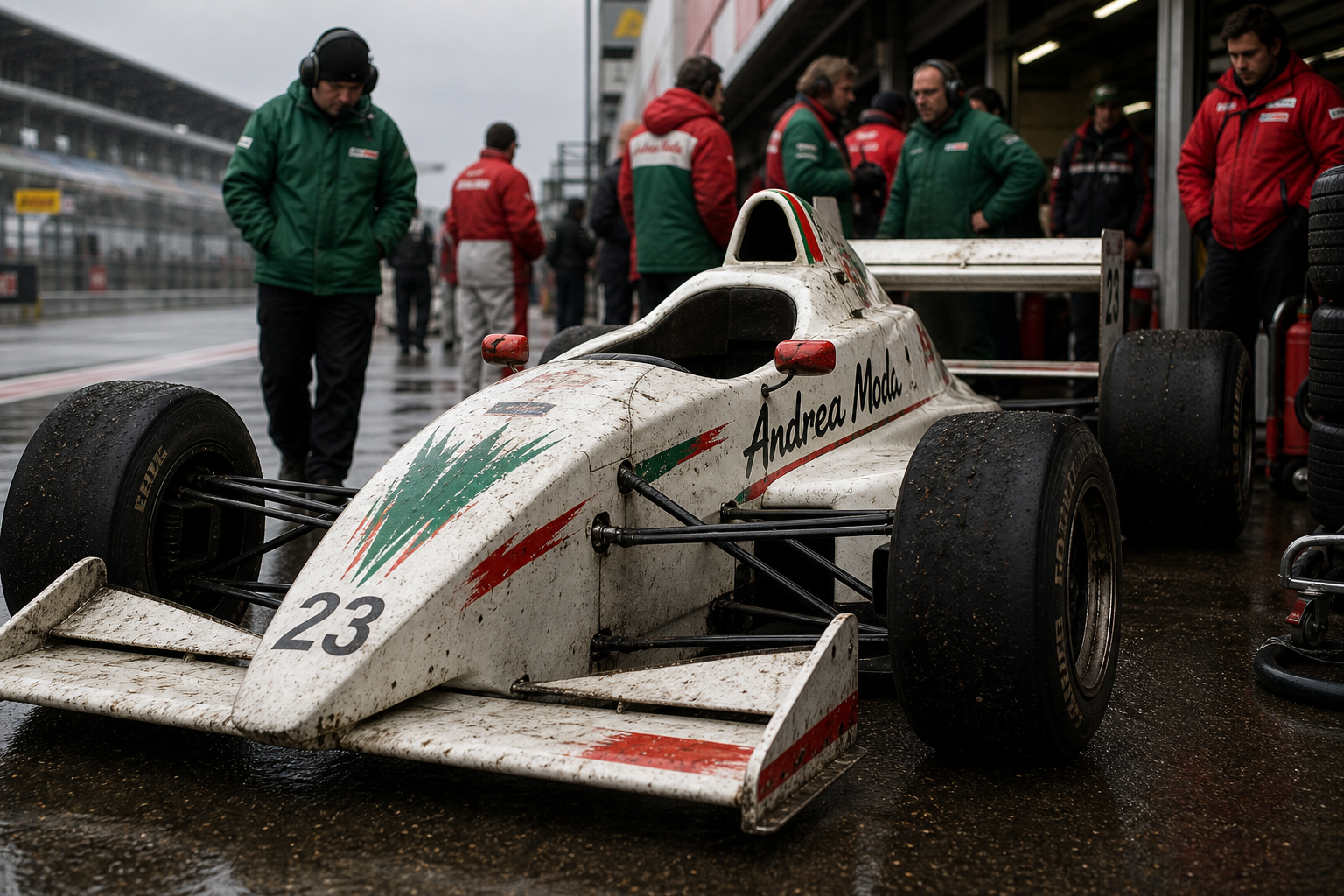

Few Formula 1 stories are remembered for the right reasons, and Andrea Moda sits near the top of the sport’s rogues’ gallery. While many teams have arrived in Grand Prix racing with ambition and underfunded expectations, Andrea Moda managed something rarer: it turned up so underprepared, so unstable and so short-lived that it became a symbol of how difficult, expensive and unforgiving F1 can be when the basics are not in place.
That is why Andrea Moda still draws attention decades later. The team was not notable for winning, nor even for regularly qualifying, but for the scale of the collapse around it. In a championship where every car is built to a demanding technical formula and every weekend leaves little room for error, Andrea Moda showed what happens when organisation, engineering, management and credibility all break down at once.
The background: why Andrea Moda entered Formula 1 at all
Andrea Moda Formula reached the World Championship in 1992, during an era when privateer entries and precarious team structures were far more common than they are today. F1 in the early 1990s still allowed ambitious outfits to attempt a place on the grid without the kind of manufacturer backing now seen as essential. But even by the standards of the time, Andrea Moda was an extreme case.
The name came from its owner, Andrea Sassetti, and the project carried the sort of rushed, fragile foundations that often spell trouble in top-level motorsport. Formula 1 is brutally expensive: a team needs not only a chassis and engine, but a strong technical department, financial stability, spare parts, logistics, testing capacity and a management structure capable of keeping all of it moving. Andrea Moda struggled to establish even the most basic version of that package.
That context matters because F1 has long attracted dreamers and outsiders. Some independent teams have arrived with modest means and still built respectable reputations. Andrea Moda is remembered differently because the scale of the dysfunction left so little for the sport to admire beyond the sheer improbability of the attempt.
What made the team so infamous?
Andrea Moda’s notoriety comes from more than poor results. The team became associated with technical confusion, unreliable cars, limited preparation and a string of setbacks that made normal race participation difficult. In Formula 1, even struggling teams usually arrive at a Grand Prix with the aim of simply qualifying, completing laps and learning. Andrea Moda often found itself unable to establish that baseline.
The broader problem was credibility. Teams can survive poor performance if there is a sense of process and progress. What made Andrea Moda stand out was the perception that the entire operation lacked coherence. That is why it has endured in F1 folklore: it was not just uncompetitive, it represented a failure of team building at every level.
Motorsport history is full of underdogs, but few are as memorable as a team that seems to have spent more time fighting itself than fighting the stopwatch. In that sense, Andrea Moda became less a sporting entry and more a case study in how not to launch a Formula 1 outfit.
The 1992 Formula 1 environment
To understand Andrea Moda’s place in history, it helps to remember the F1 landscape of the early 1990s. The sport was in a phase of rapid technological development, with advanced aerodynamics, powerful engines and increasingly sophisticated electronics setting a high entry bar. Even mid-field teams needed serious resources to stay relevant, while front-running outfits were beginning to operate on a scale that small independents could hardly match.
That made life hard for any newcomer. A new team needed more than enthusiasm: it required a sound chassis, an engine supply, a workable race programme and enough spare capacity to survive the inevitable accidents and mechanical failures. In an era before today’s more tightly controlled structures, the gap between the best-organised teams and the weakest was enormous.
Andrea Moda therefore entered a world that was already hostile to instability. The fact that the team struggled so visibly was not just embarrassing; it was a reminder that Formula 1 has always been a sport where money, preparation and discipline are as important as ambition.
Why the Andrea Moda story still matters
There is a temptation to treat failed F1 projects as comic relief, but Andrea Moda also reveals something serious about the sport. Formula 1 is often sold as a contest of speed, yet it is just as much a test of administration, staffing and operational resilience. The best teams are rarely the most glamorous; they are the ones that can keep producing, developing and adapting under pressure.
Andrea Moda’s short life illustrates the brutal difference between entering Formula 1 and functioning within it. Any team can arrive with a car and a livery. Sustaining a competitive F1 campaign requires a supply chain, engineering depth, financial control and the ability to respond to damage and development demands at short notice. Without those elements, the weekend becomes a struggle for survival rather than performance.
That is part of why motorsport fans continue to revisit the story. It is entertaining, certainly, but it is also a vivid demonstration of how difficult Formula 1 has always been for outsiders trying to force their way into the elite.
How Andrea Moda fits into F1’s long history of lost causes
Formula 1 has never lacked eccentric teams, ambitious projects or doomed ventures. Some disappeared after a season or two; others left a mark through innovation, personality or a memorable upset. Andrea Moda occupies a different category. It is remembered less for technical contribution and more for the scale of the dysfunction surrounding it.
That does not mean it is unique in being unsuccessful. Many teams have failed to score points, and some have withdrawn quickly after learning how hard F1 can be. But Andrea Moda sits in the conversation because the circumstances around its entry and operation were so chaotic that the team became a shorthand reference for failure.
For enthusiasts, that makes it fascinating in a way that a more ordinary backmarker never could be. It is the sort of story that prompts disbelief even from people who know the sport well, because it shows how thin the line is between a genuine Grand Prix team and an operation that simply is not ready for the world championship.
Legacy: remembered for the wrong reasons, but remembered nonetheless
Andrea Moda did not leave behind a technical lineage, a famous podium or a breakthrough innovation. Its legacy is reputational. In the decades since, the team’s name has become a byword for chaos in Formula 1 discussion, an example invoked whenever the sport’s most troubled entrants are discussed.
That may seem harsh, but history tends to be unkind to failed projects, especially in a sport as selective as F1. Still, the story persists because it captures the collision between aspiration and reality. The dream of Formula 1 is easy to understand; the execution is where most projects fall apart. Andrea Moda simply exposed that gap in dramatic fashion.
For modern fans, especially those used to heavily regulated, professionally managed teams, the saga is a useful reminder of how much the sport has evolved. Today’s environment leaves very little room for improvisation, and Andrea Moda is one of the reasons the idea of entering Formula 1 without deep preparation now seems almost unthinkable.
Conclusion
Andrea Moda is remembered not because it succeeded, but because it failed so completely that it became part of Formula 1 folklore. Its story is a warning about the demands of Grand Prix racing and a reminder that in F1, ambition without organisation rarely survives for long.


0 Comments