
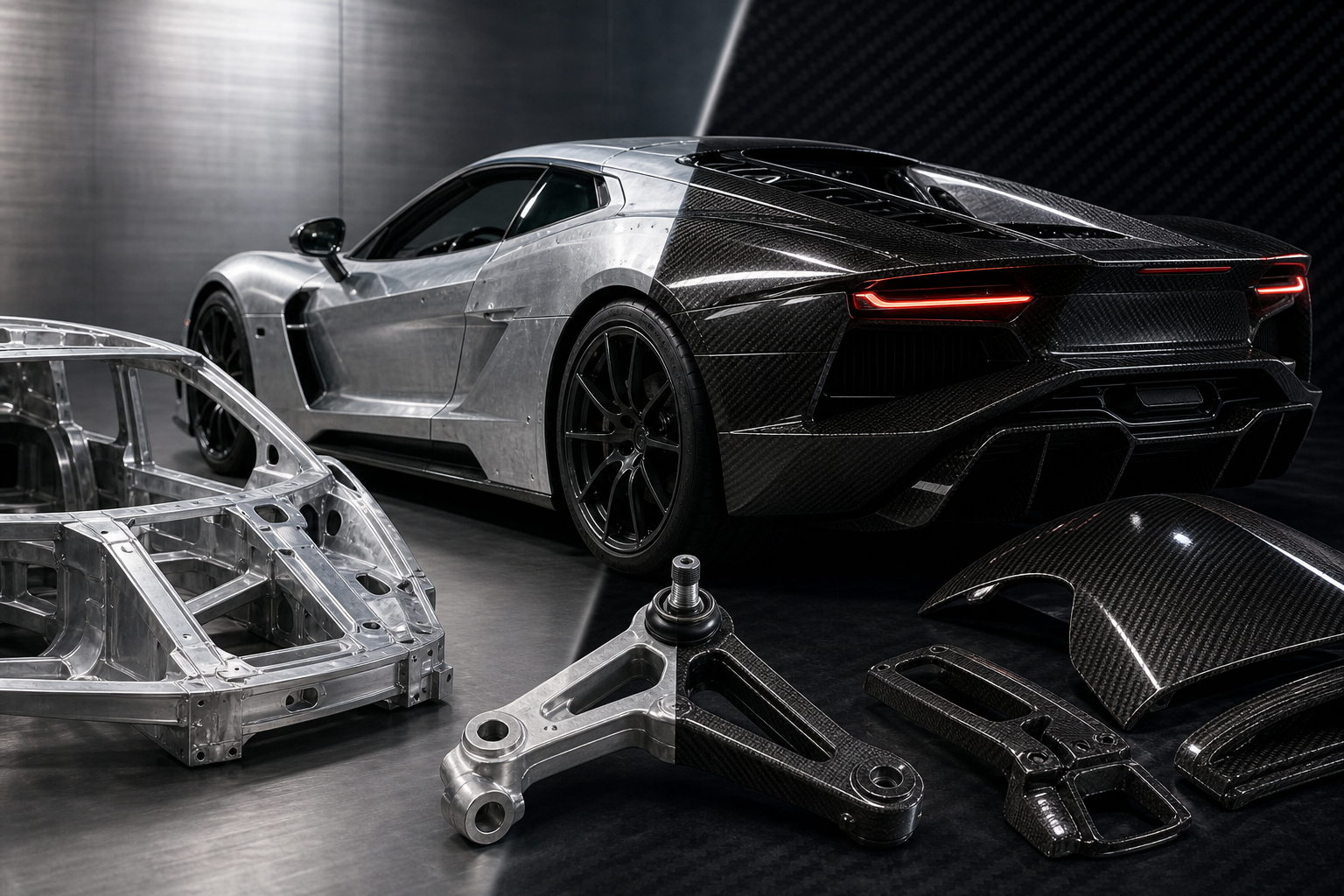

For decades, the material question in performance-car engineering has been about more than weight alone. Aluminum offered automakers a practical route to lighter structures, corrosion resistance, and manufacturing familiarity. Carbon fiber promised something more ambitious: major mass savings, exceptional stiffness, and a path to exotic-car performance. The debate between the two is now central to how manufacturers design everything from supercars to electric vehicles, and the answer is rarely as simple as choosing one over the other.
Why the material choice matters
Every vehicle starts with compromises. Engineers have to balance weight, rigidity, cost, crash performance, repairability, and production complexity. Aluminum and carbon fiber each solve parts of that equation, but they do it in very different ways.
Aluminum has become a mainstream lightweight material because it can be formed, stamped, welded, and repaired using industrial processes manufacturers already understand well. It’s lighter than steel and can significantly reduce vehicle mass without demanding an entirely new production ecosystem. That’s why it shows up in body panels, suspension components, suspension arms, and, in some cases, full-spaceframe construction.
Carbon fiber, by contrast, is a composite material built from woven fibers embedded in resin. Its appeal is obvious on a spec sheet. It can deliver a remarkable strength-to-weight ratio and excellent torsional rigidity, which is why it has long been associated with racing and low-volume supercars. But it also brings manufacturing challenges, long cycle times, and costly repair work if damage occurs.
Aluminum’s practical advantage
One reason aluminum has spread so widely is that it sits in the sweet spot between traditional manufacturing and performance goals. Automakers can use it selectively rather than redesigning an entire vehicle around a new materials strategy. That flexibility matters in high-volume segments, where cost and production efficiency are just as important as curb weight.
In performance applications, aluminum can be used for more than just body panels. It appears in chassis structures, subframes, control arms, knuckles, and other suspension pieces where reducing unsprung mass can improve steering response and ride quality. It can also help engineers lower the center of gravity when used in larger structural pieces or engine-related components.
Repair and service are part of the argument too. Compared with carbon fiber, aluminum is generally easier for body shops to work with, though it does require proper equipment and technique. For manufacturers selling sports cars into broader markets, that’s a meaningful advantage. Buyers who plan to actually use the vehicle, rather than store it as a showpiece, tend to care about how it will be repaired after a minor impact as much as they care about how it looks on a spec sheet.
Why carbon fiber remains the benchmark
Carbon fiber’s reputation comes from what it enables. A well-executed carbon tub or body structure can dramatically improve stiffness while keeping weight low, which is valuable not only for straight-line performance but also for suspension tuning and chassis precision. A rigid platform lets engineers more accurately control how the car responds over curbs, through braking zones, and under load in quick direction changes.
That’s why carbon fiber has become such an important material in motorsport and in road cars that borrow heavily from racing technology. Formula 1, endurance racing, and top-tier supercars have all used carbon structures to chase performance benefits that aluminum can’t always match at the same weight target.
Carbon fiber is also useful because it gives designers enormous freedom in shaping complex parts. Aero pieces, monocoques, roof panels, seat shells, splitter elements, and interior trim can all benefit from the material’s stiffness and low mass. In the right application, it allows engineers to reduce weight without sacrificing the structural integrity that performance vehicles need.
The cost of carbon fiber
The tradeoff is cost, and not just the purchase price of the raw material. Carbon fiber parts are typically more expensive to produce because the manufacturing process is slower and more labor-intensive than metal stamping or casting. Even when automation is involved, production volumes usually remain lower and tooling costs remain high.
There’s also a repair issue. Carbon fiber can be strong, but once it’s damaged, the fix is often more complicated and less straightforward than repairing metal. In some cases, replacement is the only sensible path. That creates a practical hurdle for owners and insurers, especially in cars meant to be driven regularly rather than kept as garage ornaments.
For that reason, carbon fiber tends to make the most sense in halo vehicles, competition machines, and limited-production performance models where the engineering payoff justifies the expense. In those applications, the material helps define the car’s character as much as its weight figure.
How manufacturers combine the two
The real-world answer for many modern performance cars is not one material or the other, but a mix of both. Automakers frequently combine aluminum, carbon fiber, and steel depending on what each section of the vehicle needs to do. A car might use aluminum for its main structure, carbon fiber for the roof or aero components, and steel in areas where crash behavior or cost control is more important.
This hybrid approach lets engineers optimize by function. Aluminum can cover large structural elements at relatively manageable cost, while carbon fiber can be reserved for components where every pound matters most. The result is a more balanced product than if the entire vehicle were built from a single expensive material.
That strategy is especially relevant in the electric-vehicle era, where battery mass has changed the rules of packaging and weight management. Automakers looking to offset heavy battery packs are increasingly interested in lightweight structures, and both aluminum and carbon fiber have roles to play. Aluminum offers scale and cost control; carbon fiber offers aggressive mass reduction where it can be justified.
Performance, feel, and engineering priorities
From a driver’s seat perspective, the differences between aluminum and carbon fiber show up in the way a car moves, stops, and changes direction. A lighter chassis generally reacts faster and places less demand on the tires and brakes. If the structure is also stiff, the suspension can do a better job of controlling body motions without relying on brute-force spring rates or damping.
Aluminum can deliver much of that benefit at a more accessible cost. Carbon fiber goes further, especially when stiffness targets are extremely demanding. That’s why the most serious track-focused road cars often lean on composite tubs or panels where the payoff is clearest. For less extreme vehicles, though, the gain from carbon fiber can be outweighed by the cost, complexity, and practical compromises.
In other words, the best material is the one that fits the vehicle’s mission. A luxury grand tourer, a volume sports car, and a race-derived hypercar do not need the same solution. Material selection is part of the car’s identity, but it’s also a straightforward engineering decision shaped by budget and intended use.
What buyers should actually look for
For shoppers comparing performance cars, the presence of carbon fiber should not automatically be treated as a verdict of superiority. It can signal serious engineering, but it can also be used selectively for visual effect. A carbon roof, mirror caps, or interior trim doesn’t tell the whole story about a car’s structure or dynamic behavior.
Aluminum, meanwhile, can be the smarter choice in a car designed to be driven hard without bringing exotic-car ownership headaches. It may not generate the same showroom appeal as exposed weave, but it often delivers many of the same benefits in a package that is easier to manufacture, repair, and live with.
The broader lesson is that both materials have earned their place. Aluminum became the workhorse of lightweight performance engineering. Carbon fiber became the specialist’s tool, reserved for the jobs where maximum stiffness and minimum weight matter most. The most effective modern performance cars usually rely on both.


0 Comments