
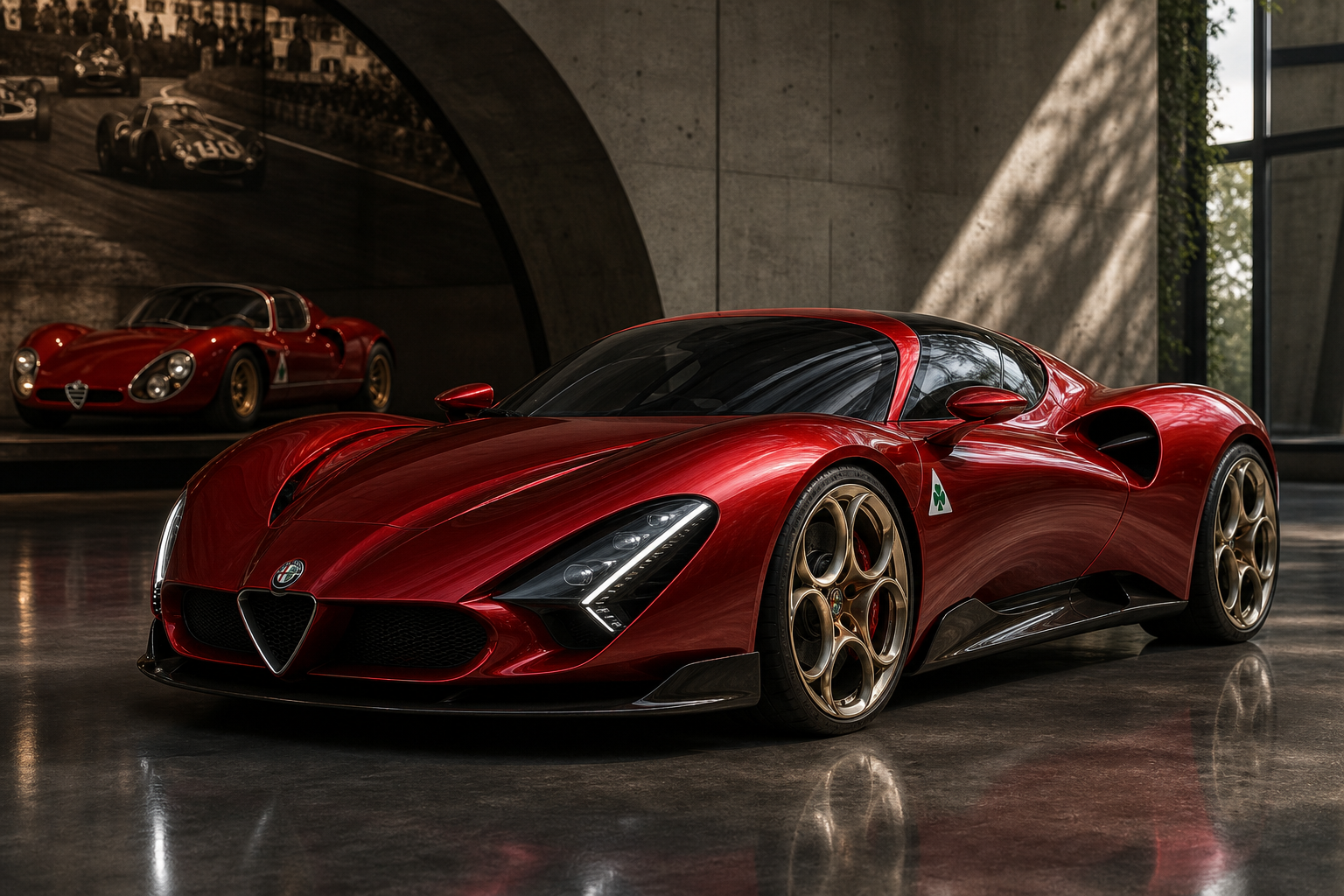

Alfa Romeo has never lacked for romantic material. The name alone carries decades of racing history, sculptural road cars and the kind of badge loyalty few manufacturers can match. That is why the company’s latest concept has drawn such attention: Alfa is presenting it as the car every Alfista has been waiting for, a machine intended to reconnect the brand with its most coveted tradition of low-volume, emotionally charged exotics.
Even in a market crowded with retro gestures and heritage tributes, Alfa Romeo’s concept stands apart because the brand’s history is so deeply tied to special-bodied performance cars. The new design is not positioned as a volume model or a conventional halo coupe. Instead, it appears to be aimed squarely at the emotional center of the brand, where collectors, longtime fans and design-minded buyers tend to overlap. That alone gives the project significance well beyond the usual concept-car reveal.
A name with real weight
The concept’s most important detail may be the badge it carries. Alfa Romeo has long used special names sparingly, and when it does, the company usually wants the reference to mean something. The 33 Stradale name is one of the most famous in the marque’s history, originally attached to the celebrated 1960s mid-engined road car derived from Alfa’s racing program. That original car remains one of the most admired Italian performance designs ever built, and any modern interpretation has to contend with that legacy.
That historical connection matters because Alfa does not have the same kind of supercar lineage as Ferrari or Lamborghini, but it does have a reputation for elegant performance cars with competition roots. A modern Stradale concept allows the company to draw directly on that heritage without pretending to be something else. For Alfa, that’s a more natural move than chasing mass-market prestige.
Why this concept matters to Alfa Romeo
Alfa Romeo has spent years balancing its identity between mainstream premium products and the performance image that defines the badge. The brand’s current and recent road cars have often been praised for chassis tuning and style, yet enthusiasts still tend to look back toward the more focused, emotionally resonant cars in Alfa’s past. A concept like this is designed to answer that expectation.
Calling the car “the one every Alfista has been waiting for” is a strong statement, but it also reflects how Alfa wants the market to read the project. This isn’t about incremental styling updates or another crossover derivative. It’s about reminding buyers that Alfa still sees itself as a maker of desirable driver’s cars, not just another premium brand with a sporting badge.
Concepts in this space usually serve several functions at once. They test public reaction, reinforce brand identity and give designers a freer hand than a production program usually allows. In Alfa’s case, the concept also acts as a statement of intent: the company is still willing to invest in vehicles that speak to enthusiasts first, even if the eventual business case is narrower than that for an SUV.
Design language and emotional appeal
Alfa Romeo has always been one of the industry’s strongest design brands, and any concept from the company is expected to carry more than just visual drama. The challenge is to make something that feels authentic to Alfa rather than simply generic exotic-car theater. That means proportion, surfacing and detail work matter as much as any headline-grabbing feature.
With a car like this, the details are part of the message. A concept referencing the 33 Stradale has to evoke compactness, speed and engineering clarity. The best Alfa designs tend to look as if they were shaped by airflow and intent rather than ornament, and that is the territory this concept needs to occupy if it is to satisfy the brand faithful.
That approach also helps explain why Alfa concepts draw such interest even when they don’t preview a direct production model. The company’s design studies often influence the way people think about future Alfas, whether or not the exact form reaches showrooms. In that sense, the concept is as much about restoring confidence in the brand’s design direction as it is about any single car.
The challenge of translating heritage into a modern product
Revisiting an icon like the 33 Stradale is never simple. The original car’s appeal came from a specific combination of rarity, racing pedigree and proportion that cannot be recreated by nostalgia alone. A modern concept has to work under contemporary expectations for safety, packaging, engineering and usability, even if it never becomes a full-scale production model.
That tension is part of what makes these Alfa projects interesting. The brand must decide how closely to hew to history and how much to reinterpret. Lean too far into the past and the car risks feeling like a tribute object; move too far away and the name loses its meaning. The sweet spot lies in carrying over the essential character without becoming a replica.
For Alfa Romeo, a concept like this also serves as a reminder of what differentiates Italian performance brands from broader-market rivals. Some manufacturers lean on technology-first messaging. Others sell themselves on usable speed. Alfa’s strongest cards have always been style, sound, chassis feel and a sense of occasion, and the 33 Stradale concept is clearly designed to keep those qualities at the forefront.
What enthusiasts will be watching for next
Whenever Alfa Romeo presents a concept with this kind of emotional charge, the next question is always whether any of it will reach production. That is especially true when the name being used is linked to one of the marque’s most famous rare cars. Enthusiasts will be looking not just for styling cues, but for whether the concept hints at a broader change in Alfa’s product direction.
Even if the concept never becomes a showroom model in exactly this form, it can still influence future Alfas in meaningful ways. Concept cars often establish themes that appear later in production design, from lighting signatures to body surfacing and cabin architecture. They also signal to the market that the company is willing to think beyond its current lineup.
For Alfa Romeo, that message is valuable. In a brand portfolio dominated by SUVs and mainstream premium expectations, a focused concept built around one of the company’s most revered names helps reset the conversation. It tells buyers and enthusiasts that Alfa still wants to be measured against its own history, which is where the badge has always carried the most weight.
That is why this concept matters even before any technical details or production plans are confirmed. Alfa Romeo is not just unveiling another show car; it is reaching back to one of the most important names in its past and asking the public to imagine what a modern interpretation of that idea could be. For a brand built on passion as much as product planning, that’s a familiar and strategically useful move.
0 Comments