
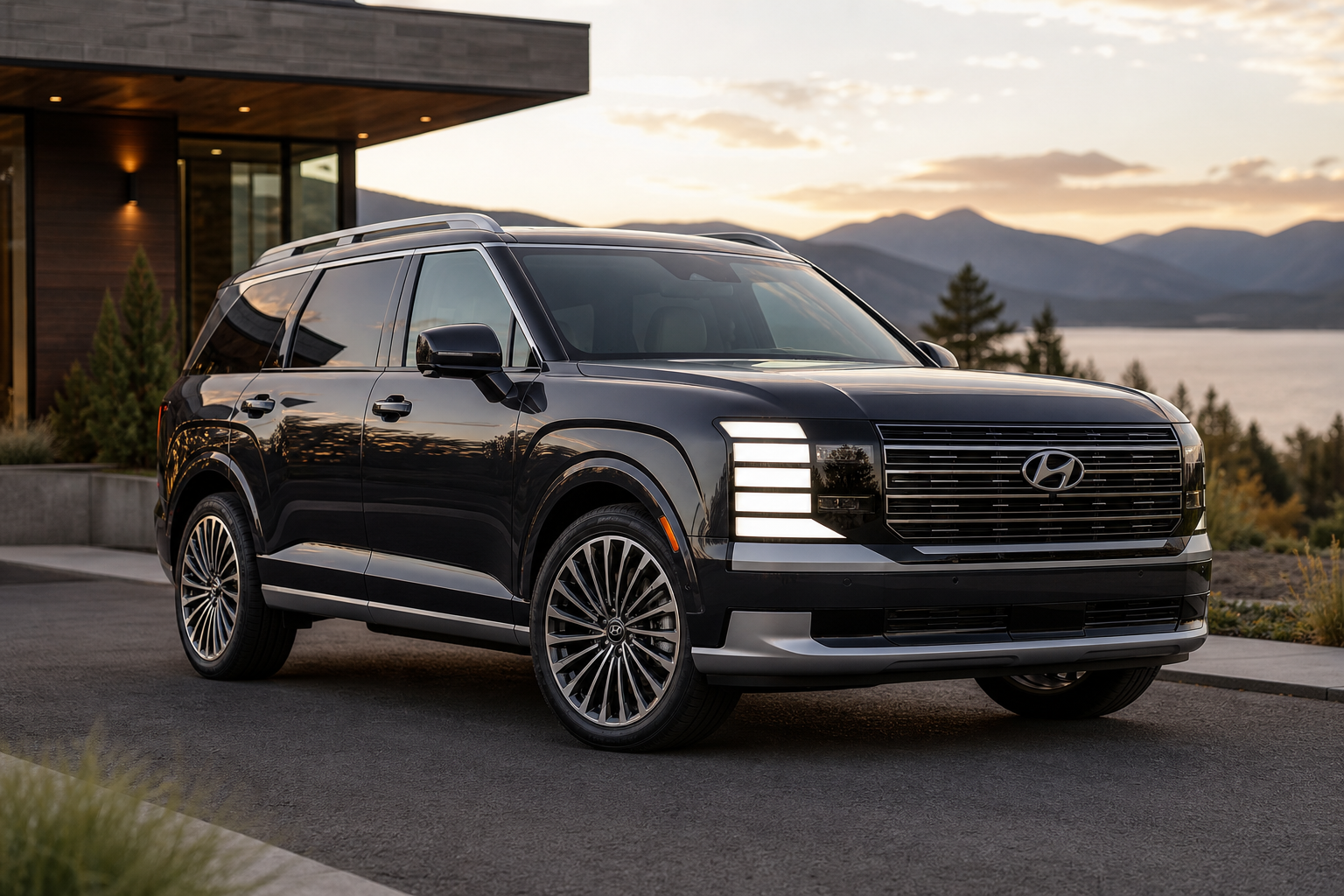

The 2026 Hyundai Palisade arrives at a moment when three-row SUVs are expected to do just about everything well: carry families, feel upscale, and avoid punishing owners at the fuel pump. Hyundai’s answer is the new Palisade Calligraphy Hybrid, a range-topping version that leans heavily on comfort and efficiency while keeping the Palisade’s core job intact. It’s the kind of model that shows how far mainstream brands have pushed the family-SUV formula.
Hyundai’s flagship SUV takes a more premium direction
The Palisade has long been Hyundai’s largest and most upscale SUV, but the 2026 model pushes that role further, particularly in Calligraphy trim. The hybrid powertrain broadens the Palisade’s appeal by adding a fuel-saving option to a lineup that has traditionally prioritized space, refinement, and strong V6 performance. For buyers who want a three-row vehicle without moving into luxury-brand pricing, that combination is likely the headline act.
Calligraphy has always been the version that best showcases Hyundai’s design and equipment ambition, and the hybrid only strengthens that positioning. The recipe is familiar on paper—large SUV, three rows, premium cabin—but the execution matters here. A vehicle of this size lives or dies on how well it balances smoothness, everyday usability, and operating costs. The hybrid variant is clearly aimed at making the Palisade more convincing in that respect.
What the hybrid changes
Hyundai has not turned the Palisade into a plug-in or a radically different machine. Instead, the hybrid system is meant to improve efficiency and broaden the SUV’s appeal without compromising the everyday qualities expected from a family hauler. That approach fits the segment well. Three-row SUVs spend much of their lives on school runs, commuting duty, and highway travel, so a hybrid powertrain can make a real difference over time without demanding changes in how the vehicle is used.
For buyers, the appeal is straightforward: the Calligraphy Hybrid brings the same flagship trim treatment with lower fuel consumption than a traditional gasoline-only large SUV. That matters in a class where size, weight, and drag can easily erode efficiency. Hyundai’s decision to pair its top trim with hybrid power shows that the company sees room for both luxury-minded equipment and practical ownership costs at the upper end of the Palisade range.
Design and presence remain central to the Palisade formula
The Palisade has always stood out with a shape that reads as substantial without becoming boxy in a utilitarian sense. The 2026 model continues that approach, using its size to create genuine road presence while keeping the lines polished rather than aggressive. In Calligraphy guise, the details are what separate it from lower trims, and that distinction is important because this version is meant to feel like the Palisade at its most complete.
That upscale mission is especially visible in a vehicle this large. A three-row SUV has to look credible from every angle; it cannot rely solely on a fancy badge or a badge-adjacent trim name. The Palisade’s design strategy is to look expensive without trying too hard, and the Calligraphy treatment gives Hyundai the freedom to emphasize texture, lighting elements, and exterior trim that help the SUV move closer to premium-brand territory.
Cabin space and everyday usability still define the package
Three-row SUVs succeed or fail based on how well they serve real families, not just on how polished they look in photos. The Palisade’s enduring strength has been its ability to provide generous seating, a user-friendly layout, and a cabin that feels coherent rather than overcomplicated. Calligraphy trim should sharpen those traits with more upscale materials and added equipment, but the underlying value is still in how well the vehicle handles the routine tasks of passenger hauling.
That includes the front seats, where long-distance comfort matters as much as styling; the second row, where access and legroom often decide whether the SUV feels genuinely family-friendly; and the third row, which may be occasional-use seating or a regular part of daily life depending on the household. The Palisade’s size gives Hyundai room to deliver a better solution than many midsize rivals, and the hybrid model does not appear to ask buyers to give that up in exchange for improved efficiency.
Why a hybrid Palisade makes sense now
The move to a hybrid version reflects where the market has gone, but it also fits the Palisade’s own strengths. Large crossovers are rarely purchased for performance alone. They are bought for flexibility, comfort, safety, and convenience, which means a hybrid powertrain can address one of the few pain points that remains difficult to ignore: fuel use.
Hyundai has already shown that it can build convincing hybrid systems in other segments, so applying that strategy to its flagship SUV feels like a logical extension rather than a marketing exercise. In a category where some competitors still lean heavily on traditional engines, the Palisade Hybrid gives Hyundai a way to stand out without abandoning the strengths that made the nameplate successful in the first place.
Position in the segment
The 2026 Palisade Calligraphy Hybrid sits in a crowded field of three-row SUVs, but it aims at a particularly broad part of that market: buyers who want near-luxury content, ample space, and better efficiency than a large gasoline SUV usually provides. That gives it an interesting position between mainstream family transport and more expensive luxury-branded alternatives.
Hyundai’s challenge is not simply to offer more features. It is to make the Palisade feel cohesive at the top of the range, with the hybrid powertrain contributing to the experience rather than functioning as a separate box checked on a spec sheet. On the evidence of the model’s direction, that is exactly the intent. The Calligraphy Hybrid is meant to be the Palisade as Hyundai wants it understood now: refined, practical, and more efficient, without losing the scale and substance that define the SUV.
For shoppers cross-shopping the top end of the three-row segment, that is a compelling formula. The 2026 Palisade Calligraphy Hybrid does not try to reinvent the family SUV, but it does sharpen the proposition in the areas that matter most: space, comfort, and day-to-day efficiency.
0 Comments