
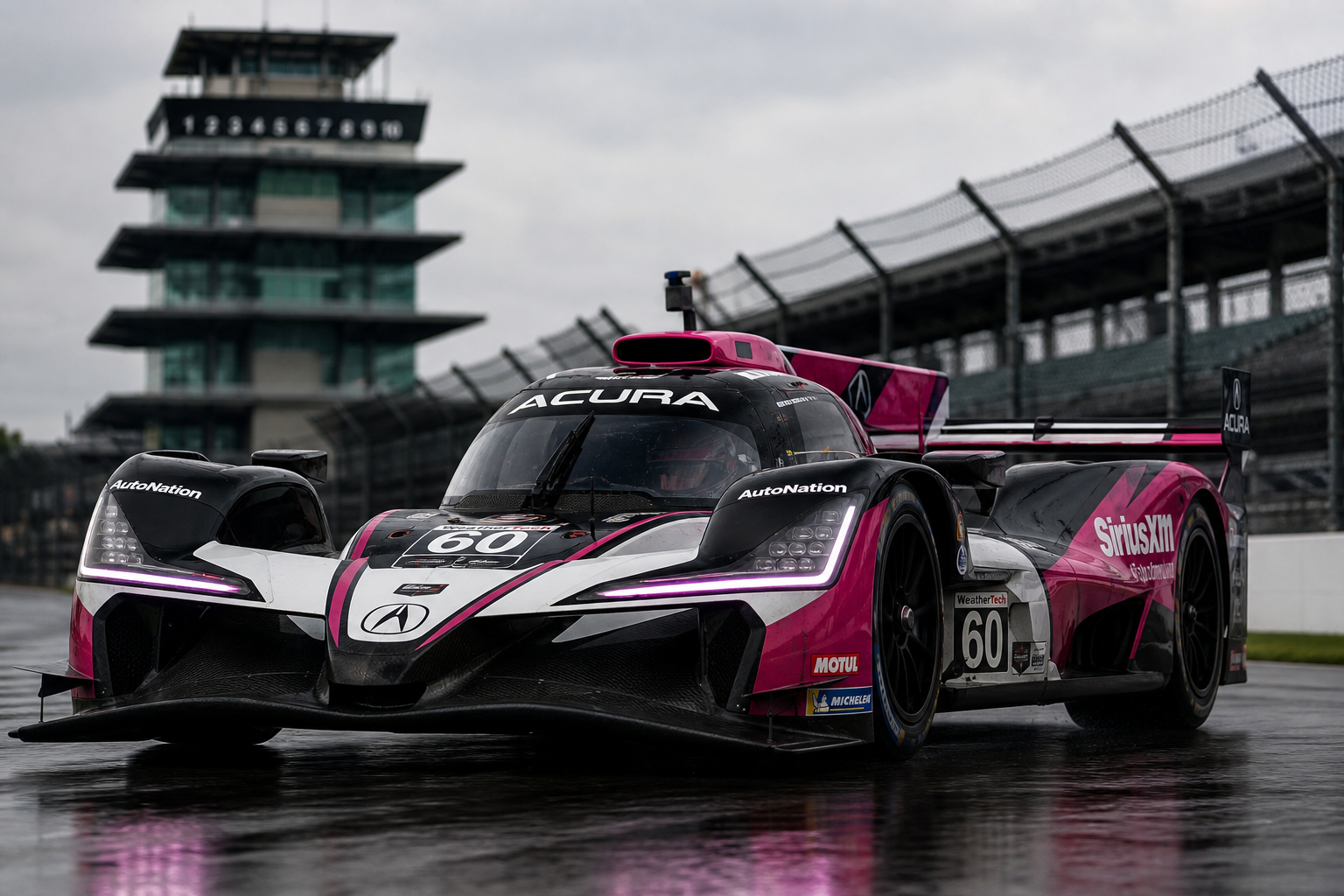

Indianapolis qualifying is rarely a gentle affair, and this one was made even less predictable by the weather. Through the damp-looking uncertainty and the pressure of a short session, Tom Blomqvist produced the lap that mattered, putting the No. 60 Acura Meyer Shank Racing ARX-06 on pole for the Battle on the Bricks.
Blomqvist’s best effort stopped the clock at 1 minute, 14.674 seconds around Indianapolis Motor Speedway’s 2.439-mile, 14-turn road course. It was his seventh career pole and gave Acura Meyer Shank Racing the prime starting position for one of the most technically demanding races on the IMSA WeatherTech SportsCar Championship calendar.
Blomqvist Finds the Lap When It Counts
Qualifying at Indianapolis is not about simply driving quickly. The circuit is a collection of compromises: long straights that reward aerodynamic efficiency, heavy braking zones that punish instability, and an infield section where a prototype has to change direction without becoming a very expensive lawnmower.
That challenge becomes considerably more complicated when weather affects the session. Tire temperature, track grip and the timing of a flying lap can all move the competitive order around. A driver may have only one genuinely useful opportunity before conditions change or traffic ruins the run.
Blomqvist made his count. The 1:14.674 lap was enough to put the Acura at the front of the GTP field, giving the team clean air for the start and avoiding the first-lap scrum that tends to develop when fast prototypes arrive at a narrow braking zone in a large, expensive flock.
A pole position does not win an endurance race, of course. It does, however, remove several immediate problems. The No. 60 Acura will start ahead of the traffic, have first choice of the racing line into the opening corners and avoid spending the early laps fighting through slower traffic before the race has properly settled.
Why Indianapolis Tests the Acura ARX-06
The Acura ARX-06 is built for the GTP class, where hybrid-assisted prototypes must deliver speed while managing tire life, energy deployment and the complicated balance between outright pace and race efficiency. Indianapolis is an especially revealing venue because it does not favor one simple type of car.
The road course begins with part of the famous oval, including the long front straight and the first corner before diving into the infield. That layout asks for a car that can carry speed through quicker sections without becoming difficult to place under braking. Too much aerodynamic drag costs time on the straight. Too little downforce makes the infield and slower corners unpleasant work.
That compromise is central to prototype racing. A car can look dominant in one sector and ordinary in the next, depending on how its aerodynamic package, hybrid system and tire usage interact. The best qualifying lap is therefore not merely a show of horsepower. It is evidence that Blomqvist and the Meyer Shank engineering crew found a setup capable of working across a circuit with several conflicting demands.
The Acura’s hybrid powertrain also adds another layer to the driver’s workload. Acceleration out of slow corners, energy deployment and braking behavior all have to be managed as one system. When the track is changing because of weather, that calibration becomes even more important. A setup that feels reassuring on one lap can suddenly become awkward if grip moves away from the tires or the track surface dries unevenly.
A Valuable Starting Position for Meyer Shank Racing
For Acura Meyer Shank Racing, the pole is a useful reward after a qualifying session in which timing mattered as much as pace. Starting first gives the team control of the opening phase, at least until pit strategy, traffic and the inevitable chaos of multi-class racing begin rearranging the order.
The advantage is particularly important at a circuit where the GTP cars share the track with other classes. Faster prototypes must work through traffic while avoiding unnecessary contact, and slower cars can create sudden gaps or bottlenecks in the infield. Beginning at the front means the No. 60 Acura can establish its own rhythm before encountering the full complexity of the field.
That does not mean the car can simply disappear into the distance. Indianapolis tends to punish small errors rather efficiently. A slightly long braking attempt, a poorly timed pass or a pit stop that loses a few seconds can erase the benefit of pole. Endurance racing has a habit of treating optimism as an amusing character flaw.
The starting position should also help the team gather information during the opening stint. Running in clean air allows the engineers to judge tire behavior and fuel usage without immediately reacting to the turbulence and traffic created by a large group of cars. Those early observations can influence the rest of the race, particularly if weather continues to threaten the circuit.
Blomqvist’s Seventh Career Pole
For Blomqvist, the result adds another pole to a career built across high-level sports-car racing. His lap demonstrates the particular skill required in prototype qualifying: extracting maximum performance from a complex machine over a short window, while leaving no room for a second attempt if the conditions turn sour.
That is a different task from managing a long race stint. In the race, consistency, traffic management and restraint matter just as much as speed. In qualifying, the driver has to commit. Every braking point arrives quickly, every curb becomes a decision, and the car must be placed accurately enough to preserve momentum through the next section.
The Indianapolis lap also adds to the qualifying record associated with the Acura Meyer Shank program. The session was reported as the 25th pole milestone in the IMSA WeatherTech SportsCar Championship context, alongside Blomqvist’s individual seventh career pole.
What Pole Changes for the Battle on the Bricks
The immediate task for the No. 60 Acura is straightforward: convert a fast Saturday into a disciplined race start. The team will need to protect the tires, manage the hybrid system and avoid getting drawn into unnecessary fights before the first round of pit stops. A pole-winning prototype that spends the opening stint defending every corner has not really gained much.
Weather could remain the great unknown. A dry race would place greater emphasis on tire degradation, traffic and pit strategy. Further changes in conditions would turn the event into a test of timing and judgment, with tire selection and caution periods potentially becoming more important than the raw pace shown in qualifying.
Either way, Acura Meyer Shank Racing begins with the advantage every prototype team wants: clear track ahead and no faster car to pass. Blomqvist has already done the spectacular bit, producing the quickest lap when the session offered very little certainty. Now the less glamorous work begins—keeping the car straight, the tires alive and the strategy out of trouble.
At Indianapolis, that is often where the real race starts.
0 Comments