Toyota’s rising star delivers a breakthrough performance in Chile, while a puncture robs Elfyn Evans of valuable championship points. Sébastien Ogier finishes second as Toyota secures another manufacturers’ title.
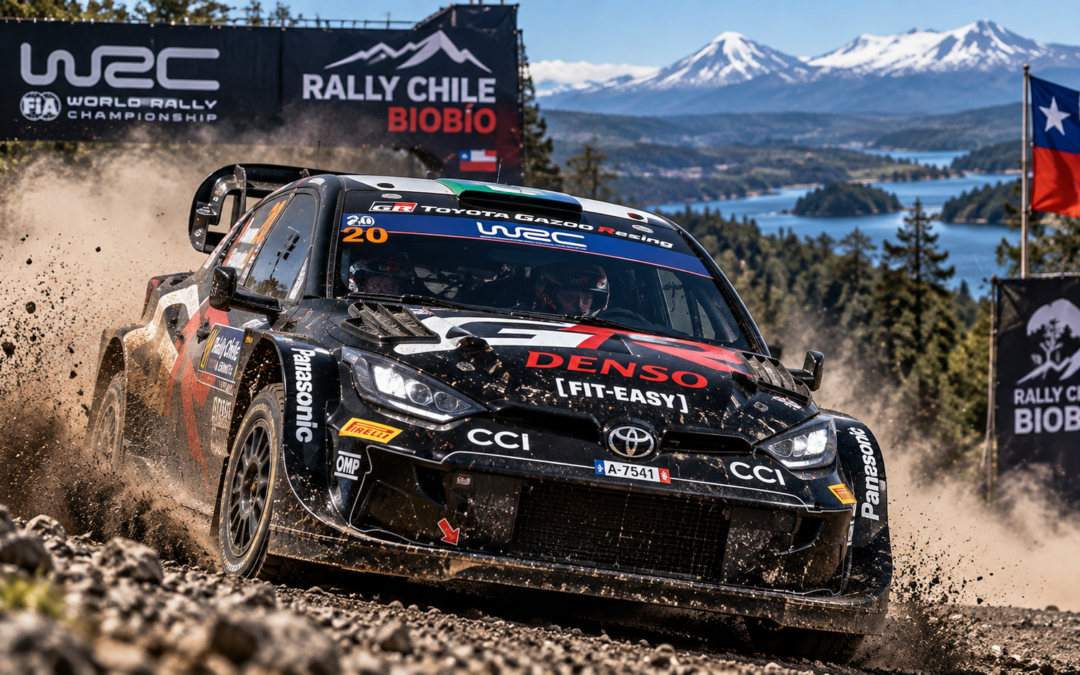
Oliver Solberg arrived at Rally Chile BIOBÍO with a chance to make a statement. By the time the final stage was complete, the young Toyota driver had done considerably more than that.
Solberg claimed victory in a dramatic edition of the World Rally Championship’s Chilean round, converting a strong opening performance into a decisive result while several of the championship’s leading contenders battled changing road conditions, technical problems, and late-rally misfortune.
The victory was particularly significant because it brought Solberg firmly back into the 2026 drivers’ title conversation. Championship leader Elfyn Evans had looked set to strengthen his advantage, but a puncture during the final leg dramatically reduced his points haul.
Behind Solberg, nine-time world champion Sébastien Ogier finished second, while Adrien Fourmaux secured third for Hyundai. The result also gave Toyota another major reason to celebrate: the Japanese manufacturer secured its sixth consecutive WRC manufacturers’ championship, equaling its record total of 10 titles.
What appeared to be a relatively straightforward rally for Solberg during much of the weekend ultimately became a contest in which the championship picture changed substantially in the closing kilometers.
Solberg Turns Speed Into a Complete Rally Victory
Solberg’s performance in Chile was not built around a single fortunate stage win. It was the product of consistent pace, careful tire management, and an ability to adapt to rapidly changing conditions.
Driving a Toyota GR Yaris Rally1, Solberg established himself as a leading contender early in the event. He showed confidence on the fast gravel roads around Concepción, where grip levels could change dramatically from one section to the next.
Chile is a demanding rally for several reasons. Its stages combine fast, flowing sections with technical corners, crests, compressions, and narrow stretches where a small mistake can carry significant consequences. Weather adds another layer of uncertainty, particularly when overnight rain transforms gravel roads into slippery, muddy surfaces.
Solberg managed those challenges effectively.
Rather than relying exclusively on outright aggression, he maintained a rhythm that allowed him to build an advantage without exposing the car to unnecessary risks. That approach became increasingly valuable as the rally progressed and the pressure on the leading drivers intensified.
By the conclusion of the event, Solberg had delivered one of the most important victories of his developing Rally1 career.
A Difficult Opening Day Reveals the Importance of Adaptability
Friday’s opening leg immediately demonstrated how quickly conditions could change.
Overnight rain left portions of the route wet and slippery. The muddy surface altered the balance between the drivers, and the usual disadvantage associated with running first on the road was reduced.
Elfyn Evans, who entered Chile as championship leader, was first through the stages. The Welshman had hoped that rain would help reduce the disadvantage of sweeping loose gravel from the racing line, and the conditions initially worked in his favor.
Solberg nevertheless adapted quickly.
He won the opening Turquía stage and remained near the front throughout the morning. Evans briefly moved ahead after the second test, but Solberg responded on the following stage and regained the lead.
The afternoon brought a different challenge. As the roads dried, the gravel became more abrasive, and the advantages associated with road position shifted once again.
Solberg remained composed, winning another stage and ending Friday at the top of the classification. Evans followed in second, while Adrien Fourmaux, Sébastien Ogier, and Sami Pajari remained close enough to keep the rally competitive.
The first day offered an early indication of Solberg’s approach: he was not simply the fastest driver in favorable conditions. He was also capable of adjusting to the surface as the rally evolved.
Evans Keeps the Championship Pressure on
For Evans, Rally Chile represented an opportunity to extend his lead in the drivers’ championship.
He arrived in South America with a 20-point advantage over Sami Pajari. Solberg was another 21 points behind Pajari, meaning the Toyota driver needed a strong result to remain within reach of the title fight.
Evans’ early performance was encouraging. Despite the challenges of opening the road, he stayed close to Solberg and avoided major mistakes during the opening stages.
That was important because the first car on the road often faces a difficult task on loose gravel. The driver must effectively clean the surface, removing loose material and potentially leaving less grip for the tires. Rain can alter that disadvantage, but as the surface dries, the challenge returns.
Evans managed to remain competitive as conditions changed. His pace was sufficient to keep pressure on Solberg, and for much of the rally he appeared capable of leaving Chile with a valuable championship result.
However, the final leg would change the outcome.
Ogier’s Late Charge Keeps the Rally Alive
Sébastien Ogier was another major factor throughout the weekend.
The veteran Toyota driver brought considerable experience to a rally where surface conditions and tire selection could make a substantial difference. After a competitive opening day, Ogier increased his pace during Saturday’s demanding stages.
The second leg featured long, technical tests that placed considerable demands on tires, suspension, and driver concentration. Ogier responded with a series of fast stage times and emerged as a serious challenger for the podium.
His charge also placed pressure on the drivers ahead of him.
While Solberg continued to protect his advantage, Ogier’s performance demonstrated that the rally remained vulnerable to a late change in momentum. The Frenchman eventually finished second, 16.6 seconds behind Solberg.
That result was another reminder of Ogier’s remarkable longevity at the highest level of rallying. Even as younger drivers increasingly shape the future of the championship, his ability to deliver fast, controlled performances remains a defining feature of the WRC.
The Final Leg Changes Everything for Evans
The most consequential moment of Rally Chile came during the final leg.
Evans suffered a puncture that undermined his hopes of securing a strong finish and increasing his championship advantage. The incident came at precisely the wrong time, with the rally reaching its decisive stages and the title battle becoming increasingly tight.
In rallying, a puncture can be far more damaging than a simple loss of speed. Depending on the location and severity of the damage, a driver may have to slow dramatically, stop to change a wheel, or continue cautiously while protecting the car from further problems.
Every lost second matters.
Evans’ puncture cost him valuable time and points. Instead of leaving Chile with a significantly larger championship advantage, he was forced to limit the damage.
The incident also altered the wider championship picture. Solberg’s victory moved him back into serious contention, while Evans’ reduced score gave his rivals renewed hope.
The result illustrated the unforgiving nature of the WRC. A driver can produce a strong performance across several days, only for a single mechanical or tire-related problem to change the outcome in a matter of minutes.
Solberg’s Victory Reopens the Drivers’ Championship
Before Rally Chile, Evans held the advantage in the drivers’ standings. After the event, that lead remained intact, but the gap to his closest challengers had narrowed.
Sami Pajari reduced the deficit to 17 points, while Solberg moved to within 21 points of Evans. That left the championship considerably more open than it might have appeared before the rally.
For Solberg, the victory was particularly valuable because it combined a major points haul with the confidence that comes from winning a demanding event.
His season had already demonstrated considerable potential, but Chile provided the kind of result that can change the trajectory of a championship campaign. A victory on challenging gravel roads against experienced competitors is a powerful indication that a driver can perform under pressure.
Pajari also remains an important part of the title battle. The Toyota driver has shown strong form throughout the season, and his ability to remain close to Evans ensures that the championship will not become a two-driver contest.
Ogier, meanwhile, strengthened his position through his runner-up finish and additional points from the final day.
With more rounds still to come, the championship remains far from decided.
Toyota Secures Another Manufacturers’ Championship
While Solberg celebrated his individual victory, Toyota Gazoo Racing secured another major achievement in the manufacturers’ standings.
The Chile result gave Toyota its sixth consecutive WRC manufacturers’ title and its 10th championship overall, matching the record for manufacturers’ crowns.
The achievement reflects the strength and consistency of Toyota’s Rally1 program. The team has maintained a competitive presence across a variety of surfaces and conditions, from snow and ice to high-speed gravel and technical asphalt.
The manufacturers’ championship is a broader test than the drivers’ title. It requires multiple crews to score consistently throughout the season, while teams must manage reliability, development, logistics, and strategy across an international calendar.
Toyota’s success in Chile was therefore more than a celebration of Solberg’s victory. It was confirmation that the organization had once again produced a package capable of delivering results across the season.
The title also adds significance to the performances of Evans, Solberg, Pajari, and Ogier. Their individual results contribute to a larger team effort that has made Toyota one of the dominant forces of the modern WRC.
Hyundai Shows Speed Despite Missing the Top Step
Hyundai Motorsport did not win Rally Chile, but Adrien Fourmaux’s third-place finish provided a positive result for the team.
Fourmaux remained competitive throughout the rally and demonstrated the pace required to challenge the Toyota contingent. Chile’s demanding roads offered opportunities for Hyundai to fight for the podium, particularly as conditions changed and the leading drivers encountered problems.
The final result nevertheless highlighted the difficulty of converting speed into victory.
Toyota occupied the top two positions, while Hyundai had to settle for third. That outcome reinforced the importance of consistency and reliability in a rally where the leading order can change quickly.
For Hyundai, the performance provides useful momentum heading into the remaining events of the season. The team will be looking to convert strong stage times into a victory as the championship enters its closing phase.
Why Rally Chile Is Such a Difficult Test
Rally Chile has quickly established a reputation as one of the most demanding gravel events on the WRC calendar.
The roads around the Concepción region feature a mixture of fast sections, technical corners, elevation changes, and unpredictable grip. Some stages can be relatively smooth and flowing, while others become rougher and more abrasive as the cars pass repeatedly over the surface.
Weather is another crucial factor.
Rain can transform the character of the rally. A road that appears relatively predictable during reconnaissance can become slippery and difficult to read once wet. Drivers must make rapid adjustments to their pace and confidence, while teams must select tires capable of handling a wide range of conditions.
The rally also places significant demands on the cars.
Suspension components, tires, underbody protection, and cooling systems must withstand high speeds over rough surfaces. Even a small mechanical issue can become a major problem when service opportunities are limited.
These characteristics make Chile an excellent test of a driver’s overall ability. Pure speed is not enough. The winner must also understand the road, manage risk, adapt to conditions, and preserve the car.
Solberg demonstrated those qualities throughout the weekend.
A Breakthrough Result for a Rising Toyota Driver
Oliver Solberg’s Rally Chile victory represents an important milestone in his development.
The Swedish-Norwegian driver has long been regarded as one of rallying’s most promising young talents. His speed has been evident in lower categories and previous WRC appearances, but success at the Rally1 level requires more than raw pace.
It demands consistency, technical understanding, effective communication with the co-driver, and the ability to manage pressure over several days.
Chile provided a compelling demonstration of those qualities.
Solberg built his advantage carefully, responded to changing conditions, and avoided the kind of mistakes that can destroy a rally lead. When rivals encountered problems, he was in a position to capitalize.
The result also strengthens his relationship with Toyota, which has invested heavily in developing competitive young talent. A victory of this magnitude gives Solberg additional confidence and establishes him as a driver who can compete for the biggest prizes in the championship.
The challenge now is to maintain that level of performance.
A single rally victory can change expectations, but sustained success requires repeating the same level of preparation and execution across different surfaces and countries.
What Comes Next for the WRC Title Fight?
Rally Chile was the 12th round of the 2026 World Rally Championship, leaving two events remaining on the calendar.
The next round is Rally Italia Sardegna, scheduled for October 1–4. The championship will then conclude with Rally Saudi Arabia in November.
Those events will present different challenges from Chile.
Sardinia is known for its technical gravel roads, narrow sections, and rough surfaces, while Saudi Arabia will introduce a new environment and a different set of demands for crews and teams.
The remaining rallies could therefore produce further changes in the championship standings.
Evans still has the advantage, but the margin is no longer as comfortable as it might have been without the late puncture. Pajari remains close enough to apply pressure, and Solberg’s victory gives him renewed momentum.
The championship may ultimately be decided by consistency rather than a single dominant performance. Drivers will need to balance speed with caution, particularly as the points become increasingly valuable.
Verdict: A Victory That Changes the Conversation
Oliver Solberg’s triumph at Rally Chile was one of the most important results of the 2026 WRC season.
It demonstrated his ability to win a demanding gravel rally, gave Toyota another major success, and reopened the drivers’ championship at a critical moment.
Elfyn Evans’ puncture was a painful setback, but it also served as a reminder that rallying rewards resilience as much as speed. His championship lead remains, yet his rivals now have a much clearer opportunity to challenge him.
Sébastien Ogier’s runner-up finish further underlined the depth of Toyota’s driver lineup, while Adrien Fourmaux’s podium provided Hyundai with a strong result in a difficult event.
The manufacturers’ title belongs to Toyota, but the drivers’ championship remains unresolved.
With Sardinia and Saudi Arabia still ahead, the 2026 WRC season has entered its most compelling phase. Solberg has momentum, Evans has the points lead, and Pajari remains within striking distance.
Rally Chile did not settle the championship.
It made the finish impossible to predict.
Rally Chile BIOBÍO 2026: Key Facts
| Category | Result |
|---|---|
| Event | Rally Chile BIOBÍO |
| Championship | FIA World Rally Championship |
| Round | 12 of 14 |
| Dates | September 10–13, 2026 |
| Winner | Oliver Solberg |
| Winning manufacturer | Toyota Gazoo Racing |
| Runner-up | Sébastien Ogier |
| Third place | Adrien Fourmaux |
| Championship leader before rally | Elfyn Evans |
| Evans’ decisive setback | Final-leg puncture |
| Toyota achievement | Sixth consecutive manufacturers’ title |
| Toyota’s total manufacturers’ titles | 10 |
| Next WRC round | Rally Italia Sardegna |
| Next round dates | October 1–4, 2026 |
| Final round | Rally Saudi Arabia |
| Final round dates | November 12–15, 2026 |
Results, championship developments, and event information are based on official WRC reporting and additional motorsport coverage.