
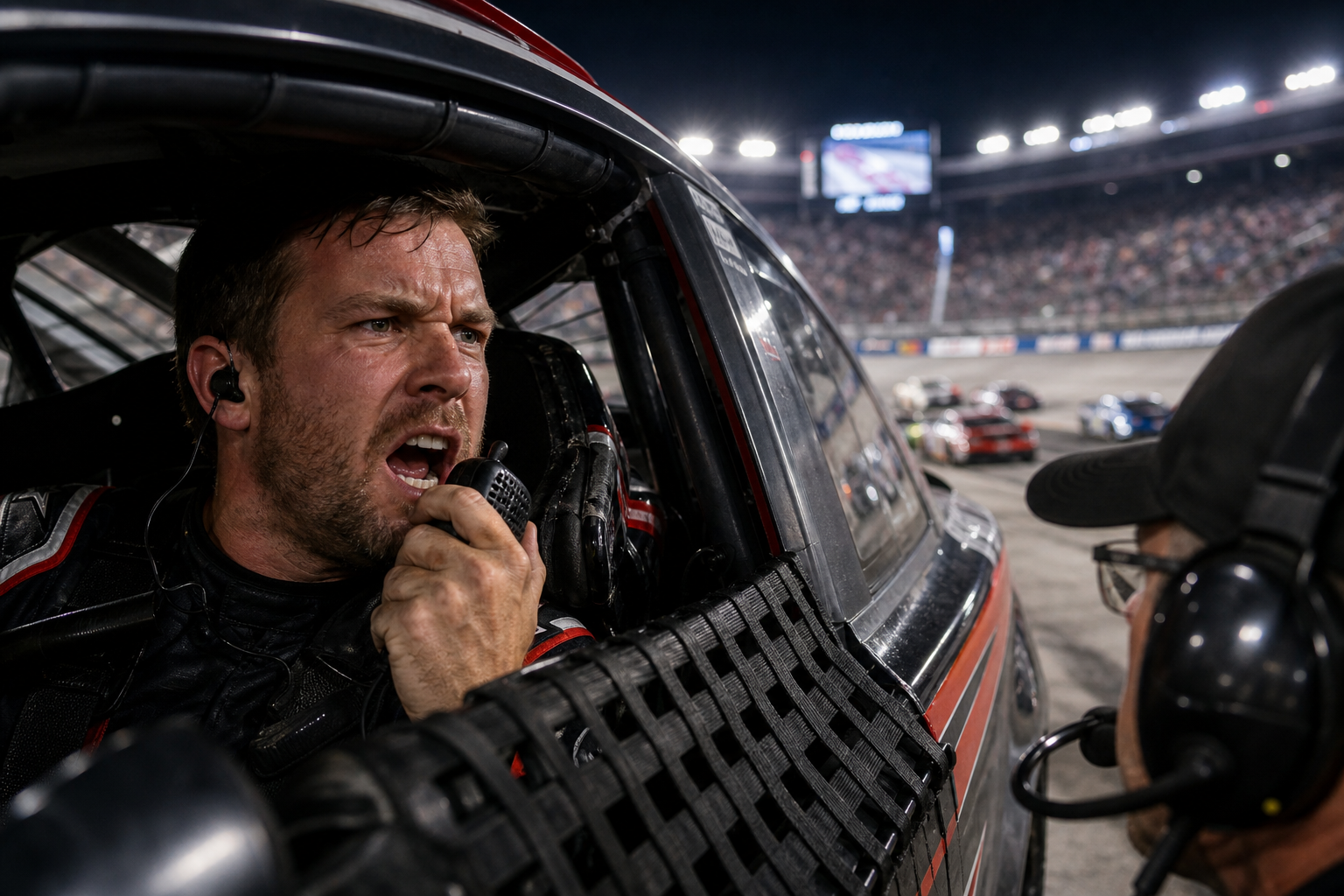

Three races into NASCAR’s Chase, the Cup Series has produced 661 recorded expletives across team radio channels—and that has pushed the series’ newly introduced swear jar to a very tidy $3,305.
The arithmetic is brutally simple: every reported swear word carries a $5 charge. Darlington, Gateway, and Bristol have therefore turned post-race frustration, driver impatience, and the occasional radio-channel meltdown into a surprisingly efficient fundraising exercise. NASCAR, meanwhile, is apparently keeping score with the enthusiasm of a school secretary wielding a red pen.
Bristol Added 193 Expletives to the Pot
The Bristol Night Race accounted for 193 of those recorded words during its 500-lap short-track contest. That makes Bristol the lowest contributor of the three races so far, although “lowest” is doing rather a lot of work here. One hundred and ninety-three swear words is still enough to make the average office sound like a library.
Darlington and Gateway supplied the other 468 expletives between them. NASCAR has not, in the available figures, broken that total into separate race-by-race numbers, but the overall count lines up exactly with the money collected: 661 words multiplied by $5 equals $3,305.
The Bristol figure is particularly amusing because short-track racing tends to produce the sort of close-quarters drama that makes calm radio communication a difficult ambition. Cars run in traffic, drivers have little room to recover from mistakes, and a small disagreement over space can become a very immediate problem. None of that proves why a particular driver swore, but it does explain why team radio is rarely a place of serene philosophical reflection.
A New Kind of NASCAR Statistic
Motorsports has always generated statistics that tell a story beyond the finishing order. Wins, laps led, caution periods, tire wear, pit-stop times, and points explain how a race unfolded. The swear jar belongs to a different category entirely: the statistic that reveals what the official timing sheets politely leave out.
Team radio is where the polished language of a race weekend disappears. Drivers communicate with crew chiefs and spotters while traveling at racing speeds, negotiating traffic, reacting to contact, and trying to understand what the car is doing beneath them. The radio is supposed to deliver useful information quickly. It also happens to capture the human response when the rear tires vanish, a rival appears where nobody wanted one, or a strategy call begins to look particularly questionable.
That tension is what makes the figure more interesting than a simple novelty. A swear word is not necessarily evidence of poor discipline or a bad relationship within a team. In many cases, it is simply the verbal punctuation of a high-pressure moment. The difference between “watch the inside” and something considerably less suitable for broadcast can be measured in milliseconds, frustration, and apparently five dollars.
Why the Number Is More Entertaining Than the Total
The $3,305 headline is the obvious attraction, but the distribution across races is the more revealing detail. Bristol’s 193 expletives represented less than one-third of the 661-word total, despite coming from a long 500-lap event. That makes the number difficult to interpret as a simple measure of race length or difficulty.
Radio language is shaped by circumstances that do not appear in a lap count. A race can produce fewer recorded outbursts because drivers spend less time in direct conflict, because incidents are spread differently through the field, or because the most heated moments simply do not result in a reportable word. Conversely, one particularly chaotic stretch can inflate the total in a hurry.
That is the charm of the swear jar. It is not pretending to be a scientific performance metric. It is an unofficial emotional barometer, one that measures the volume of irritation rather than speed. It may tell us something about the intensity of a race, but it cannot tell us which team had the best car or which driver made the cleverest strategic decision.
The Chase Has Already Produced Plenty of Tension
With three races completed in the Chase, the Cup teams have already generated hundreds of moments deemed expensive enough to count. The $3,305 total is therefore not the result of one spectacular radio eruption. It is the accumulated soundtrack of an entire postseason opening stretch.
That matters because the Chase adds a different layer of pressure to every exchange. Drivers and teams are not merely trying to collect another solid finish; they are operating in a championship environment where a poor result can carry consequences beyond one Sunday night. When the stakes rise, patience tends to become a rather scarce piece of equipment.
Still, the number should not be mistaken for a definitive ranking of which race was most dramatic. Bristol’s 193 words placed it third in the swear-count standings, but that does not mean it was the least eventful contest. It simply means fewer recorded expletives were included in NASCAR’s total. Racing, like accounting, can be very precise while leaving plenty of room for interpretation.
At Least the Math Is Easy
Unlike points calculations, playoff permutations, or the various strategic decisions that can make a NASCAR race resemble a moving spreadsheet, the swear jar has a refreshingly uncomplicated formula:
- 661 recorded expletives
- $5 per expletive
- $3,305 accumulated
There is no bonus for particularly creative language, no penalty multiplier for shouting at a teammate, and no indication that a driver can negotiate a bulk discount. Every word costs the same, whether it arrives as a muttered complaint or a full-volume broadcast that makes everyone in the pit box suddenly interested in their paperwork.
For now, Bristol’s 193-word contribution stands as the smallest of the three race totals, while the combined figure continues to climb. If the Chase produces more of the usual contact, strategic aggravation, and late-race desperation, NASCAR’s swear jar may become one of the more reliable postseason accumulators—right alongside points, tire debris, and crew chiefs insisting everything is under control.
0 Comments