
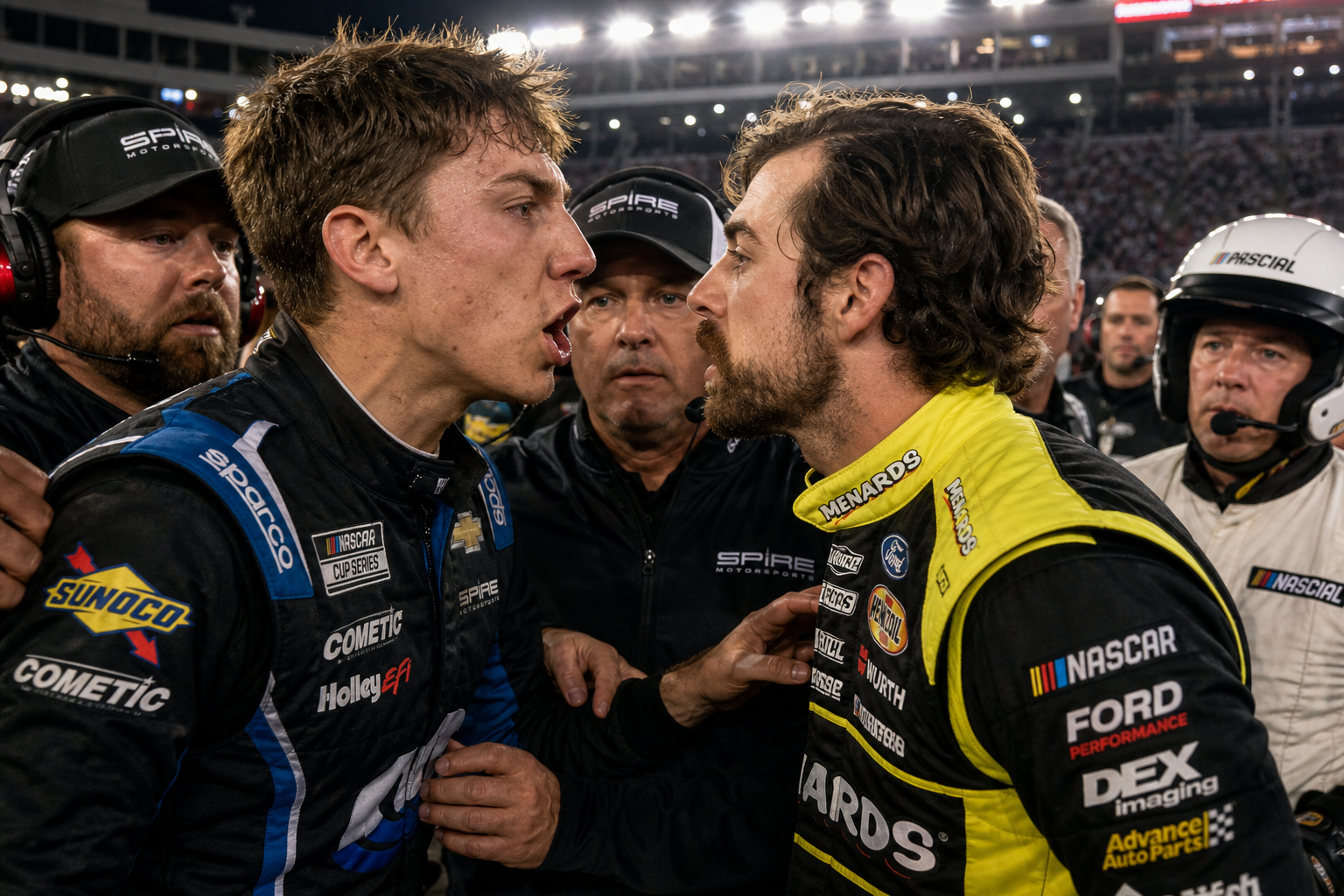

The postrace scuffle between Carson Hocevar and Ryan Blaney will not cost either NASCAR Cup Series driver a fine, suspension, or other sanction from NASCAR—at least for the moment. The sanctioning body announced Monday afternoon that it would issue no penalties to either driver following the confrontation after Saturday night’s Bristol race.
That decision does not mean NASCAR has closed the book on the incident. Officials are still reviewing video to determine whether any crew members who became involved should face discipline. In other words, the drivers have been given a pass, while the people surrounding them remain under examination. Nobody has ever accused a NASCAR garage of being a place where a disagreement stays neatly between two people.
NASCAR Separates the Drivers From the Crew
The distinction is important. NASCAR’s postrace investigations often consider the actions of drivers and team personnel separately, particularly when an argument spills out of the cars and into the pit road or garage area. A driver may avoid punishment while a crew member receives a fine or other penalty if officials believe that person crossed a line.
That is the situation facing the teams of Hocevar and Blaney. NASCAR has not announced any crew penalties, and the review remains ongoing. The organization’s Monday statement established only that the two drivers themselves would not be punished for the fight that followed the Bristol Night Race.
It also avoids turning a brief burst of postrace anger into a larger competitive penalty. A fine or suspension could have affected a driver’s championship campaign, while a crew sanction could influence a team’s preparation for the next event. By declining to penalize Hocevar and Blaney, NASCAR has treated the confrontation as an incident to be reviewed rather than one requiring immediate sporting consequences.
Why Bristol Is a Natural Place for Tempers to Boil
Bristol Motor Speedway is not a tranquil venue. The Tennessee track is a high-banked, short oval where the cars run close together, the racing surface leaves little room for error, and small moments can create enormous frustration. At roughly half a mile, Bristol compresses the field into a constant negotiation of position, traffic, and momentum.
That setting tends to produce the sort of racing where drivers remember every shove, squeeze, and lost position. Even when contact is part of the normal short-track equation, the driver on the receiving end rarely regards it as a charming example of NASCAR tradition. The checkered flag may end the race, but it does not always end the argument.
Night races add their own atmosphere. The lights, noise, packed grandstands, and immediate postrace access create an environment in which a driver can go from helmeted competitor to furious human being in a matter of seconds. Sometimes the adrenaline fades before anyone reaches pit road. Sometimes it clearly does not.
What the Decision Means for Hocevar and Blaney
For Hocevar and Blaney, the practical consequence is straightforward: neither driver has to prepare for a NASCAR-imposed penalty connected with the Bristol fight. They remain eligible to compete as normal, and their teams do not have to plan around a driver suspension or a formal loss of championship points stemming from the confrontation.
That does not make the incident irrelevant. NASCAR’s decision will be read as a judgment that the drivers’ actions did not warrant punishment under the sanctioning body’s rules, at least based on the footage reviewed so far. It also leaves room for the organization to act if additional video shows that crew members played a more serious role than initially understood.
Modern NASCAR produces a remarkable amount of camera footage. There are broadcast angles, in-car cameras, pit-road views, team recordings, and whatever material happens to appear online before the haulers have even left the track. A fight that once might have been reduced to a few eyewitness accounts can now be reconstructed frame by frame, which is excellent for accountability and rather less useful for anyone hoping a moment of poor judgment will quietly disappear.
A Familiar NASCAR Tension
NASCAR has always had to manage the line between emotion that enriches the sport and behavior that damages it. Drivers are expected to race aggressively, defend themselves, and show that a result matters. Fans generally do not want a field of perfectly polite robots exchanging scheduled compliments after every race. But the sanctioning body must also ensure that retaliation does not become a substitute for racing discipline.
That is why postrace fights are judged on their circumstances and participants rather than by a single automatic rule. A heated exchange can be part of the theater of short-track racing; an escalation involving crew members can become a safety and sporting issue. The difference may appear small in the moment, particularly when several angry people are standing around in fire suits, but NASCAR has to draw it somewhere.
In this case, the line has been drawn in a way that leaves Hocevar and Blaney without penalties while keeping the crew review open. It is a measured response to a noisy incident: the drivers can move on, but NASCAR is still checking whether anyone else turned a postrace disagreement into something more serious.
The Bristol fight will therefore remain part of the weekend’s story, even without a fine or suspension attached to either driver’s name. At a track built on close quarters and compressed tempers, that may be the most Bristol outcome imaginable: the race ends, the argument continues briefly, and NASCAR reaches for the video before reaching for the rulebook.

0 Comments