
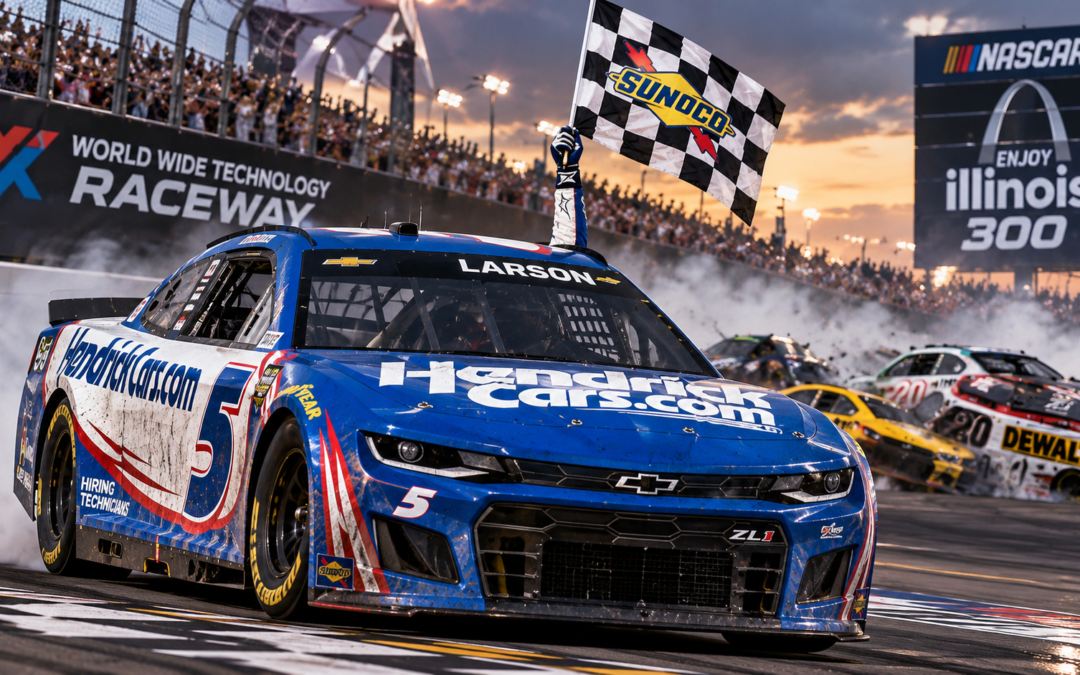
Hendrick Motorsports driver survives a wild, crash-filled Enjoy Illinois 300 to claim his first NASCAR Cup Series victory of 2026. Alex Bowman and Joey Logano complete the podium as the championship picture takes another dramatic turn.
Kyle Larson had waited a long time for this one.
After 51 consecutive NASCAR Cup Series races without a victory, the Hendrick Motorsports driver finally returned to Victory Lane on Sunday, surviving a chaotic Enjoy Illinois 300 at World Wide Technology Raceway at Gateway. What began as a race defined by tight championship competition ultimately became a battle of survival, with wrecks, mechanical failures, and overtime restarts reshaping the field.
Larson emerged from the mayhem to claim his first win of the 2026 season and the 33rd Cup Series victory of his career. Alex Bowman finished second, giving Hendrick Motorsports a memorable one-two result, while Joey Logano rounded out the podium after starting the afternoon from pole position.
The result was especially significant for Larson. His last Cup Series win had come more than a year earlier, and the drought had become an increasingly conspicuous statistic for one of NASCAR’s most accomplished drivers. At Gateway, however, speed, patience, and the ability to navigate an unpredictable finish finally came together.
A Playoff Race That Quickly Turned Unpredictable
The Enjoy Illinois 300 was the second race of the 2026 NASCAR Cup Series Chase, placing enormous importance on every position and every championship point.
World Wide Technology Raceway is a 1.25-mile oval with a distinctive layout. Its corners are not identical, and drivers must balance braking performance, corner-exit traction, and tire management throughout a long run. The circuit’s configuration can produce substantial differences in how cars behave at either end of the track.
That made setup and track position particularly important.
The race weekend began with Joey Logano demonstrating strong single-lap speed. The Team Penske driver secured pole position with a lap of 32.817 seconds at 137.124 mph, narrowly beating Larson to the front of the field.
With the Chase field tightly packed in the standings, the expectation was that Gateway would reward drivers who could maintain consistency and avoid costly mistakes.
Instead, the afternoon developed into one of the most turbulent races of the season.
Logano Controls the Opening Stage
Logano made the most of his pole position during the opening 45-lap stage, leading the entire segment and collecting the stage victory.
Christopher Bell finished second in Stage 1, followed by Kyle Larson, Ryan Blaney, and Chase Elliott. The result gave Logano an early advantage in the championship battle and confirmed that his No. 22 Ford had the pace to compete at the front.
But even the opening stage was not without drama.
The field struggled with the demanding nature of the Gateway circuit, where braking zones and corner exits can create opportunities for contact. Drivers were forced to manage traffic carefully, knowing that a small mistake could have consequences well beyond a single position.
For Larson, the opening stage was about staying close to the leaders while keeping his car intact. He had the speed to remain in contention, but the race was still far from settled.
Larson Answers in Stage 2
Larson’s fortunes improved in the second stage.
The No. 5 Chevrolet moved to the front and won Stage 2, earning valuable playoff points while establishing himself as one of the race’s strongest contenders.
Logano finished second in the segment, with Brad Keselowski, Ryan Blaney, and Josh Berry also among the leading finishers.
The stage victory was important for more than the additional points. It demonstrated that Larson’s car had the pace to win on merit, rather than simply benefiting from attrition.
Yet Gateway was proving difficult on equipment. The track’s repeated heavy braking zones placed considerable stress on the cars, while the long race distance left teams vulnerable to tire, brake, and suspension problems.
As the afternoon progressed, the difference between running at the front and simply surviving became increasingly important.
Mechanical Problems Add to the Tension
The race’s chaos was not limited to on-track incidents.
Brake-related problems became a major factor, with brake rotors reportedly exploding through the bodies of several Cup cars. The failures added another layer of danger and uncertainty to an already demanding race.
At a circuit where drivers must repeatedly slow heavy stock cars from high speed, braking performance is critical. A problem in the braking system can compromise a driver’s ability to negotiate the corners safely, especially when the field is running close together.
The mechanical failures also influenced the rhythm of the race. Teams had to balance outright speed against the need to preserve their equipment, while drivers faced an increasingly unpredictable set of circumstances.
For championship contenders, the consequences were potentially enormous. A mechanical failure or crash could turn a strong points day into a major setback.
Championship Contenders Caught in the Storm
The second race of the Chase produced a dramatic shakeup among several of NASCAR’s leading drivers.
A major late-race incident collected a number of playoff contenders, including Christopher Bell, Bubba Wallace, Tyler Reddick, and Josh Berry. The crash came with approximately 18 laps remaining and brought out a caution at a critical point in the race.
The incident underscored the narrow margins separating success from disaster in the modern Cup Series.
Bell had entered the race as one of the leading championship contenders after winning at Darlington in the opening Chase event. Reddick and Wallace had also been central figures in the title picture, while Berry had shown strong form during the race weekend.
Their involvement in the late incident meant that drivers who had been fighting for valuable championship points were suddenly forced to deal with damaged cars and lost track position.
The crash also changed the strategic landscape for the remaining competitors. With fewer cars capable of challenging at the front, the value of a clean restart and reliable equipment increased substantially.
Overtime Turns the Finish Into a Survival Test
The race ultimately required two overtime shootouts, transforming the closing laps into a frantic contest.
In NASCAR, overtime restarts can create some of the most unpredictable moments of a race. Drivers have only a short distance to establish position, and the field is often tightly bunched. A single aggressive move, a loss of traction, or contact between cars can trigger another caution.
That is precisely what happened at Gateway.
The late-race incidents produced repeated interruptions and forced the leaders to manage restarts under intense pressure. Drivers who had conserved their equipment for much of the afternoon suddenly had to make decisive moves with the finish within reach.
For Larson, the key was maintaining control through the disorder.
His experience in high-pressure situations helped him navigate the final sequence, while the Hendrick Motorsports team provided a car capable of remaining competitive through the race’s extended closing stages.
Bowman also handled the final restarts effectively, positioning himself to take advantage of the chaos and secure his best result of the 2026 season.
Hendrick Motorsports Delivers a One-Two Finish
Larson’s victory was impressive on its own, but Alex Bowman’s runner-up finish made the result even more meaningful for Hendrick Motorsports.
Bowman had endured a difficult personal week, having recently lost his dog, Finn, whom he described as his best friend. Despite the emotional burden, he delivered a strong performance at Gateway and finished second.
The result marked Bowman’s best finish of the 2026 season and his first top-10 result at World Wide Technology Raceway in five appearances.
For Hendrick Motorsports, the one-two finish represented a significant boost at a crucial point in the championship campaign. Larson earned the victory and the associated playoff momentum, while Bowman collected a major points haul.
The team’s performance also demonstrated the strength of its organization during a race in which several leading competitors were unable to reach the finish without major trouble.
Logano Converts Pole Into a Podium
Joey Logano’s third-place finish was another strong result from a driver who had controlled the opening stage.
Starting from pole, Logano showed that his Team Penske Ford was competitive from the beginning. He led the first stage and remained a factor throughout the race, even as the field became increasingly difficult to manage.
The podium finish gave Logano another valuable result in the Chase and helped offset the uncertainty created by the late-race chaos.
Although he did not secure the victory, Logano’s performance reinforced his status as a serious championship contender. His ability to collect stage points and finish near the front remains an important asset in a playoff format where consistency can be as valuable as outright wins.
What the Result Means for Larson’s Championship Campaign
Larson’s victory could not have arrived at a more important time.
The 2026 Chase began with the driver facing a significant winless streak, despite continuing to demonstrate competitive pace throughout the season. A victory at Gateway not only ended that drought but also delivered a substantial boost to his championship hopes.
Winning a Chase race provides more than a trophy. It creates momentum, strengthens a team’s confidence, and can change the way competitors approach the remaining events.
Larson’s success also gives Hendrick Motorsports an important advantage as the championship battle moves forward. The team now has a clear indication that its No. 5 Chevrolet can perform under the pressure of a playoff race characterized by mechanical problems and repeated restarts.
However, the victory does not eliminate the challenges ahead. The 2026 championship remains a long campaign, and the remaining races will present different track configurations, weather conditions, and strategic demands.
Larson will need to continue collecting strong finishes if he hopes to convert his Gateway breakthrough into a championship run.
Gateway Exposes the Fine Margins of NASCAR’s Playoffs
The Enjoy Illinois 300 was a reminder that NASCAR’s championship battles are not determined by speed alone.
A driver can qualify near the front, win a stage, and run competitively for most of the afternoon before losing everything in a late incident. Conversely, a driver who avoids trouble and manages the final restarts can emerge with a result that dramatically improves his championship position.
Gateway’s unique characteristics magnified those pressures.
The circuit’s braking zones place significant demands on the cars, while its relatively short length keeps the field closely connected. Drivers must repeatedly navigate traffic, manage tire wear, and find a balance between aggression and restraint.
That combination makes Gateway a difficult venue for championship contenders. There is little room for error, and the consequences of a mistake can be substantial.
The 2026 race demonstrated that reality in spectacular fashion.
A Memorable Victory in a Wild Afternoon
Kyle Larson’s return to Victory Lane at World Wide Technology Raceway was not a routine win.
It came after a 51-race drought, in the middle of a championship battle, and during a race that descended into a succession of crashes, mechanical failures, and overtime restarts.
Larson had the pace to win, but he also needed the composure to survive.
Alex Bowman’s second-place finish added to the significance of the day for Hendrick Motorsports, while Joey Logano’s podium result ensured that the pole winner remained a major factor in the championship picture.
For the drivers caught in the late wrecks, the afternoon represented a costly reminder of how quickly fortunes can change in NASCAR.
And for Larson, it was the kind of victory that could redefine a season.
The drought is over. The No. 5 Chevrolet is back in Victory Lane. With the Chase continuing, Kyle Larson now has the opportunity to turn a chaotic Gateway triumph into something much bigger.
2026 Enjoy Illinois 300: Key Facts
| Category | Result |
|---|---|
| Race | Enjoy Illinois 300 |
| Series | NASCAR Cup Series |
| Date | September 13, 2026 |
| Circuit | World Wide Technology Raceway at Gateway |
| Location | Madison, Illinois |
| Winner | Kyle Larson |
| Winning team | Hendrick Motorsports |
| Runner-up | Alex Bowman |
| Third place | Joey Logano |
| Larson’s winless streak ended | 51 races |
| Larson’s career Cup victories | 33 |
| Larson’s 2026 wins | 1 |
| Stage 1 winner | Joey Logano |
| Stage 2 winner | Kyle Larson |
| Overtime restarts | 2 |
| Track length | 1.25 miles |
| Race distance | 240 laps / 300 miles |
| Championship significance | Second race of the 2026 Chase |
Race facts and results are based on NASCAR’s official race recap, published race results, and additional motorsports reporting.