
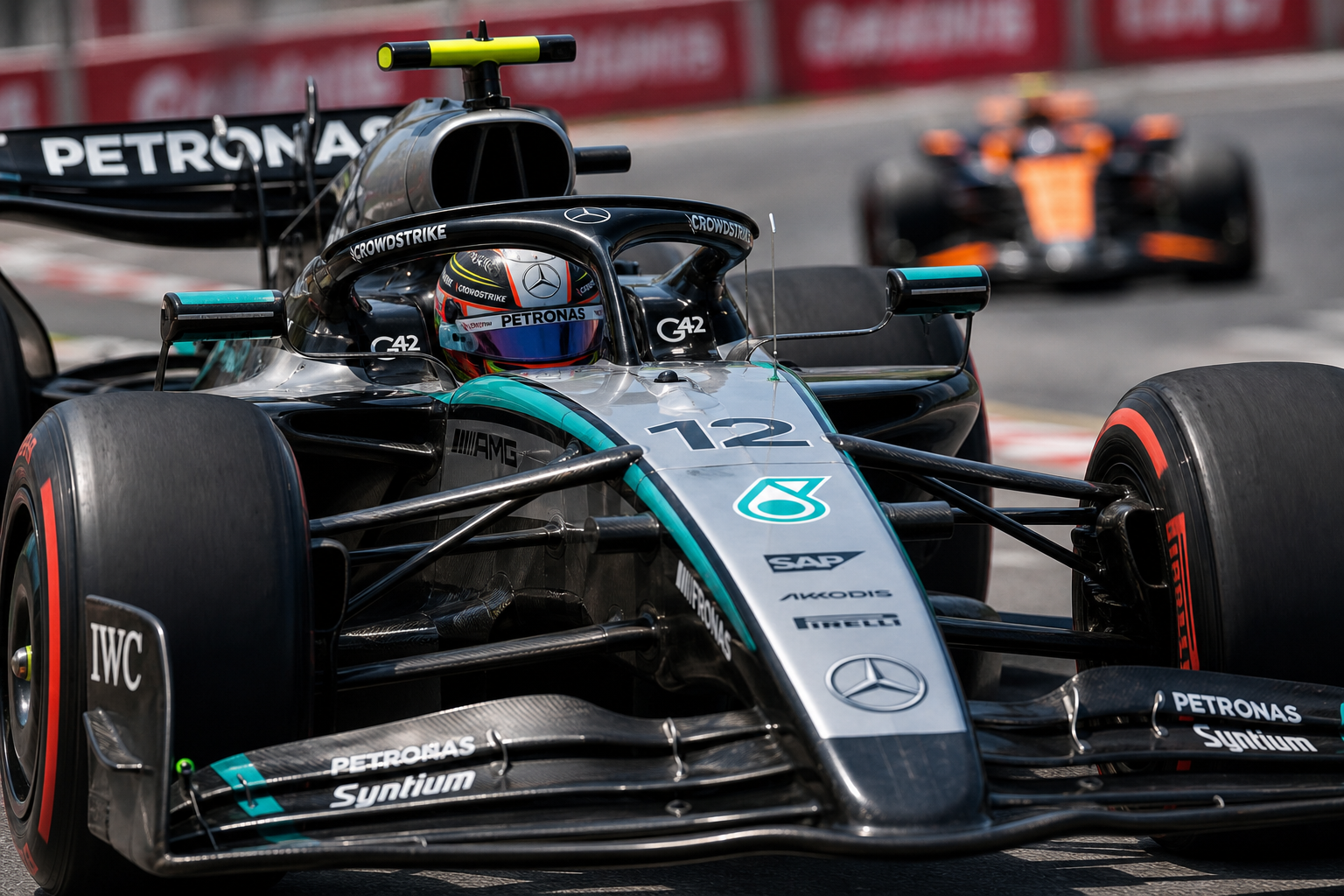

Mercedes has spent years trying to build a Formula 1 lineup that can keep up with the front of the grid. It now appears to have one of those rare and irritatingly pleasant problems: a youngster who is so quick that the team’s chief concern is not pace, but keeping him within the white lines and out of trouble with the stewards.
That youngster is Kimi Antonelli, and in Madrid he gave Pete Bonnington a fresh round of vocal exercises. Bonnington, who has seen enough F1 chaos to qualify as a full-time referee, had to keep reminding the 20-year-old Italian about track limits while the race ticked away and the margins got tighter. On a circuit where overtaking was about as realistic as finding a free espresso at a Grand Prix paddock, the job was simple in theory: stay tidy, stay patient, and bank the result.
A Quick Car Can Be A Problem Too
This is the sort of issue teams are happy to have. The modern paddock is full of organizations desperate to find speed, then just as desperate to figure out what to do with it once it arrives. Mercedes has Antonelli, a driver with serious natural pace, and that creates a rather luxurious sort of tension. He is quick enough to put pressure on teammates, rivals, and the pit wall alike. The downside is that speed at this level tends to come wrapped in risk, and the errors can be deliciously expensive.
There was already a hint of that in Madrid. Antonelli had gained from an earlier virtual safety car, which is exactly the sort of race-shaping intervention teams pray for and then pretend was entirely within their strategic genius. With overtaking effectively strangled on the circuit, track position mattered enormously. Once he had the opportunity, he simply had to finish the job without picking up penalties or making a mess of the final stretch.
Easy enough to say from the sofa. In the car, with the pressure mounting and every lap monitored by invisible referees in race control, it is a different matter entirely.
Why Mercedes Calls It A Luxury Problem
Team boss Toto Wolff has been around long enough to know the difference between a genuine crisis and a first-world racing headache. This is the latter. Mercedes is not lamenting a lack of speed. It is managing an abundance of it, and trying to make sure Antonelli’s natural aggression is turned into points rather than paperwork.
The phrase “grey hairs” is doing a lot of work here, but it fits. A driver with Antonelli’s pace is valuable precisely because he forces the team to think harder. He can extract more from a lap than a conservative, metronomic points collector. He can also invite unnecessary drama if the edge gets a little too sharp. F1 tends to reward bravery until it suddenly doesn’t, which is a thoroughly irritating feature of the sport.
For Mercedes, the balance is obvious. You do not want to dull the instincts of a fast young driver just because he occasionally makes life difficult for the pit wall. But you also cannot afford to let him treat the race like a private test session with bonus scenery. That is where Bonnington’s calm persistence comes in. The radio messages may sound schoolmasterly, but in an F1 race they are part instruction, part damage limitation, part parental supervision.
The Madrid Race Made The Point
Madrid was the perfect illustration of the issue. Track limits were being watched closely, overtaking was stubbornly difficult, and the margin for error was tiny. In that sort of race, discipline matters as much as raw pace. Antonelli had the speed to be useful, the position to benefit from the virtual safety car, and the task of converting that into something worthwhile without donating time or penalties for free.
That combination is often where young F1 careers are shaped. Plenty of drivers arrive with speed. The trick is turning speed into repeatable, race-long effectiveness. The very best do it while looking eerily calm, as if the whole thing were a pleasant afternoon drive with some bonus telemetry. Most take a bit longer. Antonelli is still in the phase where the team is learning how much freedom to give him and how much leash to keep on the table.
And let’s be honest, it is a rather nicer problem than wondering where the lap time has gone. A driver can be coached into greater restraint. He cannot be coached into being fast in the first place. That bit has to be there from the start.
What It Means For Antonelli And Mercedes
Mercedes clearly believes Antonelli has the ingredients to become a serious long-term asset. The team would not be fussing over track limits and race craft if it did not think the upside was worth the aggravation. In Formula 1, the line between “promising” and “properly important” is often drawn by how quickly a driver learns to manage his own pace. Antonelli is still doing the learning, and that is entirely normal.
What makes the story interesting is the shape of the concern. This is not a team trying to hide a weakness. It is a team trying to refine a strength. That is a far more pleasant place to be, even if it comes with a few extra wrinkles for Wolff and a bit of throat-clearing for Bonnington over the radio.
Mercedes would gladly accept a little more of this kind of headache. A quick driver who keeps the engineers busy is a much better source of grey hair than one who leaves them staring at the timing screens in silence. The former can be managed. The latter usually means you have a problem far larger than track limits.
Antonelli, then, is giving Mercedes exactly what it hoped for and exactly what it feared: proof of speed, proof of potential, and just enough rough edge to keep everybody honest. In F1, that is practically a compliment.


0 Comments