
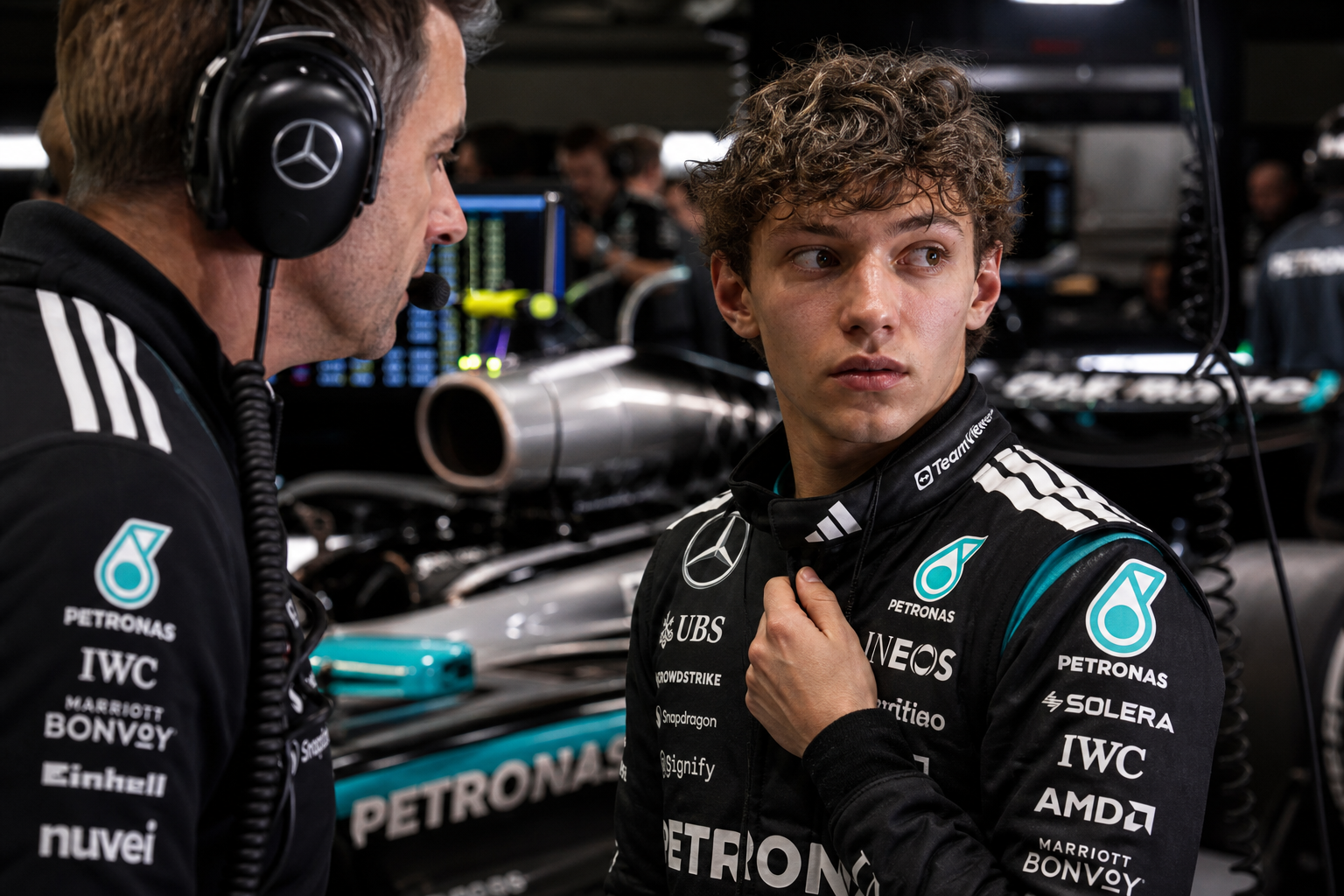

Kimi Antonelli appears to have decided that the normal rules of Formula 1 development do not apply to him. In Madrid, the Mercedes rookie was quick enough to create a very pleasant problem for the team and a mildly alarming one for everyone else in the garage.
That was obvious over the radio, where race engineer Pete Bonnington found himself in the unenviable role of schoolmaster, repeatedly telling the 20-year-old Italian to respect track limits. Not exactly the glamorous side of Grand Prix racing, but then motorsport is often less about heroics and more about one bloke trying to stop another from collecting penalties like supermarket vouchers.
Mercedes had already caught a useful break with an earlier virtual safety car, and on a circuit where overtaking was stubbornly difficult, Antonelli’s task was simple enough: keep it tidy, keep it legal, and bring home the result. Easier said than done when a driver is clearly pushing hard enough to flirt with the edge of the rules, lap after lap. That, in a rather roundabout way, is the whole issue.
A rookie who is already too quick for comfort
Teams usually want their new drivers to settle in quietly, learn the systems, and avoid expensive theatrics. Antonelli seems to have skipped that stage and gone straight to the bit where the engineers start asking awkward questions about ceiling heights, future lineups, and whether the current plan may need a small fire extinguisher.
For Mercedes, speed is supposed to be a blessing, not a source of mild panic. Yet that is exactly what Antonelli’s performances are becoming. If a rookie is fast enough to regularly threaten the established order, the team is forced into a slightly luxurious sort of headache: how to manage the talent without clipping the wings of the very driver it wants to develop.
This is where Bonnington’s radio messages become more telling than any highlight reel. A driver who needs constant reminders about track limits is not necessarily driving badly. Quite the opposite, actually. He is often driving right on the threshold, which is precisely where you want a youngster with proper pace to live. But that threshold is also where errors, penalties, and bruised team radio messages breed like damp in a badly ventilated garage.
Why Madrid exposed the problem
The Spanish Grand Prix can be a cruel little test of patience. The circuit tends to punish the ambitious and reward the tidy, which makes it a rather awkward place for a driver who wants to prove just how much grip and confidence he really has. Once the virtual safety car had played into Mercedes’ hands, Antonelli did not need a miracle. He needed discipline.
And discipline, in Formula 1, is rarely as straightforward as it sounds. Track limits at modern circuits are not merely painted lines and stern words. They are part of the sporting calculus, a constant calculation of how much curb to attack, how much runoff to use, and how hard to lean on the car without stepping over the line that brings the stewards into the picture.
That Antonelli was still being urged to rein things in says plenty about where Mercedes thinks his ceiling is. Teams do not nag drivers this persistently unless they believe there is more performance on the table. Bonnington was not trying to slow down a cautious rookie. He was trying to keep an evidently rapid one from getting carried away with himself.
Mercedes has a useful dilemma on its hands
Every successful team dreams of having too many good drivers and too many competitive cars. It sounds wonderful until the garage begins to resemble a family dinner where nobody agrees on the seating plan. Antonelli’s pace is creating exactly that sort of internal tension for Mercedes.
If he is quick enough to pressure the team’s established order, then Mercedes has to think carefully about how it manages his progression. Too much control, and you risk dulling the sharpness that makes him special. Too little, and the team ends up spending entire Sundays trying to explain penalties, missed opportunities, and why the pit wall now needs stronger coffee.
That is why this is being described as a luxury problem. It is easier to calm down a fast driver than to manufacture speed from scratch. You can coach restraint. You cannot coach outright pace into someone who does not have it. Mercedes would much rather be having conversations about track limits than wondering where the speed has gone.
What Antonelli’s rise means beyond one race
Antonelli’s early Formula 1 form matters because it suggests Mercedes may already have a genuine front-running prospect on its hands. That is not the same as saying he is finished article. Far from it. But the raw speed is there, and in this sport that is usually the bit you can’t fake for very long.
What comes next is the difficult part. The quickest young drivers often have to learn that a fast lap and a finished race are not always the same thing, especially when the margins are this fine. The best teams help them trim the excess without sanding off the edge. That is delicate work. A bit like trying to sharpen a knife while insisting nobody gets hurt.
Mercedes, for its part, will take the inconvenience. Every team would. A rookie who is constantly being told to watch the track limits is a far better problem than a rookie who needs to be told where the braking point is. Antonelli’s speed may be causing grey hairs, but they are exactly the sort of grey hairs Toto Wolff would happily keep.
For everyone else, it is another reminder that the transition from promising young driver to serious Formula 1 force rarely happens quietly. Sometimes it arrives with a bit of noise on the radio, a few clipped curbs, and an engineer sounding like he has had enough of your nonsense before lunch.


0 Comments