
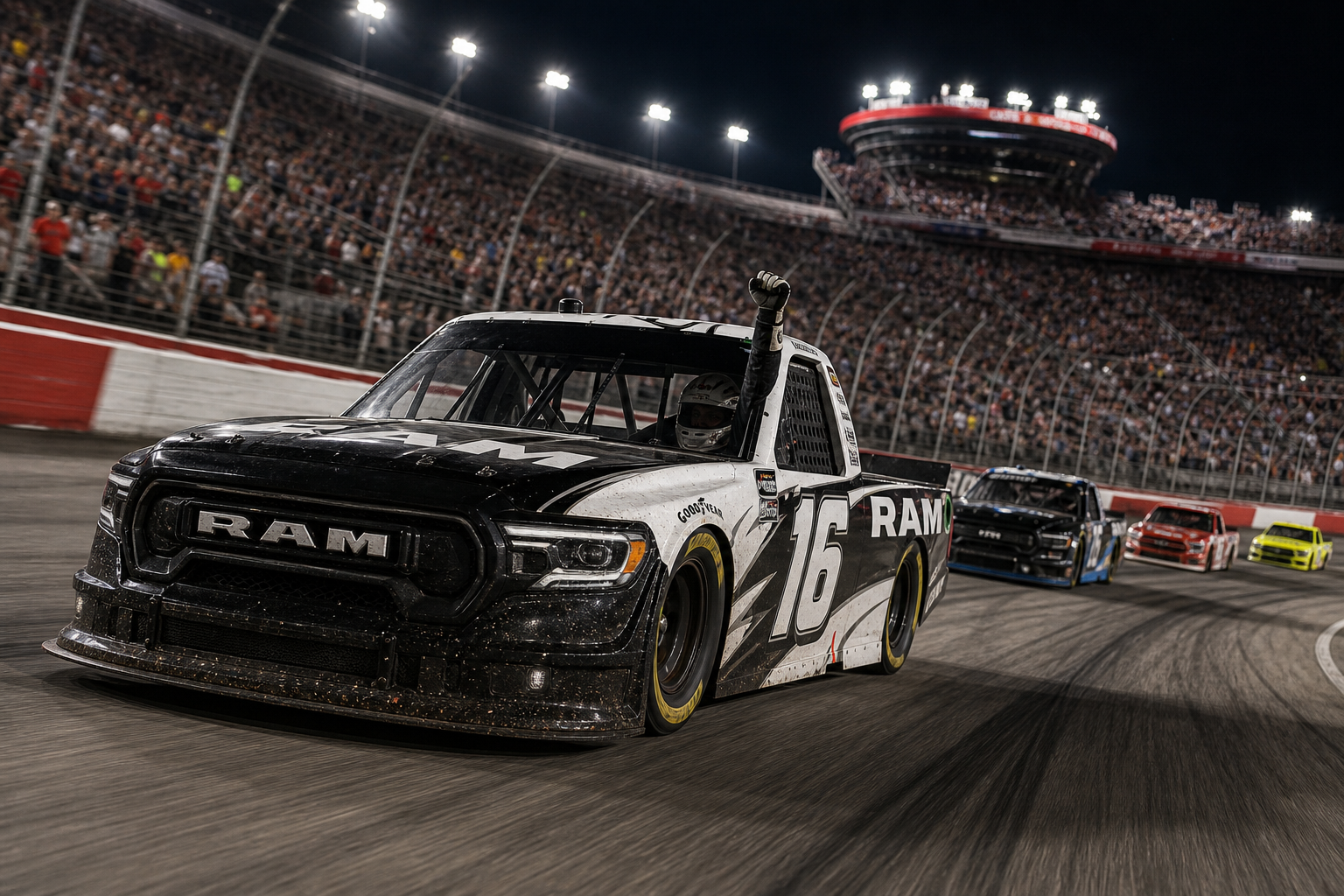

When a manufacturer returns to the NASCAR Craftsman Truck Series with no simulator data, no prior notes and a brand-new collection of race trucks, the early months tend to be less a learning curve and more a controlled slide down a hill. That has been the reality for Kaulig Racing’s RAM programme, which came into the season effectively blind and spent much of the year trying to catch up to rivals who already knew every bump, braking point and tyre quirk the series could throw at them.
And yet, for all the misery that sort of reset can bring, Kaulig’s five-truck RAM effort has not exactly been a washout. The group has already banked 15 top-10 finishes, which is no small feat when you consider the amount of groundwork still required in a programme like this. But until Bristol, there was still one awkward hole in the story: no top five. In NASCAR terms, that is the difference between respectable progress and a result you can pin to the workshop wall.
A first proper breakthrough at Bristol
That changed at Bristol Motor Speedway, where Justin Haley delivered the No. 16 RAM to the team’s first-ever top-five finish. It was the sort of result that does not just pad the stat sheet; it gives a young or newly reassembled programme something far more valuable — proof that the machinery, the people and the process are beginning to mesh under race pressure rather than merely survive it.
Bristol is a suitably unsentimental place for such a breakthrough. The half-mile bullring has a habit of stripping away excuses, and any team still in the delicate business of building its notebook gets judged rather sharply there. You do not stumble into a decent result at Bristol by accident. If a truck finishes well there, it has usually earned it through decent pace, sensible execution and a driver who has not spent the afternoon decorating the barriers.
Starting from zero is exactly as unpleasant as it sounds
The challenge for Kaulig’s RAM operation has been the lack of institutional memory. Other teams arrive with years of set-up knowledge, digital models, telemetry archives and the kind of notes that look like the filing cabinets of a particularly obsessive civil servant. Kaulig and RAM, by contrast, had to start again. No sim. No established truck history. No tidy folder marked “Bristol, good in traffic, horrible on exits.”
That matters because NASCAR Truck racing is as much about the accumulation of tiny advantages as it is about outright speed. If you can’t lean on prior data, you spend a lot of your season simply learning where the edges are. What works in traffic, what the tyres do after a restart, how the truck reacts as rubber builds up, when to chase balance and when to stop fiddling before you make it worse. Racing teams love to talk about “process.” This is the bit where the process is mostly guesswork, crossed fingers and a great deal of debriefing.
So the fact that the programme has already managed 15 top 10s tells you the base is not hopeless. It just isn’t mature yet. A top-five at Bristol suggests the learning is starting to stick.
Why this result matters more than a line in the results sheet
For a factory-backed or manufacturer-linked effort, especially one that has arrived with a fresh identity, early milestones are about momentum as much as points. The first top 10 is a relief. The first top five is validation. It tells the team that its pace is no longer theoretical, and that the architecture of the programme is good enough to threaten the established runners when the race gets properly messy.
There is also a psychological value that motorsport people love to pretend does not exist until they need it. Confidence matters. Drivers drive differently when they know a truck can live near the front. Engineers tend to make cleaner calls when they have evidence their package works. Even the crew guys carry a little more spring in the step when the post-race pizza tastes less like consolation and more like fuel for the next one.
None of this means Kaulig and RAM have suddenly solved the Truck Series. Far from it. One strong result at Bristol does not erase a tough opening stretch, and there is still a pile of work ahead if they want to turn promising flashes into a regular front-running habit. But in a season where they began with next to nothing to lean on, the first top five is exactly the sort of marker a programme needs.
Justin Haley gives the programme something concrete
Justin Haley’s drive in the No. 16 truck was the headline, and rightly so. In these situations the driver often becomes the most visible part of a much larger technical story. Haley had to convert what the team had built into a finish that would stand up against the grinding business of a Bristol night — a place where track position is precious, mistakes are expensive and patience can vanish in a single restart.
The result gives Kaulig a reference point, too. Now there is an actual benchmark to build from rather than a vague sense that the speed is “almost there.” That is enormously useful in a brand-new programme. Engineers do not need encouraging slogans. They need a lap time, a stint trend and a decent sense of what the truck is doing when the field compresses and everyone starts getting a bit heroic.
The broader picture for RAM’s return
RAM’s return to the Truck Series was always going to involve some pain. That is the price of re-entering a category where everyone else has had time to get comfortable. The upside, of course, is that there is real reward in the climb. A manufacturer comeback means visible progress, fresh identity and a reason for the team to keep sharpening the package every weekend rather than merely keeping the thing afloat.
Kaulig’s early season has shown the usual frustrations of a restart, but it has also shown enough solid work to suggest this is not some vanity project destined to drift around midfield. Fifteen top 10s and now a first top five say the same thing in different ways: the programme has substance. It just needed a Bristol-sized shove to turn potential into a result worth talking about.
And in NASCAR, as in most forms of racing, those first properly meaningful finishes have a habit of opening doors. Not all at once, and not without a few more bruises, but enough to change the mood in the garage. Which, when you have spent a season starting from scratch, is no small thing at all.
0 Comments