
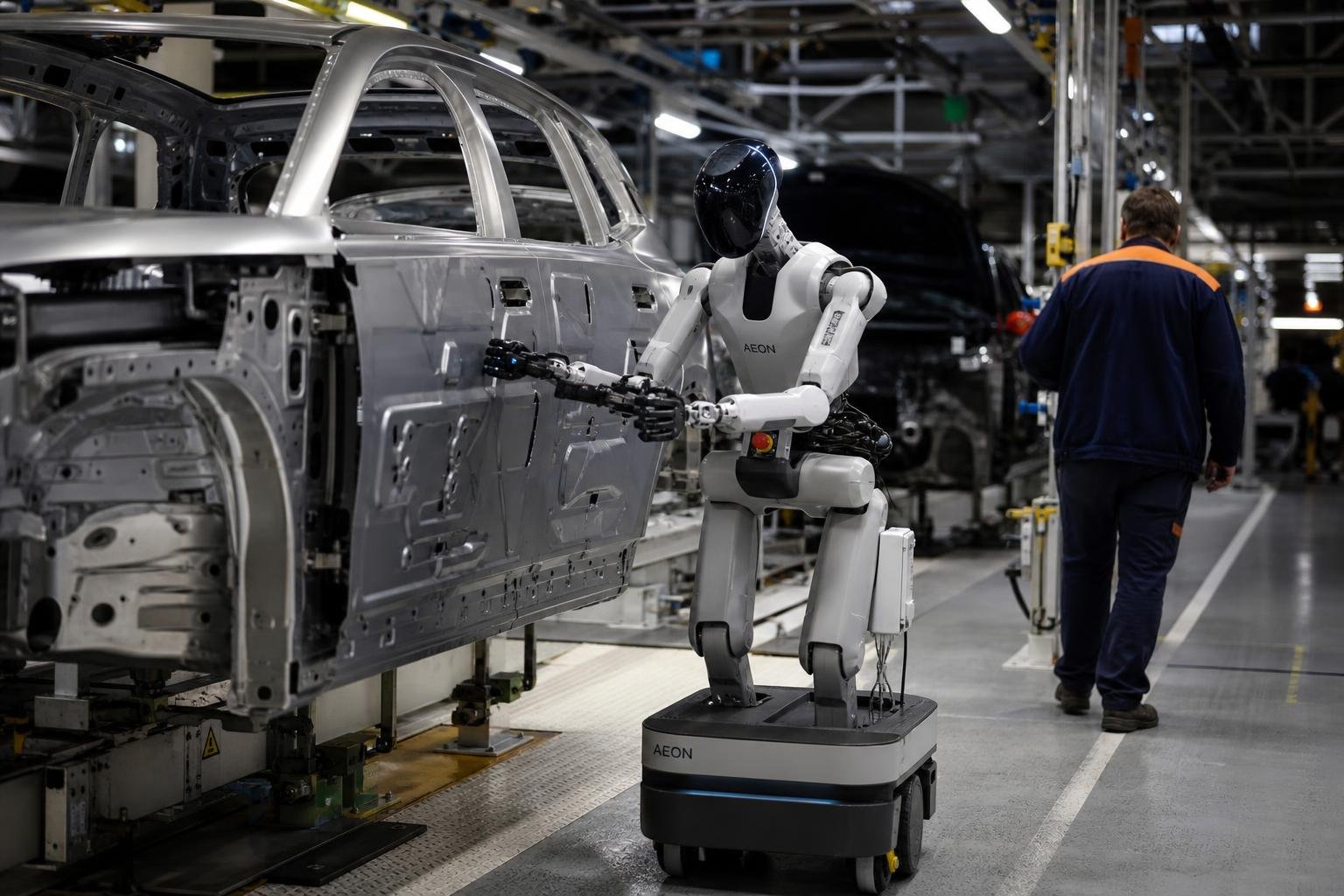

Volvo Cars has begun training humanoid robots at its plant in Ghent, Belgium, with the first machines expected to perform real factory work from mid-2027. The project is an early test of whether flexible, AI-powered robots can handle tasks that are difficult to automate with conventional industrial equipment.
The automaker says the robots are intended to support employees with repetitive and ergonomically challenging jobs. That distinction matters: Volvo has not announced a plan to replace its factory workforce wholesale. Instead, it is testing whether humanoid machines can take on physically demanding activities while fitting into production areas designed for people.
Volvo is testing AEON robots at Ghent
The machines being evaluated are AEON humanoid robots developed by Hexagon Robotics. Unlike many humanoid designs, AEON does not walk on two feet. It moves on wheels, allowing it to travel through a factory at speeds of up to 5.34 miles per hour.
Each robot stands approximately 5.41 feet tall and weighs about 132.3 pounds. Volvo says the machine can carry loads of up to 22 pounds. Cameras and other sensors allow it to interpret its surroundings, locate components and position them accurately.
Those specifications are more relevant to factory deployment than a robot’s human-like appearance. Wheeled movement should require less energy and may be easier to control than bipedal walking, while the humanoid form gives the machine a reach and working posture that can be compatible with existing benches, fixtures and storage areas.
Imitation learning is the first step
Volvo is currently using imitation learning to teach the AEON units how to pick up components and place them into two fixtures with precision. In practical terms, engineers demonstrate the desired process, allowing the robot’s software to learn the movements and sequence required to complete it.
The training will become progressively more demanding. Volvo plans to introduce multiple components, movement between different areas of the plant and interaction with automated systems. That progression reflects the difference between a controlled demonstration and a reliable production tool.
A robot may be able to repeat a simple pick-and-place movement under ideal conditions, but a factory introduces variation: parts may be presented at slightly different angles, workers may enter the same space and automated equipment may not always complete its cycle at exactly the expected moment. The test in Ghent is therefore as much about perception, safety and integration as it is about mechanical lifting.
Why humanoid robots are attracting automakers
Automotive plants have used fixed robotic arms for decades. These systems are exceptionally effective when a task is repetitive and the position of every component is tightly controlled. They can weld body structures, apply adhesives and perform other operations at high speed and consistency.
Their limitation is flexibility. A conventional robot is generally designed around a particular movement and work cell. Changing the product or relocating the task can require new tooling, safety systems and programming. A mobile humanoid robot could, in theory, be trained for several jobs and move between areas without requiring a complete redesign of the factory.
That flexibility is particularly attractive as automakers introduce more vehicle variations and adapt plants for electric vehicles. Battery packs, electric-drive components and other parts can require different handling processes, while production volumes may change quickly as demand shifts. A general-purpose machine could help manufacturers respond without committing to as much fixed infrastructure.
However, the technology remains at an early stage. The ability to demonstrate a task does not necessarily prove that a robot can perform it for an entire shift, meet automotive quality standards or operate economically once maintenance, charging, supervision and safety controls are included.
Volvo is part of a wider factory-robot race
Volvo’s project follows a broader push by automakers and industrial suppliers to bring physical artificial intelligence into production. Tesla has promoted its Optimus humanoid robot for factory applications, while other manufacturers and robotics companies are testing machines for material handling, warehouse work and repetitive assembly tasks.
Some of the most important developments are taking place outside vehicle assembly itself. Trials involving wheeled humanoid robots at industrial facilities have focused on moving boxes and materials through existing plants. Other research projects are collecting human motion data to teach robots how people grip, lift and manipulate objects. Such data is especially important because dexterity and force control are harder to reproduce than simple movement.
Labor shortages are another factor behind the investment. Mitsubishi, for example, has announced a partnership with robotics startup Highlanders to explore humanoid robots and a broader industrial ecosystem in Japan. The companies have cited the country’s aging population and declining birth rate as part of the background to that work, although the partnership remains an early-stage memorandum of understanding.
The impact on factory workers remains unresolved
For employees, the most immediate potential benefit is relief from tasks involving awkward reaches, repeated lifting or long periods of standing. Reducing those activities could improve workplace ergonomics and allow human workers to focus on inspection, problem-solving, machine supervision and jobs requiring judgment.
There are also legitimate concerns. As robots become more capable, some tasks currently performed by people could disappear or change substantially. Training requirements, job security and the collection of worker movement data are already subjects of debate in other industrial robotics projects.
Volvo’s approach will provide a useful test because the AEON units are being introduced into an existing production environment rather than a laboratory built specifically for robots. The company will need to show that they can work safely alongside employees, maintain consistent cycle times and justify their cost before the technology can expand across its manufacturing network.
A cautious first move toward flexible automation
The planned mid-2027 start is not evidence that humanoid robots are about to take over Volvo factories. It is a limited deployment designed to establish whether a mobile, adaptable machine can perform useful work alongside people.
If the Ghent trials succeed, Volvo could gain a new way to automate tasks that are too variable for fixed equipment but too repetitive or physically demanding for workers. If the robots prove slow, unreliable or expensive, the project will still identify where traditional automation remains the better solution. Either way, the outcome will help define whether humanoid robots become practical manufacturing tools or remain impressive demonstrations waiting for a stronger business case.
Sources: InsideEVs; AOL; AL Auto Nexus.


0 Comments