
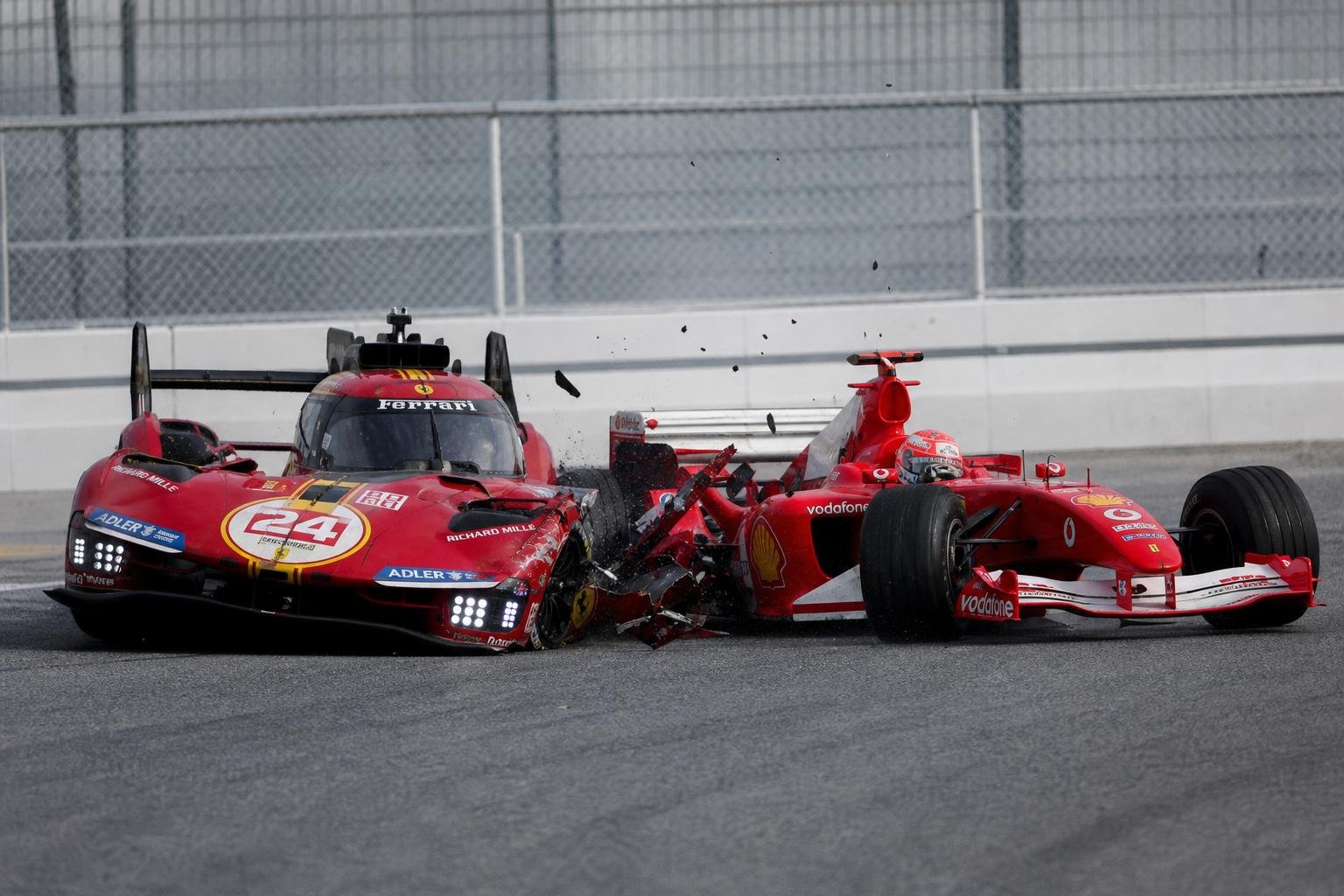

A Ferrari 499P Modificata collided with a Ferrari F2004 during customer track sessions at Circuit de Barcelona-Catalunya, turning a showcase of Ferrari racing history into an expensive recovery operation.
The incident occurred at Turn 11 after the F2004 slowed for the corner. The faster 499P Modificata closed rapidly and struck the Formula 1 car from behind, briefly lifting its rear from the track before both cars entered the runoff area. Recovery crews removed both Ferraris from the circuit, ending their participation in the session.
Footage of the crash was published by AutoNext after being captured by TikTok user jgs92x. Ferrari has not publicly released a statement, repair estimate, or the chassis number of either vehicle. Both drivers were reported to be uninjured.
A modern prototype with extraordinary performance
The 499P Modificata is not simply a race car with its numbers removed. Ferrari developed it as a strictly limited, track-only model based on the 499P that won the overall 2023 24 Hours of Le Mans. It is intended for noncompetitive driving through Ferrari’s Sport Prototipi Clienti program, which provides owners with track events, logistics, technical assistance, and maintenance.
Ferrari says the Modificata’s hybrid powertrain produces up to 640 kilowatts, or 870 cv, when its temporary power function is active. That works out to approximately 858 horsepower using U.S. conversion. The system combines a mid-rear-mounted 120-degree twin-turbo V6 with a front electric motor and an 800-volt battery. A seven-speed sequential transmission sends the power to the driven wheels.
The car’s performance advantage over the competition 499P comes partly from its freedom from FIA World Endurance Championship regulations. The front electric axle can operate at low speeds, rather than being restricted to activation above 118.06 miles/h—about 118 mph—as it is on the racing car. That gives the Modificata all-wheel-drive capability through slower corners.
It also includes a push-to-pass system. Ferrari rates the normal output at 697.3 hp, with an additional 160.9 hp available for up to seven seconds when the driver is at full throttle. The system’s availability depends on battery charge and energy recovery.
Why the crash matters
Even a modest contact between these cars is more serious than an ordinary track-day accident. The 499P Modificata uses a carbon-fiber monocoque, pushrod suspension, brake-by-wire technology, and a load-bearing engine. Its bespoke Pirelli tires are designed to provide predictable handling and consistent grip for customer drivers, but the car remains a full-scale endurance prototype with extreme braking and acceleration capability.
The F2004 represents a different kind of value. Ferrari used that car during Michael Schumacher’s dominant 2004 championship season, when he secured his seventh and final Formula 1 world title. However, there is no confirmation that the damaged F2004 was a chassis raced by Schumacher, and it would be inaccurate to describe it as his personal race car without documentation.
Running historic Formula 1 cars alongside modern prototypes is the point of Finali Mondiali, Ferrari’s annual customer-racing celebration. The event brings together Ferrari’s current client programs, historic machinery, and high-value competition cars. That combination creates an atmosphere unavailable at a normal race weekend, but it also demands careful traffic management because the cars differ dramatically in braking performance, visibility, pace, and driver experience.
The incident illustrates that risk. The F2004 may be more than two decades old, but it remains a genuine Grand Prix car. The 499P Modificata, meanwhile, is a nearly 860-horsepower prototype designed to deliver modern endurance-racing performance to private owners. Sharing a circuit can be spectacular, but the performance gap leaves little margin when one car suddenly lifts or reduces speed.
A costly reminder of Ferrari’s customer-racing gamble
Ferrari’s decision to offer a customer version of a Le Mans Hypercar is unusual. Most track-focused customer programs are derived from production-based supercars or older racing platforms. The 499P Modificata is built around a carbon-fiber prototype architecture and retains the single-seat cockpit and engineering character of the Le Mans machine.
That exclusivity also makes damage difficult to quantify. The car is part of a strictly limited program, while running F2004s are scarce pieces of Ferrari Formula 1 history. Reports suggesting that repairs could cost millions of dollars have not been confirmed, so the final financial impact remains unknown.
For now, the important facts are limited: both drivers escaped injury, both cars were recovered, and Ferrari has not identified the F2004’s chassis or announced the repair plan. The crash is an unfortunate interruption to an event designed to let Ferrari’s past and present share the same pavement—a reminder that even a controlled historic showcase still involves very real racing machinery.
Sources: Motor1; Ferrari Corse Clienti; Ferrari.
0 Comments