
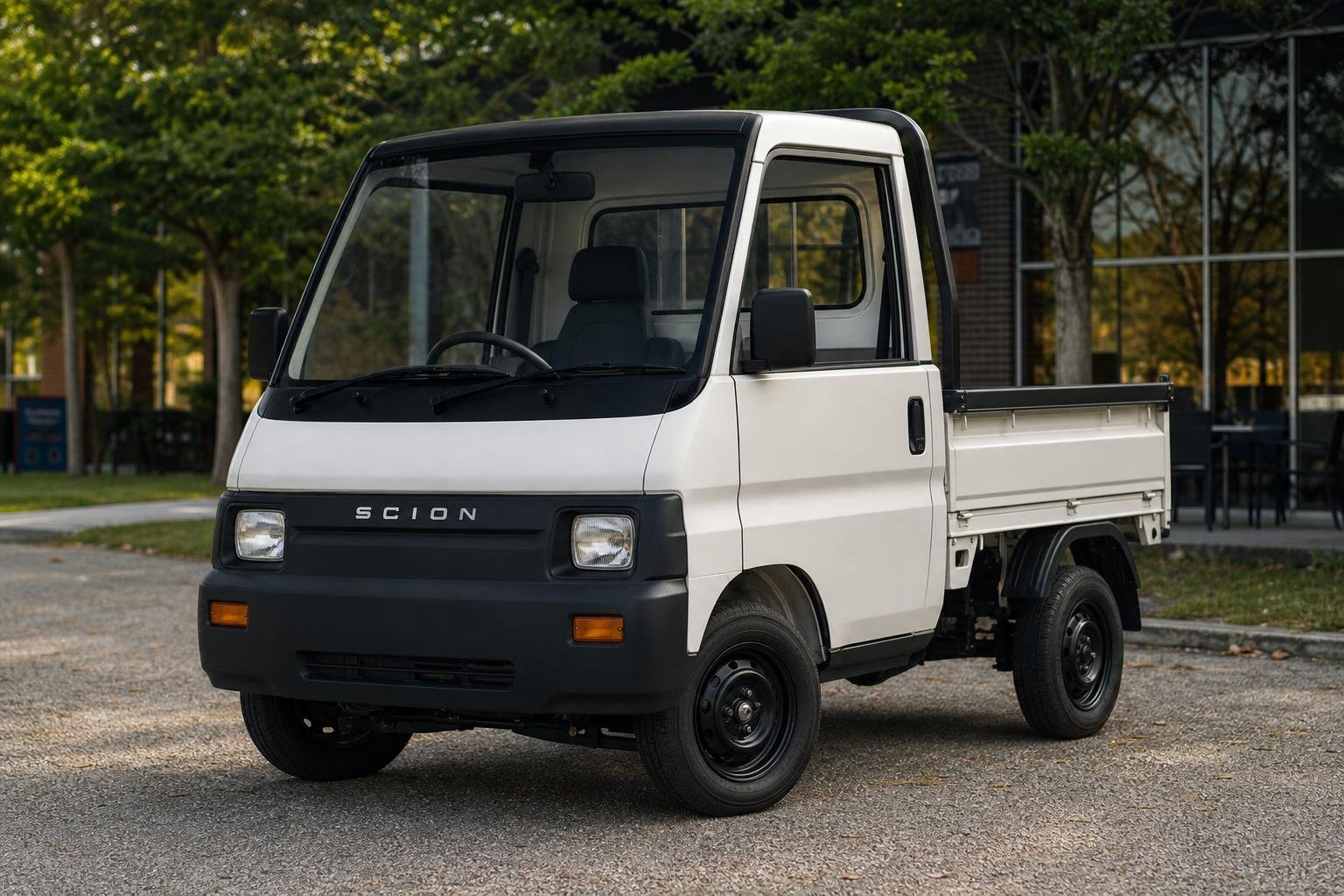

Toyota’s revived Scion brand will return to the United States with an unusual first product: a tiny, right-hand-drive pickup designed for short-distance work rather than highway travel. The Scion by Toyota KEI-01 is compact, mechanically straightforward and limited to 25 mph, but that narrow mission may be its strongest argument.
Production is expected to begin in the second half of 2027, with the truck initially offered only to fleet customers. Toyota says it may consider retail sales later if demand is strong. That makes the KEI-01 less a conventional pickup than a factory-backed alternative to imported kei trucks, utility vehicles and golf-cart-style low-speed vehicles.
A kei truck adapted for American work
The KEI-01 takes its name and basic concept from Japan’s kei-vehicle class, which prioritizes compact dimensions and efficient use of space. In the United States, however, Toyota is not presenting it as a normal road-going pickup. It will be certified as a Low Speed Vehicle, restricting it to roads with speed limits of 35 mph or less and limiting its own maximum speed to 25 mph.
That restriction immediately defines the truck’s likely customers. Toyota identifies applications including ranches, farms, campuses, facility maintenance and other controlled environments where equipment must be moved but highway capability is unnecessary. The company also describes the KEI-01 as a possible platform for small businesses and mobile operations.
At just over 11 feet long and approximately 5 feet wide, the truck can maneuver through spaces that would be awkward for a full-size pickup. Its compact footprint could be useful on a farm, in a municipal facility or around a large industrial site, where turning space and parking area matter more than cruising speed.
Small dimensions, useful cargo capacity
The KEI-01’s cargo bed is rated to carry up to 600 pounds. Its three sides fold down manually, simplifying loading and unloading without adding complex powered mechanisms or elaborate storage systems. The bed also extends slightly into the area behind the cab, allowing longer objects to fit within the truck’s compact layout.
There is a real spare tire beneath the bed, another practical detail that reinforces the vehicle’s work-first character. The design does not attempt to imitate a lifestyle pickup with numerous accessories, hidden compartments or multiple drive modes. Instead, the truck’s utility comes from being small, accessible and easy to understand.
Four-wheel drive is selectable, with the driver able to lock the system or allow it to manage power distribution automatically. That should make the KEI-01 more useful on uneven ground, dirt roads and work sites, although its low-speed classification means it is not intended to compete with a conventional off-road truck.
A simple powertrain and an intentionally basic cabin
Toyota has confirmed a 660cc three-cylinder gasoline engine, an automatic transmission and four-wheel drive. The transmission is a continuously variable unit. A vehicle inspected during the reported drive carried an engine code associated with a naturally aspirated three-cylinder producing approximately 45 horsepower and 44 lb-ft of torque, but Toyota has not confirmed that output as the final American production specification.
That level of power would be modest even in a small passenger car, but the KEI-01 is lightweight and limited to 25 mph. The goal is not acceleration or long-distance refinement; it is predictable operation and enough capability for short trips, inclines and light hauling.
The cabin follows the same philosophy. Climate control uses four physical sliders for temperature, fan speed, airflow direction and fresh-air or recirculation selection, along with a separate air-conditioning button. Power windows, a push-button starter, collision-warning controls and traction-control switches provide modern convenience without turning basic functions into touchscreen menus.
The shifter uses a conventional PRNDSB layout. The S and B settings provide different levels of engine braking, which could be useful on descents. Toyota has not finalized the U.S.-market infotainment specification, although related versions use screens measuring 6.8 or 9 inches with Apple CarPlay and Android Auto.
What the KEI-01 feels like to drive
Reported driving impressions came from a very short route of several hundred yards, so they should not be treated as a full road test. Even so, the drive included bumpy dirt surfaces and steep inclines. The truck reportedly felt composed in those conditions, with responsive engine and transmission behavior, effective brakes and clear outward visibility.
The 25-mph limiter is easy to reach, and the cabin allows considerable outside noise inside. That is not necessarily a flaw: the KEI-01 is not engineered as a highway vehicle, and additional sound insulation would add weight, cost and complexity to a machine intended for short operational trips.
Interior space will depend heavily on the driver. A six-foot-six tester was able to fit, but found the legroom constrained and the area between the door and steering wheel narrow. The right-hand-drive layout may also require adjustment for American users, particularly around drive-throughs, left-side traffic positioning and familiar vehicle controls.
Why the Scion name matters
The KEI-01 is also notable because it revives Scion, the Toyota-affiliated brand that sold affordable, youth-oriented compact cars in the United States from 2003 to 2016. This is not a return to the sporty coupes and hatchbacks associated with the original brand. Instead, Toyota is using “Scion by Toyota” to frame the truck as an unconventional answer to changing ideas about mobility.
That positioning makes sense for a product that does not fit neatly into America’s dominant pickup categories. The KEI-01 cannot tow or haul like a full-size truck, cannot travel on highways and will initially be unavailable to private buyers. Its appeal rests on avoiding capabilities that many users may never need.
It also arrives as interest in imported Japanese kei trucks continues to grow. Older examples can offer greater road speed, but importing and maintaining a decades-old vehicle involves compromises around age, parts availability and support. A new Toyota-backed truck could offer a simpler ownership proposition for businesses willing to accept its operating limits.
A narrow product with a clear purpose
The KEI-01 will not replace a Tacoma, a side-by-side or a conventional commercial pickup. Its 600-pound payload, 25-mph top speed and right-hand-drive configuration make that impossible. The more relevant question is whether those limitations are acceptable for customers who need a small utility vehicle rather than an all-purpose truck.
Toyota’s decision to begin with fleet sales is a sensible way to test that question. Businesses, campuses and public agencies can evaluate the vehicle in controlled environments where its size and simplicity may be more valuable than speed. If those operators respond positively, retail availability could give individual buyers access to something rarely offered in the United States: a new, genuinely small truck designed around a specific job.
The KEI-01’s importance will ultimately depend on pricing, final specifications and how widely it can be used under local regulations. But its basic idea is already distinctive. In an era when vehicles increasingly try to combine luxury, performance, technology and versatility, Toyota’s little Scion is making a different argument: sometimes the most useful truck is the one that does less, costs less to operate and never pretends to be anything else.
Sources: Carscoops; DPCcars; GearJunkie.
0 Comments