
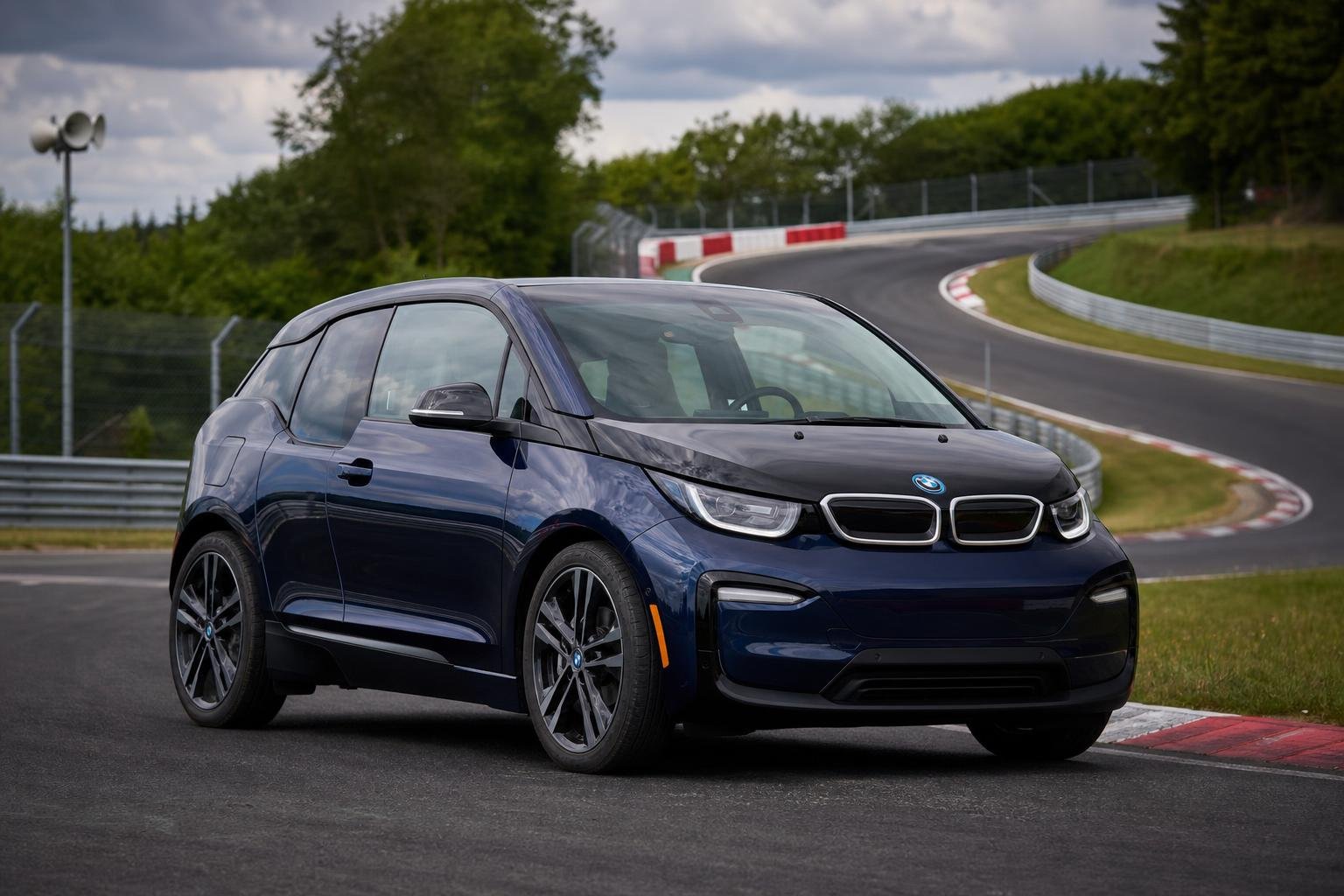

The upcoming BMW i3 50 is being positioned as a long-distance electric sedan, but a recent Nürburgring drive suggests it may have considerably more performance capability than its range-focused mission implies. In footage from Misha Charoudin, the all-wheel-drive i3 completed a hard lap of the demanding German circuit while overtaking a variety of faster-looking performance cars.
That combination is unusual. Large batteries typically improve road-trip range but add substantial weight, which can work against handling, braking and repeat-lap performance. The i3 50’s 109-kilowatt-hour battery appears to help offset that compromise in one important area: sustained track use.
A high-output electric sedan with touring-car range
The i3 50 is currently described as the only version on sale, with two electric motors producing a combined 463 horsepower and 476 pound-feet of torque. Those figures place it above the output of many previous-generation BMW M3 variants, although power alone does not make the i3 an M car. The M3 benefits from a different chassis philosophy, more aggressive hardware and a much stronger motorsport-derived identity.
What makes the i3 50 distinctive is the way that performance is paired with a claimed EPA range of 468 miles. That is an exceptional figure for a performance-oriented electric sedan and reflects BMW’s decision to install a much larger battery than might normally be expected in a car of this type.
The tradeoff is mass. A battery large enough to deliver nearly 500 miles of rated range inevitably adds weight, even though it also provides a substantial energy reserve. On a circuit such as the Nürburgring, that reserve can become useful because repeated acceleration, braking and high-speed running consume energy rapidly.
What happened during the Nürburgring run
According to the report, the i3 began its roughly 12-mile lap with a 79-percent state of charge and finished with 65 percent remaining. A 14-percent reduction during a hard lap of the Nordschleife is notable, particularly because the circuit combines long full-throttle sections with steep elevation changes, heavy braking zones and numerous low- and medium-speed corners.
The car reportedly completed three additional laps with another driver before reaching 20 percent charge. That does not mean four flat-out laps would be repeatable in every condition, since temperature, traffic, driving style and the starting state of charge would all affect consumption. Nevertheless, it suggests that the i3 50 has considerably more endurance than many electric performance cars that must manage battery temperature and energy use after only a few aggressive laps.
That endurance also changes the character of the car on a public tourist session. Nürburgring traffic can include everything from serious track machinery to ordinary rental cars. A vehicle that can accelerate strongly out of slower corners while maintaining usable battery reserves is better equipped to deal with constantly changing gaps in traffic.
Why the i3 looked quick on track
The video reportedly shows several traits that help explain the i3’s pace. Instant electric torque gives the twin-motor system strong acceleration out of corners, while all-wheel drive can help distribute that torque when the road surface is cold or uneven. The car also demonstrated sharp turn-in and strong braking, with both regenerative and conventional friction braking contributing to speed control.
Those observations should be treated as evidence of the car’s capability rather than proof of a Nürburgring lap-record threat. Traffic prevents a direct comparison with timed laps, and the performance of other cars on a tourist-session lap can vary dramatically. Still, the i3’s ability to pass more overtly sporting vehicles is a useful demonstration of how quickly modern electric powertrains can make a relatively practical sedan feel.
Conditions made the run more interesting. The i3 was reportedly using efficiency-focused electric-vehicle tires in cold weather rather than especially aggressive warm-weather performance tires. A warmer surface and stickier rubber could improve grip, braking and cornering, although those changes would also increase rolling resistance and potentially energy consumption.
Battery temperature is the bigger test
Electric performance cars are often limited not by their peak power output but by the ability of their battery, motors and cooling system to sustain that output. As cells heat up, the vehicle’s control software may reduce power to protect the pack. That can turn a fast first lap into a much slower session.
In this case, the battery temperature display reportedly remained in its normal range until the final part of the run and only indicated elevated temperatures near the end. That is important because it suggests the i3 50 was able to use its performance without immediately triggering severe thermal restrictions. The battery’s large capacity may also help: demanding the same power from a larger pack generally places less relative stress on each cell than drawing it from a much smaller one.
However, one filmed drive cannot establish long-term track durability. Repeated sessions, warmer ambient temperatures or a different state of charge could produce different results. Battery cooling, tire wear and brake performance would all need to be evaluated over a complete track day before the i3 could be judged as a dedicated performance machine.
The road-trip advantage remains the main story
The Nürburgring footage is entertaining because it challenges the assumption that long-range EVs must be dull. Yet the i3 50’s most important achievement may still be its touring ability. The same model has also been reported to have completed a journey from Norway to Spain while requiring a combined 2 hours and 46 minutes of charging. That claim, like the track demonstration, illustrates the potential value of a large battery when paired with efficient charging and highway-friendly range.
For most owners, the ability to travel long distances without frequent stops will matter far more than lap performance. The car’s circuit behavior nevertheless adds another dimension to BMW’s electric strategy. It indicates that the company is not treating efficiency and driving involvement as mutually exclusive goals.
What this could mean for a future electric M3
The i3 50 is not an electric M3, and its Nürburgring performance should not be interpreted as a preview of exact specifications. It does, however, show how much performance BMW can extract from a dual-motor electric platform while retaining substantial range.
A future electric M3 would likely place greater emphasis on chassis tuning, thermal repeatability, braking, tires and driver feedback than the i3 50. Those priorities could make it faster and more engaging, but they might also require compromises in efficiency and range. The i3 demonstrates that the basic ingredients are already available; the M division’s challenge will be combining them with the precision and consistency expected from its performance cars.
For now, the i3 50’s Nürburgring outing makes a compelling case that a high-range EV does not have to be merely a comfortable commuter. Its strongest advantage may be the unusual combination of long-distance usability, immediate acceleration and enough thermal headroom to remain convincing when the road becomes a racetrack.
Sources: InsideEVs
0 Comments