
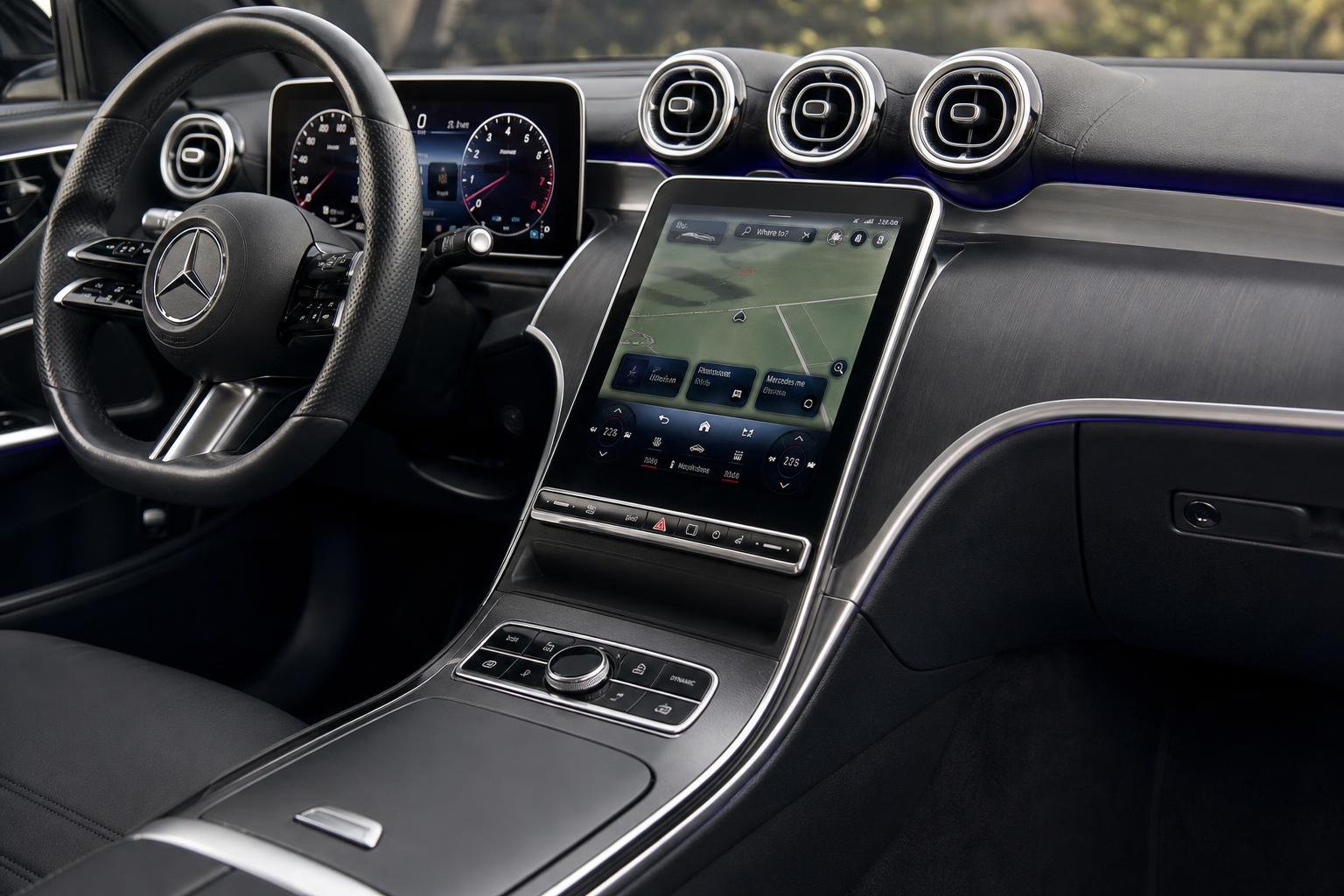

Mercedes-Benz is changing direction on interior controls after acknowledging that the industry moved too aggressively toward touchscreens. CEO Ola Källenius says the company will restore physical buttons and switches in several models, while making clear that large digital displays—including the MBUX Hyperscreen—remain central to Mercedes’ cabin strategy.
The shift is less a rejection of digital interiors than an admission that different functions require different types of controls. Navigation, vehicle personalization and multimedia benefit from software-driven displays, but climate adjustment, volume control and steering-wheel inputs are often easier to operate when they provide a physical response.
Mercedes recognizes the limits of an all-screen cabin
During a question-and-answer session, Källenius said Mercedes moved toward increasingly digital interiors as part of the wider industry trend toward software-defined vehicles. Screens allow manufacturers to add functions, change layouts and introduce updates without redesigning an entire dashboard.
That flexibility helped make systems such as Mercedes’ MBUX Hyperscreen possible. The broad, glass-covered display integrates the instrument cluster, central infotainment system and passenger screen into one visually dramatic dashboard. It also gives Mercedes more room to present vehicle settings, navigation and personalization features through software.
But flexibility does not automatically equal usability. A touchscreen has no permanent physical relationship with a function: a button for temperature adjustment remains in the same place, while an on-screen control may move between menus or change depending on the selected display. Drivers can also operate a conventional knob or switch by feel, reducing the need to look away from the road.
Källenius acknowledged that physical controls have not lost their value. He specifically said he enjoys a “good rocker and roller” on a steering wheel, an observation that reflects Mercedes’ recent changes to its steering-wheel interfaces.
Buttons are returning to several Mercedes models
According to Mercedes, models including the GLS, GLE, S-Class, GLC EV and GLB EV are among the vehicles receiving greater emphasis on physical controls. The company also plans to introduce tactile controls in additional upcoming models, although it has not identified every vehicle or specified exactly which functions will return to buttons.
The changes are already visible in the company’s approach to steering-wheel controls. Some Mercedes models have moved away from controversial touch-sensitive surfaces toward rollers, switches and buttons that provide a clearer physical response. That distinction matters because steering-wheel controls are used frequently and often without the driver looking directly at them.
The likely objective is not to recreate an older Mercedes dashboard one control at a time. Instead, the brand appears to be separating functions according to how they are used. Features that benefit from visual information and customization can remain on a display, while frequently adjusted or safety-relevant functions can receive dedicated controls.
Why Mercedes is keeping the screens
Mercedes does not view its large displays as a failed experiment. Källenius said digital controls still feel like the right direction for modern vehicles, and the company continues to regard screens as important to the premium-car experience.
That position is understandable from both an engineering and commercial perspective. A software interface can support multiple languages, user profiles and feature updates. It can also combine navigation, media, charging information and vehicle settings without requiring a separate physical switch for every function. For electric vehicles in particular, digital displays provide space to present energy use, charging status and route-planning information.
Large screens also remain a visible way for luxury manufacturers to distinguish their cabins. The MBUX Hyperscreen, which stretches more than 4.59 feet across the dashboard in the applications where it is used, is as much a design statement as an interface. Mercedes therefore appears unwilling to reduce screen area simply because some individual functions are better served by buttons.
The company’s position can be summarized as “more buttons, not fewer screens.” That is a more nuanced response than either returning completely to conventional dashboards or continuing to place every function behind a touchscreen.
The safety argument is about attention, not technology
The debate over buttons is often presented as a conflict between old-fashioned controls and modern technology. The more relevant issue is driver workload. A screen is not inherently unsafe, just as a physical switch is not automatically intuitive. The important question is how much visual and mental attention a task requires while the vehicle is moving.
Adjusting a physical dial usually involves locating one object and turning it. Performing the same task through a screen may require activating the display, finding the correct menu and confirming that the vehicle has registered the input. Glare, gloves, road vibration and unfamiliar software layouts can make that process more difficult.
Safety organizations are also influencing the discussion. Research cited in coverage of Mercedes’ change has linked complex infotainment tasks with increased distraction, while updated European assessment practices are expected to place greater emphasis on easily accessible controls for essential functions. Those developments encourage automakers to keep critical operations immediate, even as secondary features become increasingly software-based.
However, the case against touchscreens should not be overstated. A poorly placed or ambiguous physical switch can also be difficult to use, and some touch interfaces are faster when functions are logically arranged and remain accessible. The strongest cabin design is therefore not defined by the number of buttons, but by whether drivers can complete common tasks quickly and predictably.
Mercedes is following a wider industry reassessment
Mercedes is not alone in reconsidering the removal of traditional controls. Volkswagen has faced criticism over touch-sensitive interfaces and has indicated that future products will restore more conventional controls. Ferrari has also acknowledged that touch controls became attractive partly because of their production-cost advantages, while signaling a return to more physical interfaces.
Other manufacturers are taking different approaches. Some continue to use large screens but add fixed climate-control areas, rotary controllers or shortcut buttons. Others rely more heavily on voice commands. Voice control can reduce the need for screen interaction, but it is not a complete replacement: passengers may not know the correct commands, systems can misinterpret speech, and many drivers still prefer a direct control for a simple adjustment.
For Mercedes, the challenge will be consistency. Returning a few buttons will not solve the problem if essential functions remain buried in menus or if controls vary dramatically between models. Customers will judge the change through everyday use rather than through the size of the screen or the number of restored switches.
A more practical definition of high-tech
Mercedes’ reversal is significant because the company helped popularize the screen-heavy luxury interior. Its next generation of cabins will likely continue to look highly digital, but the interaction model should become more selective. Screens can handle information-rich tasks, while physical controls can provide speed, feedback and muscle memory where those qualities matter most.
That balance may prove more durable than the recent race to eliminate buttons. A modern luxury car does not need to choose between a sophisticated software platform and a well-designed switch. The better solution is to use each technology where it serves the driver best.
Sources: Motor1.com; Carscoops.
0 Comments